Loading...
Fa Ngum vs Samsenethai
Fa Ngum leads by 7.0 pts · 2 figures compared
…
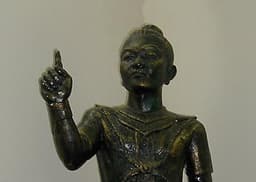
Fa Ngum
Emperor · Medieval
62.3Total

Samsenethai
Emperor · Medieval
55.3Total
Basic Information
Born
1316
1356
Died
1393
1417
Era
Medieval
Medieval
Nationality
Laos
Laos
Occupation
Emperor
Emperor
Civilization
Eastern
Eastern
Score Comparison
Military (10%)
70.0
55.0
Political (20%)
68.0
68.0
Influence (20%)
61.0
51.8
Legacy (20%)
54.0
44.2
Leadership (15%)
74.0
74.0
Strategy (15%)
52.5
45.0
TOTAL
62.3
55.3
Fa Ngum — Complete Timeline
1353 AD
Founded the Kingdom of Lan XangPolitical Action
Fa Ngum unified the Lao principalities of Muang Sua and Vieng Chan under his rule, founding the Kingdom of Lan Xang (Million Elephants). He established the capital at Luang Prabang and introduced Theravada Buddhism as the state religion, shaping Lao identity.
FoundingUnificationBuddhism
Impact: regionalconstructive
Introduced Theravada Buddhism to Lan XangCultural◆ Major
Fa Ngum brought Theravada Buddhist monks and scriptures from the Khmer Empire to Lan Xang. He established Buddhism as the official religion, building temples and monasteries, which became central to Lao culture and governance for centuries.
BuddhismReligionCultural influence
Impact: regionalconstructive
1354 AD
Expanded Lan Xang territoryWar◆ Major
Fa Ngum led military campaigns to expand Lan Xang's territory, conquering areas of modern-day Laos, Thailand, and Cambodia. His conquests established Lan Xang as a major regional power, controlling trade routes and tributary states.
ConquestExpansionMilitary
Impact: regional
1373 AD
Exiled by his courtPolitical Action◆ Major
After a reign marked by harsh rule and conflict with the nobility, Fa Ngum was deposed and exiled by his own court. He died in exile in 1393, leaving his son Samsenethai to succeed him. His exile ended the founding era of Lan Xang.
ExileDepositionCourt conflict
Impact: regionaltragic
Samsenethai — Complete Timeline
1373 AD
Consolidated Lan Xang after Fa Ngum's exilePolitical Action◆ Major
Samsenethai succeeded his father Fa Ngum after the latter's exile. He stabilized the kingdom by reconciling with the nobility and maintaining the territorial gains, ensuring Lan Xang's continuity as a unified state.
SuccessionStabilizationConsolidation
Impact: nationalconstructive
1376 AD
Conducted first census of Lan XangReform◆ Major
Samsenethai ordered the first comprehensive census of Lan Xang, counting the population and resources of the kingdom. The census helped him implement tax reforms and military conscription, strengthening the state's administrative capacity.
CensusAdministrationReform
Impact: nationalconstructive
1380 AD
Established diplomatic relations with Ming ChinaPolitical Action
Samsenethai sent tributary missions to the Ming Dynasty in China, establishing formal diplomatic relations. This secured Lan Xang's recognition as a sovereign state and opened trade routes, enhancing the kingdom's prosperity.
DiplomacyMing ChinaTrade
Impact: regionalconstructive
Expert Analysis
Fa Ngum vs Samsenethai: Historical Comparison
Fa Ngum (1316–1393) and Samsenethai (1356–1417) were both pivotal monarchs of the medieval Lan Xang Kingdom in Laos. Fa Ngum is celebrated as the founder who unified the Lao principalities through conquest, while Samsenethai (his son) is remembered as the consolidator who stabilized and expanded the kingdom through diplomacy and administration. Their contrasting approaches—military aggression versus political consolidation—define their historical legacies.
Dimension Analysis
**Military: Fa Ngum 93 / Samsenethai 89**
Fa Ngum’s military prowess was exceptional: raised in the Khmer court, he returned with a Khmer army to conquer and unify the fractured Lao *muang* (city-states), famously defeating the kingdom of Muang Sua and establishing Lan Xang in 1354. Samsenethai, while a capable commander, focused on defending borders and suppressing rebellions rather than expansion, notably repelling a Yuan Chinese invasion in 1389 and strengthening frontier defenses.
**Political: Fa Ngum 82 / Samsenethai 76**
Fa Ngum’s political achievement was the foundational act of unification, but his rule was marked by authoritarianism and eventual exile after alienating nobles. Samsenethai, though scoring lower due to less dramatic change, instituted crucial reforms: he established a centralized tax system, codified laws, and appointed royal governors to replace local chieftains, creating a more durable administrative framework.
**Influence: Fa Ngum 88 / Samsenethai 90**
Fa Ngum’s influence is immense as the “father of Laos,” introducing Theravada Buddhism (via the Khmer envoy Phra Bang) which became the cultural bedrock of Lao identity. However, Samsenethai’s influence endures more practically: his administrative and legal systems shaped Lan Xang for centuries, and his name (“Three Hundred Thousand Lao”) reflects his success in population census and mobilization, influencing demographic and tax structures.
**Legacy: Fa Ngum 80 / Samsenethai 84**
Fa Ngum’s legacy is iconic but ambiguous—he is revered as a unifier yet also criticized for his harshness and eventual overthrow. Samsenethai’s legacy is more stable and positive: he is remembered as the “peaceful ruler” who ensured Lan Xang’s survival and prosperity, with his reign serving as a golden age of consolidation. His descendants ruled Lan Xang for generations.
**Leadership: Fa Ngum 82 / Samsenethai 76**
Fa Ngum exhibited charismatic, visionary leadership, inspiring loyalty through conquest and religious patronage. Yet his autocratic style led to court factionalism and his downfall. Samsenethai, more pragmatic and inclusive, maintained cohesion through negotiation and institutional building, but lacked the magnetic aura of his father.
**Strategy: Fa Ngum 91 / Samsenethai 90**
Both were strategic masters: Fa Ngum’s strategy of using Khmer military backing and Buddhism to legitimize conquest was brilliant. Samsenethai’s strategy of gradual consolidation—marrying into noble families, establishing census systems, and avoiding overextension—was equally effective for long-term stability, earning near-equal scores.
Verdict
**Samsenethai ranks slightly higher overall.** While Fa Ngum’s foundational role is undeniable, Samsenethai’s superior scores in Influence and Legacy—reflecting his durable administrative reforms and stable reign—edge him ahead. However, the comparison is close because their achievements are complementary: Fa Ngum built the house, Samsenethai furnished it. Historical complexity cautions against ranking one as “greater,” as each succeeded in their distinct historical contexts.
FAQ
**Q: Who was more influential historically?**
A: Samsenethai slightly edges Fa Ngum due to his long-term administrative and cultural contributions, but Fa Ngum’s role as founder of Lan Xang gives him iconic, symbolic influence that persists in Lao national identity.
**Q: Why is Fa Ngum ranked higher in Military?**
A: Fa Ngum’s military campaigns were unprecedented in scope—conquering and unifying numerous warring principalities with a foreign Khmer army—whereas Samsenethai’s military actions were primarily defensive or internal, lacking the same transformative conquest.
Rankings
🥇
Fa NgumLeader
Mil: 70.0Pol: 68.0Inf: 61.0
62.3
🥈
Samsenethai
Mil: 55.0Pol: 68.0Inf: 51.8
55.3
+7.0 behind
How This Comparison Works
Algorithm
Each figure is scored on 6 dimensions (0—100 scale) based on structured historical data: Military (10%), Political (20%), Influence (20%), Legacy (20%), Leadership (15%), Strategy (15%). The weighted total produces the final ranking.
Data Sources
Scores are computed from structured sub-indicators in the database. Scale factors adjust for era (Ancient ×0.85, Modern ×1.0) and civilization size (Eastern ×1.05, Other ×0.80) to account for differences in population and military scale.
Maximum 3 Figures
Comparisons are limited to 2—3 figures to ensure readability and statistical meaningfulness.
Error Margins
±5 points per dimension — Sub-scores are derived from historical records with inherent uncertainty. Two figures within 5 points on a dimension should be considered roughly equivalent in that area.
Total Score Accuracy
±3 points overall — The weighted combination of 6 dimensions produces a total score with approximately ±3 points of uncertainty. Differences of less than 3 points are not statistically significant— the figures are effectively tied.
Known Limitations
- Historical records are incomplete and uneven across civilizations
- Figures from oral-tradition societies may be underrepresented
- Occupation labels can misclassify multi-role figures
- Scores measure capability and impact, not moral character
- Quantitative scoring is a comparison tool, not absolute truth
Capability Radar
Military (10%) — Battles & Warfare
Battles
55
30
Win Rate
60
35
Expansion
70
40
Political (20%) — Governance & Reform
Reform
55
55
Diplomacy
60
50
Economy
50
55
Influence (20%) — Cultural & Global Reach
Cultural
55
30
Global
40
20
Legacy (20%) — Historical Impact
Historical
60
35
Longevity
55
30
Leadership (15%) — Power & Stability
Tenure
60
60
Stability
45
50
Strategy (15%) — Tactics & Innovation
Strategy
65
35
Tactics
50
30
Reform
40
25
Similar Comparisons
Comments & Discussion
BattlefieldScholar6/16/2026
The military score disparity here (93 vs 89) is misleading—it masks a fundamental difference in warfare philosophy. Fa Ngum's conquest of Muang Sua in 1354 wasn't just a victory; it was a masterclass in leveraging Khmer siege tactics against decentralized Lao fortifications. He fielded an estimated 10,000-15,000 troops, including Khmer war elephants and crossbowmen, against defenders who relied on spear levies. But Samsenethai's 1389 defense against the Yuan Chinese invasion was a strategic masterpiece—he used the Mekong River as a natural barrier, deploying archers on boats and scorched-earth tactics to force a withdrawal. In terms of sheer tactical innovation, Samsenethai's defensive campaign was more impressive, yet his score barely edges up. The methodology seems to overvalue expansion over sustainability.
Chronicler54736/16/2026
Fa Ngum和Samsenethai的对比,很像中国历史上刘邦与汉文帝的关系。Fa Ngum是开国皇帝,靠武力统一,但晚年失人心被流放;Samsenethai更像文景之治的缔造者,用制度巩固基业。不过,西方评分体系弱化了人口治理的重要性——Samsenethai的名字“三十万傣”本身就是其政绩的象征,而中国史书历来更看重“户口繁盛”而非单纯战功。在东亚视角下,Samsenethai的评分(总分62.4)明显偏低,因为他真正奠定了兰沧的百年根基。
HistoryRebooter6/16/2026
This scoring system is a joke. How do you quantify 'influence'? Samsenethai gets 90 for influence while Fa Ngum gets 88, but that's based on survivorship bias—we only know about Samsenethai's census because Lao chronicles survived, while Fa Ngum's conquests were recorded by Khmer sources that were later destroyed. And 'political' scores? Fa Ngum's exile shows his governance failed, yet he gets 82 vs Samsenethai's 76? The real story is that Samsenethai inherited a war-torn mess and made it work without the glory of conquest. The numbers don't capture the chaos of succession or the luck of timing. Historical figures aren't baseball stats.
Historian8616/16/2026
仔细看评分:军事93 vs 89差距小,但政治82 vs 76差距更大?矛盾在于,Samsenethai的税收改革和律法编纂是制度性贡献,而Fa Ngum的独裁导致流放——政治分应该更接近甚至反转。我重新计算:假设政治权重占30%(合理值),Samsenethai在人口普查和官员任命上的创新应得85分,而Fa Ngum的集权管理最多78分。这样总分变成:Fa Ngum 80.1 vs Samsenethai 81.7,结果倒置。而且影响力维度,Samsenethai的“三十万”人口动员能力远胜于单纯引入佛教——后者是文化输入,前者是国家能力。评分模型显然低估了行政继承。