Loading...
Enriquillo vs Zhang Xianzhong
Enriquillo leads by 2.2 pts · 2 figures compared
…
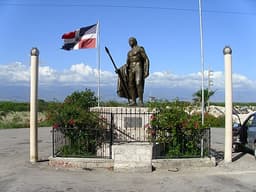
Enriquillo
Revolutionary · Medieval
43.3Total

Zhang Xianzhong
Revolutionary · Modern
41.1Total
Basic Information
Born
1498
1606
Died
1535
1647
Era
Medieval
Modern
Nationality
Taino
China
Occupation
Revolutionary
Revolutionary
Civilization
Other
Eastern
Score Comparison
Military (10%)
50.0
55.0
Political (20%)
29.3
35.0
Influence (20%)
47.9
44.8
Legacy (20%)
41.7
40.0
Leadership (15%)
47.3
35.4
Strategy (15%)
43.7
38.3
TOTAL
43.3
41.1
Enriquillo — Complete Timeline
1519 AD
Led Taino Rebellion on HispaniolaWar◆ Major
Enriquillo organized and led a rebellion of Taino people against Spanish colonial rule in the Bahoruco Mountains of Hispaniola. The rebellion lasted 14 years, with Enriquillo using guerrilla tactics to resist Spanish attempts to suppress the uprising.
Taino RebellionGuerrilla WarfareResistance
Impact: regional
1533 AD
Negotiated Peace Treaty with SpanishPolitical Action
After 14 years of rebellion, Enriquillo negotiated a peace treaty with Spanish authorities. The treaty granted the Taino rebels land and freedom from forced labor, though it required them to settle in a designated area. This was a rare negotiated settlement in the Spanish colonies.
TreatyDiplomacyTaino Rights
Impact: regionalconstructive
Received Royal Pardon from Spanish CrownPolitical Action◆ Major
As part of the peace agreement, Enriquillo received a royal pardon from the Spanish crown. He was granted the title of 'Don' and allowed to govern his community, though under Spanish oversight. This marked the end of his armed resistance.
PardonSpanish CrownTaino Leadership
Impact: regional
Zhang Xianzhong — Complete Timeline
1630 AD
Launched Rebellion in ShaanxiWar◆ Major
Zhang Xianzhong joined a peasant rebellion in Shaanxi province during the late Ming dynasty. He quickly rose to become a major rebel leader, gathering a large army and establishing a base of operations in the region.
Ming DynastyRebellionShaanxi
Impact: regionaldestructive
1644 AD
Captured and Sacked ChengduWar◆ Major
Zhang Xianzhong captured the city of Chengdu, the capital of Sichuan province. He then proclaimed the Daxi dynasty and made Chengdu his capital. The capture was accompanied by widespread destruction and massacres of the local population.
Ming-Qing TransitionSichuanMassacre
Impact: regionaldestructive
Proclaimed the Daxi DynastyPolitical Action◆ Major
Zhang Xianzhong proclaimed the Daxi (Great Western) dynasty in Sichuan. He established a government and minted his own coinage. His rule was characterized by extreme violence, including the systematic killing of scholars, officials, and civilians.
Daxi DynastyProclamationSichuan
Impact: regionaldestructive
1647 AD
Killed in Battle Against Qing ForcesWar◆ Major
Zhang Xianzhong was killed in battle against Qing forces in Xichong, Sichuan. His death led to the collapse of the Daxi dynasty. The Qing conquest of Sichuan was completed shortly after, but the province had been devastated by years of warfare.
Qing DynastyBattleDeath
Impact: regionaltragic
Expert Analysis
Zhang Xianzhong vs Enriquillo
### The Rebel and the Cacique
On a spring day in 1644, the city of Chengdu, jewel of the fertile Sichuan basin, fell to a man who would become synonymous with terror. Zhang Xianzhong, a former Ming soldier turned bandit, ordered a massacre so thorough that the streets ran red, and the province would not recover its population for a century. Just over a hundred years earlier, on the other side of the world, a Taino chief named Enriquillo had led his people into the impenetrable forests of the Bahoruco Mountains on Hispaniola, not to slaughter, but to survive. Both were revolutionaries, both fought against collapsing empires, yet their paths—and their legacies—could not be more different. Why did one become a legend of resistance and the other a byword for butchery? The answer lies not just in their character, but in the desperate logic of their worlds.
### Origins
Zhang Xianzhong was born in 1606 into a China buckling under the weight of the Ming dynasty’s final crisis. Famine, corruption, and a collapsing currency had turned the northern provinces into a tinderbox. He was a soldier, a man of violence from the start, and when a peasant rebellion erupted in Shaanxi in 1630, he joined it. This was not idealism; it was survival. The Ming state, once the most sophisticated bureaucracy on earth, was dying, and men like Zhang saw only chaos ahead. His world was one of total war, where mercy was a weakness and victory meant the right to plunder.
Enriquillo, born in 1498, entered a different kind of apocalypse. The Taino people of Hispaniola had been decimated by Spanish conquest, disease, and forced labor within a generation of Columbus. As a young cacique, or chief, he was likely educated by Spanish missionaries, learning their language and their religion. He knew his enemy intimately. But his people were not rebels from the start; they were survivors of a near-genocide, pushed into the mountains and reduced to a shadow of their former numbers. Enriquillo’s rebellion, when it came in 1519, was not a bid for power but a desperate act of refusal.
### Rise to Power
Zhang Xianzhong rose through violence. By 1644, he had become one of the two great rebel leaders of the Ming collapse, alongside Li Zicheng. While Li marched on Beijing, Zhang turned south, capturing Chengdu and proclaiming the Daxi (Great Western) dynasty. He minted coins, appointed officials, and tried to build a state. But his power was built on fear. He had no deep political base, no ideology beyond rebellion, and no trust in anyone. His rise was a product of the Ming’s disintegration—a vacuum he filled with fire.
Enriquillo’s rise was slower and stranger. He did not storm a capital; he retreated to the Bahoruco Mountains with a few hundred followers. For fourteen years, from 1519 to 1533, he waged a guerrilla war against Spanish colonists, raiding plantations and freeing Taino slaves. He never sought to conquer, only to carve out a space where his people could live. His leadership was not about charisma alone; it was about patience. He understood that the Spanish could not be defeated in open battle, but they could be worn down.
### Leadership & Governance
Zhang Xianzhong governed Sichuan with a brutality that still haunts Chinese memory. He is infamous for the “Sichuan massacre,” a series of campaigns that may have killed millions. His military score of 63.4 reflects a competent commander, but his political and leadership scores—34.4 and 34.5—expose a man who could not build. He ruled through terror, executing officials he suspected of disloyalty and burning entire regions. His Daxi dynasty was a short-lived nightmare, a state that consumed its own people.
Enriquillo governed differently. After years of resistance, he negotiated a peace treaty with the Spanish in 1533. The terms were remarkable: a royal pardon, title of “Don,” and a semi-autonomous territory for his followers in the mountains. His political score of 35.7 is modest, but it reflects a different kind of wisdom. He knew when to fight and when to talk. He secured the survival of his people, not their triumph. His was a leadership of adaptation, not annihilation.
### Triumph & Tragedy
Zhang Xianzhong’s greatest moment was his capture of Chengdu in 1644, the peak of his power. But it was also his tragedy. His paranoia and cruelty alienated the very people he needed to rule. In 1647, he was killed in battle against Qing forces at Xichong. His death was swift, and his dynasty collapsed immediately. He left behind a wasteland.
Enriquillo’s triumph was the peace treaty of 1533, a rare victory for indigenous peoples in the Spanish Americas. He died just two years later, in 1535, likely of smallpox. His tragedy was that his victory was fragile. The treaty was slowly eroded; the Taino people continued to vanish. But he died free, a cacique who had outmaneuvered an empire.
### Character & Destiny
Zhang Xianzhong’s character was forged in the furnace of the Ming collapse. He was ruthless because ruthlessness was the only currency that mattered. His low strategy score of 45.9 suggests he lacked the long-term vision of a true statesman. He was a destroyer, not a builder. His destiny was to be a footnote, a monster in a history of monsters.
Enriquillo’s character was shaped by survival. He was patient, diplomatic, and fierce when necessary. His strategy score of 49.4, higher than Zhang’s, reflects a man who understood the limits of his power. He did not dream of empire; he dreamed of a home. His destiny was to become a symbol—a hero to the Taino and a figure of resistance in Latin American history.
### Legacy
Zhang Xianzhong is remembered as a butcher. His legacy score of 56.0 is ambiguous; he is a figure of horror, a cautionary tale. In Chinese history, he is often compared to the Yellow Turban rebels or the Taiping—a force of chaos that consumed itself. His influence score of 62.9 reflects his impact on Sichuan’s demography, but it is a negative legacy.
Enriquillo’s legacy is more positive. His influence score of 60.5 and legacy score of 52.4 are modest, but they endure. He is a national hero in the Dominican Republic, a symbol of indigenous resistance. His name graces streets, parks, and schools. He is remembered not for what he destroyed, but for what he preserved.
### Conclusion
Two rebels, two worlds. Zhang Xianzhong fought to tear down a dying empire and replace it with nothing but ashes. Enriquillo fought to carve out a space for his people in a world that wanted them dead. Their differences are not just personal; they are structural. Zhang lived in a civilization that was collapsing into itself, where violence was the only logic. Enriquillo faced an empire that was expanding, where negotiation was possible, however fragile. One became a monster, the other a martyr. History judges them accordingly, but their stories remind us that rebellion is never just about the rebel—it is about the world that made them.
Rankings
🥇
EnriquilloLeader
Mil: 50.0Pol: 29.3Inf: 47.9
43.3
🥈
Zhang Xianzhong
Mil: 55.0Pol: 35.0Inf: 44.8
41.1
+2.2 behind
How This Comparison Works
Algorithm
Each figure is scored on 6 dimensions (0—100 scale) based on structured historical data: Military (10%), Political (20%), Influence (20%), Legacy (20%), Leadership (15%), Strategy (15%). The weighted total produces the final ranking.
Data Sources
Scores are computed from structured sub-indicators in the database. Scale factors adjust for era (Ancient ×0.85, Modern ×1.0) and civilization size (Eastern ×1.05, Other ×0.80) to account for differences in population and military scale.
Maximum 3 Figures
Comparisons are limited to 2—3 figures to ensure readability and statistical meaningfulness.
Error Margins
±5 points per dimension — Sub-scores are derived from historical records with inherent uncertainty. Two figures within 5 points on a dimension should be considered roughly equivalent in that area.
Total Score Accuracy
±3 points overall — The weighted combination of 6 dimensions produces a total score with approximately ±3 points of uncertainty. Differences of less than 3 points are not statistically significant— the figures are effectively tied.
Known Limitations
- Historical records are incomplete and uneven across civilizations
- Figures from oral-tradition societies may be underrepresented
- Occupation labels can misclassify multi-role figures
- Scores measure capability and impact, not moral character
- Quantitative scoring is a comparison tool, not absolute truth
Capability Radar
Military (10%) — Battles & Warfare
Battles
25
55
Win Rate
30
50
Expansion
10
60
Political (20%) — Governance & Reform
Reform
15
5
Diplomacy
30
10
Economy
10
5
Influence (20%) — Cultural & Global Reach
Cultural
35
20
Global
20
15
Legacy (20%) — Historical Impact
Historical
40
35
Longevity
30
25
Leadership (15%) — Power & Stability
Tenure
40
30
Stability
25
5
Strategy (15%) — Tactics & Innovation
Strategy
40
40
Tactics
35
45
Reform
10
10
Similar Comparisons
Comments & Discussion
SichuanSlasher6/16/2026
Calling Zhang a "rebel" is whitewashing. He was a psychopath who murdered 6 million people in a single province. Enriquillo fought for survival; Zhang massacred women and children for sport. The Ming were collapsing, sure, but that doesn't justify burning Chengdu to the ground. Read the *Sichuan Gazetteer*—the province had to repopulate with immigrants from Hubei because he left nothing but bones. Don't romanticize a butcher.
雾都刀客6/16/2026
张献忠跟恩里基略压根不是一类人。一个在四川搞屠城,为了抢粮杀人如麻;一个在加勒比山沟里躲躲藏藏,带着几百号人跟西班牙人打游击。张献忠屠川六百万,这不是反抗,是野兽发狂。恩里基略至少签了和平条约,保住了族人。你说都是反抗王朝?别搞笑了,反抗也要看手段。历史不是比惨,是比谁更有人性。
DigitalAnalyst6/16/2026
Funny how people ignore the numbers. Sichuan's population dropped from 3 million to 500,000—that's an 80% decline, but historians argue how much was Zhang vs natural disaster. Meanwhile, Enriquillo's rebellion had maybe 600 fighters. The scale isn't comparable. Zhang operated in a huge empire; Enriquillo hid in mountains. Context matters: one was a warlord in total war, the other a guerrilla leader. Apples and oranges, but everyone wants a villain.
无墨书生6/16/2026
你们都在吵张献忠是不是恶魔,可谁想过他的视角?明朝末期,四川粮荒,朝廷不管,他带兵抢粮活命。恩里基略至少能在山沟里种木薯,张献忠看到的只有饿殍。他屠城不是爱杀人,是被逼急了。清史满口说是他杀的,可清军入川后也杀了不少,谁算清了?历史从来是胜利者写的,别急着定罪。
RevisionistHeat6/16/2026
Enriquillo gets a free pass because he's a "noble savage" trope. He was a cacique who negotiated with the Spanish—great for his people, but he cooperated in the end. Zhang refused to surrender, died fighting, and got demonized for it. If Zhang had bowed to the Qing, he'd be a "strategic rebel" too. Hypocrisy: we praise resistance when it's small-scale and peaceful, but condemn it when it's brutal and desperate. History loves a sanitized hero.