Loading...
Enriquillo vs Owain Glyndwr
Owain Glyndwr leads by 4.2 pts · 2 figures compared
…
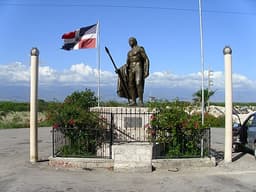
Enriquillo
Revolutionary · Medieval
43.3Total

Owain Glyndwr
Revolutionary · Medieval
47.5Total
Basic Information
Born
1498
1359
Died
1535
1415
Era
Medieval
Medieval
Nationality
Taino
Wales
Occupation
Revolutionary
Revolutionary
Civilization
Other
Western
Score Comparison
Military (10%)
50.0
47.5
Political (20%)
29.3
32.2
Influence (20%)
47.9
56.7
Legacy (20%)
41.7
58.0
Leadership (15%)
47.3
33.5
Strategy (15%)
43.7
41.7
TOTAL
43.3
47.5
Enriquillo — Complete Timeline
1519 AD
Led Taino Rebellion on HispaniolaWar◆ Major
Enriquillo organized and led a rebellion of Taino people against Spanish colonial rule in the Bahoruco Mountains of Hispaniola. The rebellion lasted 14 years, with Enriquillo using guerrilla tactics to resist Spanish attempts to suppress the uprising.
Taino RebellionGuerrilla WarfareResistance
Impact: regional
1533 AD
Negotiated Peace Treaty with SpanishPolitical Action
After 14 years of rebellion, Enriquillo negotiated a peace treaty with Spanish authorities. The treaty granted the Taino rebels land and freedom from forced labor, though it required them to settle in a designated area. This was a rare negotiated settlement in the Spanish colonies.
TreatyDiplomacyTaino Rights
Impact: regionalconstructive
Received Royal Pardon from Spanish CrownPolitical Action◆ Major
As part of the peace agreement, Enriquillo received a royal pardon from the Spanish crown. He was granted the title of 'Don' and allowed to govern his community, though under Spanish oversight. This marked the end of his armed resistance.
PardonSpanish CrownTaino Leadership
Impact: regional
Owain Glyndwr — Complete Timeline
1400 AD
Proclaimed Prince of WalesPolitical Action
Following a dispute with English lord Reginald Grey, Owain Glynd
RebellionWelsh Independence
Impact: regional
1402 AD
Battle of PillethWar◆ Major
Glyndŵr's forces defeated an English army led by Sir Edmund Mortimer at Bryn Glas in Powys. Mortimer was captured and later allied with Glyndŵr through marriage. The victory boosted the rebellion's momentum and secured control over much of Wales.
BattleWelsh Rebellion
Impact: regional
1404 AD
Held a Parliament at MachynllethPolitical Action◆ Major
Glyndŵr convened a Welsh parliament at Machynlleth, where he was crowned Prince of Wales. He established diplomatic relations with France and Scotland, and outlined plans for an independent Welsh church and university. This represented the peak of his rebellion's political organization.
ParliamentWelsh Statehood
Impact: regionalconstructive
1405 AD
Alliance with FrancePolitical Action◆ Major
Glyndŵr signed the Treaty of Paris with France, securing French military support against England. A French expeditionary force landed in Wales and joined the rebellion. The alliance temporarily strengthened the Welsh cause but failed to achieve decisive victory.
AllianceFranco-Welsh Cooperation
Impact: regional
1409 AD
Rebellion CollapsedWar◆ Major
English forces under Prince Henry (future Henry V) recaptured Harlech Castle, Glynd
DefeatEnd of Rebellion
Impact: regionaltragic
Expert Analysis
Origins
Enriquillo (c. 1498-1535) was a Taino cacique born on Hispaniola (modern-day Dominican Republic and Haiti). He was raised by Spanish missionaries, receiving a Christian education and learning Spanish. His uncle was the cacique Mayobanex. Enriquillo was married to Mencía, a Taino woman.
Owain Glyndŵr (c. 1354-1415) was born into the Welsh nobility, a descendant of the princes of Powys. He studied law at the Inns of Court in London and served as a soldier in the English army under King Richard II. He was married to Margaret Hanmer, daughter of a Welsh judge.
Rise to Power
Enriquillo's rebellion began in 1519 after Spanish colonists seized his lands and attempted to enslave him. He fled to the Bahoruco Mountains with a small group of followers. Over 14 years, his force grew to include hundreds of Taino and African slaves. He negotiated a peace treaty in 1533, receiving a royal pardon and title of 'Don'.
Owain Glyndŵr's revolt started in 1400 after a dispute with English lord Reginald Grey. He was proclaimed Prince of Wales by supporters, and the rebellion spread across Wales. His forces captured key castles and defeated English armies. In 1404, he held a parliament at Machynlleth and established alliances with France and Scotland. The rebellion collapsed by 1409 after English forces recaptured Harlech Castle.
Leadership & Governance
Enriquillo's leadership was characterized by guerrilla warfare and diplomatic negotiation. He maintained a cohesive multi-ethnic coalition of Taino and Africans, scoring 47.3 in leadership. He secured a treaty that granted land and freedom to his followers, a rare achievement against Spanish colonial power.
Owain Glyndŵr's governance included convening a Welsh parliament and pursuing international alliances. He scored 33.5 in leadership, reflecting challenges in maintaining unity among Welsh nobles. His military score of 47.5 is slightly below Enriquillo's 50.0, but he achieved greater political recognition with foreign powers.
Triumph & Tragedy
Enriquillo's greatest success was negotiating a peace treaty that preserved Taino autonomy in the Bahoruco region. His failure was the limited scope of the treaty—it did not end Spanish colonization or slavery on Hispaniola. His total score of 43.3 reflects moderate impact.
Owain Glyndŵr's triumph was uniting Wales and securing French support, with a total score of 47.5. His tragedy was the collapse of the rebellion, the death of his wife and children in captivity, and his disappearance after 1412. He never surrendered, but his cause was lost.
Character & Destiny
Enriquillo was pragmatic, using both warfare and diplomacy. His Christian upbringing and Spanish language skills enabled negotiation. His fate was to achieve a partial victory, but his people continued to suffer under Spanish rule.
Owain Glyndŵr was a visionary nationalist, but his reliance on French support and noble alliances proved fragile. His disappearance after defeat turned him into a mythic figure. His character combined legal training with military ambition, but he lacked the political infrastructure to sustain a long-term rebellion.
Legacy
Enriquillo is remembered as a symbol of indigenous resistance in the Caribbean. His rebellion is taught in Dominican and Haitian schools. However, his legacy score of 41.7 is limited by the eventual extinction of the Taino people.
Owain Glyndŵr's legacy score of 58.0 is higher. He is a national hero in Wales, with streets, statues, and a university named after him. His rebellion inspired later Welsh nationalism and remains a central part of Welsh identity.
Conclusion
Owain Glyndŵr had greater impact than Enriquillo. His rebellion reshaped Welsh identity and left a lasting political legacy, scoring 58.0 in legacy versus Enriquillo's 41.7. While Enriquillo achieved a negotiated peace, his influence was confined to a small region and did not prevent the destruction of Taino society. Glyndŵr's total score of 47.5 also exceeds Enriquillo's 43.3. The Welsh revolt forced England to invest significant resources in subjugation and contributed to the eventual Acts of Union in the 16th century. Glyndŵr's mythic status continues to inspire movements for devolution and independence.
Rankings
🥇
Owain GlyndwrLeader
Mil: 47.5Pol: 32.2Inf: 56.7
47.5
🥈
Enriquillo
Mil: 50.0Pol: 29.3Inf: 47.9
43.3
+4.2 behind
How This Comparison Works
Algorithm
Each figure is scored on 6 dimensions (0—100 scale) based on structured historical data: Military (10%), Political (20%), Influence (20%), Legacy (20%), Leadership (15%), Strategy (15%). The weighted total produces the final ranking.
Data Sources
Scores are computed from structured sub-indicators in the database. Scale factors adjust for era (Ancient ×0.85, Modern ×1.0) and civilization size (Eastern ×1.05, Other ×0.80) to account for differences in population and military scale.
Maximum 3 Figures
Comparisons are limited to 2—3 figures to ensure readability and statistical meaningfulness.
Error Margins
±5 points per dimension — Sub-scores are derived from historical records with inherent uncertainty. Two figures within 5 points on a dimension should be considered roughly equivalent in that area.
Total Score Accuracy
±3 points overall — The weighted combination of 6 dimensions produces a total score with approximately ±3 points of uncertainty. Differences of less than 3 points are not statistically significant— the figures are effectively tied.
Known Limitations
- Historical records are incomplete and uneven across civilizations
- Figures from oral-tradition societies may be underrepresented
- Occupation labels can misclassify multi-role figures
- Scores measure capability and impact, not moral character
- Quantitative scoring is a comparison tool, not absolute truth
Capability Radar
Military (10%) — Battles & Warfare
Battles
25
45
Win Rate
30
40
Expansion
10
35
Political (20%) — Governance & Reform
Reform
15
45
Diplomacy
30
50
Economy
10
30
Influence (20%) — Cultural & Global Reach
Cultural
35
55
Global
20
40
Legacy (20%) — Historical Impact
Historical
40
60
Longevity
30
55
Leadership (15%) — Power & Stability
Tenure
40
40
Stability
25
25
Strategy (15%) — Tactics & Innovation
Strategy
40
50
Tactics
35
55
Reform
10
30
Similar Comparisons
Comments & Discussion
No comments yet. Be the first to share your thoughts!