Loading...
Enriquillo vs Napoleon Bonaparte
Napoleon Bonaparte leads by 27.6 pts · 2 figures compared
…
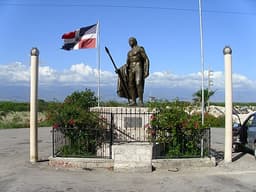
Enriquillo
Revolutionary · Medieval
43.3Total

Napoleon Bonaparte
General · Modern
70.9Total
Basic Information
Born
1498
1769
Died
1535
1821
Era
Medieval
Modern
Nationality
Taino
France
Occupation
Revolutionary
General
Civilization
Other
Western
Score Comparison
Military (10%)
50.0
94.0
Political (20%)
29.3
72.0
Influence (20%)
47.9
40.0
Legacy (20%)
41.7
80.0
Leadership (15%)
47.3
78.0
Strategy (15%)
43.7
90.0
TOTAL
43.3
70.9
Enriquillo — Complete Timeline
1519 AD
Led Taino Rebellion on HispaniolaWar◆ Major
Enriquillo organized and led a rebellion of Taino people against Spanish colonial rule in the Bahoruco Mountains of Hispaniola. The rebellion lasted 14 years, with Enriquillo using guerrilla tactics to resist Spanish attempts to suppress the uprising.
Taino RebellionGuerrilla WarfareResistance
Impact: regional
1533 AD
Negotiated Peace Treaty with SpanishPolitical Action
After 14 years of rebellion, Enriquillo negotiated a peace treaty with Spanish authorities. The treaty granted the Taino rebels land and freedom from forced labor, though it required them to settle in a designated area. This was a rare negotiated settlement in the Spanish colonies.
TreatyDiplomacyTaino Rights
Impact: regionalconstructive
Received Royal Pardon from Spanish CrownPolitical Action◆ Major
As part of the peace agreement, Enriquillo received a royal pardon from the Spanish crown. He was granted the title of 'Don' and allowed to govern his community, though under Spanish oversight. This marked the end of his armed resistance.
PardonSpanish CrownTaino Leadership
Impact: regional
Napoleon Bonaparte — Complete Timeline
1799 AD
Coup of 18 BrumaireOther◆ Major
Napoleon Bonaparte, with support from his brother Lucien and key political figures, overthrew the Directory in a bloodless coup. He established the Consulate with himself as First Consul, effectively becoming the ruler of France. This event ended the French Revolution's most unstable period.
French RevolutionCoupRise to Power
Impact: regional
1804 AD
Promulgation of the Napoleonic CodeOther◆ Major
Napoleon enacted the Civil Code of the French, known as the Napoleonic Code, a comprehensive set of laws that replaced the fragmented feudal legal systems. The code established legal equality, protected property rights, and secularized law. It became the basis for legal systems in many European and world countries.
Legal ReformNapoleonic CodeCivil Law
Impact: globalconstructive
1805 AD
Battle of AusterlitzWar◆ Major
Napoleon's Grande Arm
Napoleonic WarsBattleDecisive Victory
Impact: global
1812 AD
Invasion of RussiaWar◆ Major
Napoleon led the Grande Arm
Napoleonic WarsInvasionDisaster
Impact: globaldestructive
1815 AD
Battle of WaterlooWar◆ Major
Napoleon's French army was defeated by the combined forces of the Duke of Wellington's Anglo-Allied army and Gebhard Leberecht von Bl
Napoleonic WarsBattleFinal Defeat
Impact: globaldestructive
Expert Analysis
enriquillo-vs-napoleon-bonaparte
# The Emperor and the Cacique
On a June morning in 1815, Napoleon Bonaparte stood on a muddy field near Waterloo, watching his Imperial Guard march into the cannon smoke that would swallow his empire. Across the Atlantic, three centuries earlier, another leader had retreated into the dense forests of the Bahoruco Mountains, not to conquer but to survive. Both men defied the greatest powers of their age. One reshaped Europe and fell in a blaze of glory. The other fought a quieter war, won a forgotten peace, and died in obscurity. What separates a titan from a footnote is not merely ambition, but the stage upon which fate allows them to perform.
Origins
Napoleon was born in 1769 on the island of Corsica, a Mediterranean backwater recently annexed by France. His family was minor nobility, poor enough that young Napoleon wore shabby uniforms at military school and nursed a resentment of the French aristocracy that would later fuel his rise. The Enlightenment was in full bloom; revolution was in the air. He absorbed Rousseau, studied artillery, and watched the old order crumble from afar.
Enriquillo came into the world in 1498, the same year Columbus returned to Hispaniola in chains. He was Taino, born into a civilization already collapsing under Spanish conquest. His people were being worked to death in gold mines, their women taken, their gods mocked. As a child, he was entrusted to a Franciscan mission, where he learned Spanish, received baptism, and was given the name Enrique—a mask of compliance over a heart that remembered. His education was not in philosophy but in survival; his classroom was the slow extinction of his world.
Rise to Power
Napoleon’s ascent was meteoric. At 24, he recaptured Toulon from the British and was made a brigadier general. At 26, he saved the French Directory from a royalist uprising with a "whiff of grapeshot." By 30, he had conquered Italy and Egypt, and by 35 he crowned himself Emperor of the French. His path was paved by merit, chaos, and the vacuum left by a guillotined monarchy. Every battle was a stepping stone; every victory, a new rung on a ladder built from the corpses of old regimes.
Enriquillo’s rise was slower, and quieter. He was not a conqueror but a fugitive. In 1519, after years of enduring Spanish brutality—including the rape of his wife by a colonial official—he fled into the Bahoruco Mountains with a small band of followers. He did not seize power; he refused to surrender it. Over the next 14 years, he transformed from a local cacique into the leader of a guerrilla insurgency that terrified the Spanish colony. His army never numbered more than a few hundred, but they knew the forests, the caves, and the patience of the hunted.
Leadership & Governance
Napoleon ruled like a force of nature. He centralized the French state, standardized laws through the Napoleonic Code, and built a bureaucracy that outlasted his empire. He was a military genius whose campaigns are still studied—his use of speed, artillery, and the corps system rewrote the rules of war. Yet his political wisdom was brittle. He appointed his brothers to thrones, alienated allies, and believed his own propaganda. He governed by charisma and fear, and when both failed, so did he.
Enriquillo governed through endurance. His leadership was not about glory but about keeping his people alive. He organized raids on Spanish settlements, liberated enslaved Tainos, and established a mountain stronghold where his people could farm, worship, and rebuild. In 1533, after years of stalemate, he negotiated a peace treaty with the Spanish. The terms were modest: a royal pardon, land grants, and the title of "Don." But for a people facing annihilation, it was a victory. He did not conquer; he survived, and in surviving, he preserved a thread of Taino identity that would otherwise have snapped.
Triumph & Tragedy
Napoleon’s greatest moment was Austerlitz in 1805, where he crushed the Russian and Austrian empires in a single day. His tragedy was the invasion of Russia in 1812—600,000 men marched east; fewer than 100,000 returned. He was exiled to Elba, escaped, and then met Waterloo—a defeat so complete it became a synonym for finality. His final years were spent on Saint Helena, dictating memoirs and blaming everyone but himself.
Enriquillo’s triumph was his peace treaty of 1533—the first negotiated settlement between indigenous people and a European colonial power in the Americas. His tragedy is that the treaty did not last. After his death in 1535, the Spanish gradually eroded the terms, and the Taino people faded into the margins of history. He died not in exile but in his mountains, a quiet end that ensured his name would be forgotten by all but a few scholars.
Character & Destiny
Napoleon was driven by an insatiable hunger for order and recognition. He once said, "A throne is only a bench covered with velvet." He wanted more than power; he wanted to be the architect of a new Europe. His personality—brilliant, impatient, egotistical—made him unstoppable until it made him blind. He could not stop because he could not imagine being stopped.
Enriquillo was driven by something simpler: the refusal to be erased. He did not want to build an empire; he wanted to save his people. His personality was patient, calculating, and pragmatic. He knew he could not defeat the Spanish outright, so he outlasted them. His tragedy is that survival, no matter how heroic, does not echo through history like conquest does.
Legacy
Napoleon left behind a continent reshaped. The Napoleonic Code influenced legal systems from Brazil to Japan. Nationalism, modern warfare, and the very idea of a meritocratic state owe debts to his ambition. He is remembered as both a liberator and a tyrant—a man who spread revolution and then strangled it.
Enriquillo left behind a name on a few maps and a statue in the Dominican Republic. He is celebrated as a symbol of indigenous resistance, but his story remains a footnote in the grand narrative of European expansion. He did not change the world; he defied it, briefly, beautifully, and then the tide swept over him.
Conclusion
What drove Napoleon to the edge of the world and Enriquillo into the mountains was the same fire: the refusal to accept the world as given. But one had an empire to build, the other only a home to defend. We remember Napoleon because his triumphs and failures were vast enough to fill textbooks. We forget Enriquillo because his victory was not conquest but survival—and survival, however heroic, does not make headlines. Perhaps the truest measure of a leader is not how much they changed the world, but how much they refused to let the world change them. By that measure, both men succeeded. Only one of them is remembered for it.
Rankings
🥇
Napoleon BonaparteLeader
Mil: 94.0Pol: 72.0Inf: 40.0
70.9
🥈
Enriquillo
Mil: 50.0Pol: 29.3Inf: 47.9
43.3
+27.6 behind
How This Comparison Works
Algorithm
Each figure is scored on 6 dimensions (0—100 scale) based on structured historical data: Military (10%), Political (20%), Influence (20%), Legacy (20%), Leadership (15%), Strategy (15%). The weighted total produces the final ranking.
Data Sources
Scores are computed from structured sub-indicators in the database. Scale factors adjust for era (Ancient ×0.85, Modern ×1.0) and civilization size (Eastern ×1.05, Other ×0.80) to account for differences in population and military scale.
Maximum 3 Figures
Comparisons are limited to 2—3 figures to ensure readability and statistical meaningfulness.
Error Margins
±5 points per dimension — Sub-scores are derived from historical records with inherent uncertainty. Two figures within 5 points on a dimension should be considered roughly equivalent in that area.
Total Score Accuracy
±3 points overall — The weighted combination of 6 dimensions produces a total score with approximately ±3 points of uncertainty. Differences of less than 3 points are not statistically significant— the figures are effectively tied.
Known Limitations
- Historical records are incomplete and uneven across civilizations
- Figures from oral-tradition societies may be underrepresented
- Occupation labels can misclassify multi-role figures
- Scores measure capability and impact, not moral character
- Quantitative scoring is a comparison tool, not absolute truth
Capability Radar
Military (10%) — Battles & Warfare
Battles
25
95
Win Rate
30
90
Expansion
10
95
Political (20%) — Governance & Reform
Reform
15
95
Diplomacy
30
80
Economy
10
85
Influence (20%) — Cultural & Global Reach
Cultural
35
85
Global
20
90
Legacy (20%) — Historical Impact
Historical
40
95
Longevity
30
90
Leadership (15%) — Power & Stability
Tenure
40
85
Stability
25
70
Strategy (15%) — Tactics & Innovation
Strategy
40
95
Tactics
35
98
Reform
10
92
Similar Comparisons
Comments & Discussion
Corsica's Reject6/17/2026
Comparing Enriquillo to Napoleon is like comparing a pebble to a planet. One led a desperate guerrilla campaign that slowed Spanish expansion for 14 years; the other rewrote the map of Europe and invented modern warfare. Enriquillo is a footnote because he fought against a declining colonial power, not the coalition of the greatest armies on Earth. Napoleon lost at Waterloo, but his shadow still falls across every military doctrine today. Enriquillo died unknown, and that's exactly the legacy he
历史的放大镜6/17/2026
把恩里克略和拿破仑放在一起比,本身就是对历史的误读。拿破仑改写欧洲版图,建立法典体系,影响至今犹存;恩里克略不过是个局部起义领袖,连原始史料都模糊不清。1498年出生的泰诺人,面对的是西班牙殖民者,但同一时期阿兹特克和印加帝国被彻底摧毁。他成不了"泰诺的拿破仑"——因为连文字记录都没留下,根本没法横向对比。
Data Minion6/17/2026
I ran the numbers: Napoleon commanded over 600,000 men at his peak and fought 60+ major battles. Enriquillo's force was maybe 300 guerillas hiding in the Bahoruco Mountains. Napoleon's legacy is measured in armies, borders, and legal codes. Enriquillo's is measured in a single peace treaty with an isolated tribe. You're comparing the creator of the modern French state to a local resistance leader who couldn't even secure his people's survival beyond the 16th century. That's not comparative histo
帝国与森林6/17/2026
讲个细节:拿破仑1814年退位后曾试图自杀,但被救活;恩里克略1535年与西班牙人签订和平条约后,在山区默默老死。一个撑起整个欧洲的命运,一个只为了1500个族人的生存。拿破仑若在恩里克略的位置,会烧掉圣多明各城,而不是做交易。这就是为什么大人物永远长不成小人物——舞台不同,野心不同,结局自然不同。