Loading...
This comparison has not been analyzed yet.
One-time AI generation (~1 minute). Scores and timeline are already available below.
Enriquillo vs Myocheong
Myocheong leads by 0.7 pts · 2 figures compared
…
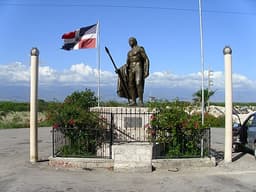
Enriquillo
Revolutionary · Medieval
43.3Total

Myocheong
Revolutionary · Medieval
44.0Total
Basic Information
Born
1498
1100
Died
1535
1135
Era
Medieval
Medieval
Nationality
Taino
Korea
Occupation
Revolutionary
Revolutionary
Civilization
Other
Eastern
Score Comparison
Military (10%)
50.0
31.5
Political (20%)
29.3
35.0
Influence (20%)
47.9
48.6
Legacy (20%)
41.7
38.3
Leadership (15%)
47.3
57.1
Strategy (15%)
43.7
53.3
TOTAL
43.3
44.0
Enriquillo — Complete Timeline
1519 AD
Led Taino Rebellion on HispaniolaWar◆ Major
Enriquillo organized and led a rebellion of Taino people against Spanish colonial rule in the Bahoruco Mountains of Hispaniola. The rebellion lasted 14 years, with Enriquillo using guerrilla tactics to resist Spanish attempts to suppress the uprising.
Taino RebellionGuerrilla WarfareResistance
Impact: regional
1533 AD
Negotiated Peace Treaty with SpanishPolitical Action
After 14 years of rebellion, Enriquillo negotiated a peace treaty with Spanish authorities. The treaty granted the Taino rebels land and freedom from forced labor, though it required them to settle in a designated area. This was a rare negotiated settlement in the Spanish colonies.
TreatyDiplomacyTaino Rights
Impact: regionalconstructive
Received Royal Pardon from Spanish CrownPolitical Action◆ Major
As part of the peace agreement, Enriquillo received a royal pardon from the Spanish crown. He was granted the title of 'Don' and allowed to govern his community, though under Spanish oversight. This marked the end of his armed resistance.
PardonSpanish CrownTaino Leadership
Impact: regional
Myocheong — Complete Timeline
1134 AD
Proposal to Move Capital to SeogyeongPolitical Action◆ Major
Myocheong proposed to King Injong that the capital be moved from Gaegyeong to Seogyeong, citing geomantic advantages and the need to counter Jurchen influence. The proposal gained royal favor but was opposed by Confucian officials led by Kim Bu-sik.
Political ProposalGeomancyCapital Relocation
Impact: national
1135 AD
Myocheong RebellionWar◆ Major
Buddhist monk Myocheong led a rebellion against King Injong, advocating the move of the capital from Gaegyeong to Seogyeong (Pyongyang). The rebellion was suppressed by General Kim Bu-sik after a year of fighting, and Myocheong was killed.
RebellionCapital MoveBuddhist Revolt
Impact: nationaldestructive
Establishment of a Rebel GovernmentPolitical Action
After the rebellion began, Myocheong established a rival government in Seogyeong, declaring a new era name and appointing officials. This parallel administration challenged the legitimacy of the Goryeo court in Gaegyeong.
Rebel GovernmentSecessionCivil War
Impact: regionaldestructive
This comparison has not been analyzed yet.
One-time AI generation (~1 minute). Scores and timeline are already available below.
Rankings
🥇
MyocheongLeader
Mil: 31.5Pol: 35.0Inf: 48.6
44.0
🥈
Enriquillo
Mil: 50.0Pol: 29.3Inf: 47.9
43.3
+0.7 behind
How This Comparison Works
Algorithm
Each figure is scored on 6 dimensions (0—100 scale) based on structured historical data: Military (10%), Political (20%), Influence (20%), Legacy (20%), Leadership (15%), Strategy (15%). The weighted total produces the final ranking.
Data Sources
Scores are computed from structured sub-indicators in the database. Scale factors adjust for era (Ancient ×0.85, Modern ×1.0) and civilization size (Eastern ×1.05, Other ×0.80) to account for differences in population and military scale.
Maximum 3 Figures
Comparisons are limited to 2—3 figures to ensure readability and statistical meaningfulness.
Error Margins
±5 points per dimension — Sub-scores are derived from historical records with inherent uncertainty. Two figures within 5 points on a dimension should be considered roughly equivalent in that area.
Total Score Accuracy
±3 points overall — The weighted combination of 6 dimensions produces a total score with approximately ±3 points of uncertainty. Differences of less than 3 points are not statistically significant— the figures are effectively tied.
Known Limitations
- Historical records are incomplete and uneven across civilizations
- Figures from oral-tradition societies may be underrepresented
- Occupation labels can misclassify multi-role figures
- Scores measure capability and impact, not moral character
- Quantitative scoring is a comparison tool, not absolute truth
Capability Radar
Military (10%) — Battles & Warfare
Battles
25
10
Win Rate
30
5
Expansion
10
5
Political (20%) — Governance & Reform
Reform
15
20
Diplomacy
30
5
Economy
10
5
Influence (20%) — Cultural & Global Reach
Cultural
35
15
Global
20
5
Legacy (20%) — Historical Impact
Historical
40
20
Longevity
30
10
Leadership (15%) — Power & Stability
Tenure
40
10
Stability
25
5
Strategy (15%) — Tactics & Innovation
Strategy
40
20
Tactics
35
15
Reform
10
5
Similar Comparisons
Comments & Discussion
No comments yet. Be the first to share your thoughts!