Loading...
Empress Jingu vs King Munmu
King Munmu leads by 20.8 pts · 2 figures compared
…
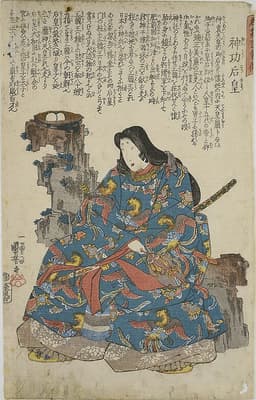
Empress Jingu
Emperor · Ancient
43.7Total

King Munmu
Emperor · Ancient
64.5Total
Basic Information
Born
169
-626
Died
269
—
Era
Ancient
Ancient
Nationality
Japan
Korea
Occupation
Emperor
Emperor
Civilization
Eastern
Eastern
Score Comparison
Military (10%)
55.0
76.0
Political (20%)
33.6
70.0
Influence (20%)
51.8
58.3
Legacy (20%)
44.2
52.0
Leadership (15%)
33.6
85.0
Strategy (15%)
41.0
61.2
TOTAL
43.7
64.5
Empress Jingu — Complete Timeline
200 AD
Conquest of the Three Korean KingdomsWar◆ Major
According to the Nihon Shoki, Empress Jingu led a naval expedition to the Korean peninsula and conquered the kingdoms of Silla, Baekje, and Goguryeo. This legendary campaign is said to have established Japanese dominance in Korea for several centuries, though archaeological evidence is lacking.
Korean CampaignLegendary ConquestYamato
Impact: regional
210 AD
Returned from Korea with TributePolitical Action
After her legendary conquest, Empress Jingu is said to have returned to Japan with tribute from the Korean kingdoms, including gold, silver, and textiles. This event is recorded as a triumph that enriched the Yamato court and solidified her reputation as a warrior ruler.
TributeDiplomacyWealth
Impact: nationalconstructive
Regency for Emperor OjinPolitical Action
Empress Jingu is said to have served as regent for her son, Emperor Ojin, after her husband's death. Her regency is credited with maintaining stability and continuing the expansion of Yamato influence, though the historical accuracy of her rule is disputed.
RegencySuccessionYamato
Impact: nationalconstructive
King Munmu — Complete Timeline
660 AD
Battle of HwangsanbeolWar◆ Major
Silla forces under King Munmu (then Prince) allied with Tang China to defeat the Baekje army at Hwangsanbeol. This victory led to the fall of the Baekje kingdom, a key step toward unification.
Three Kingdoms PeriodSilla-Tang AllianceBaekje Conquest
Impact: regional
668 AD
Battle of Salsu RiverWar◆ Major
Silla forces under King Munmu, in coordination with Tang China, defeated the Goguryeo army at the Salsu River. This victory resulted in the fall of Goguryeo, completing the unification of the Three Kingdoms under Silla.
Three Kingdoms PeriodSilla-Tang AllianceGoguryeo Conquest
Impact: regional
670 AD
Silla-Tang WarWar◆ Major
After the fall of Goguryeo, Tang China attempted to establish control over the Korean peninsula. King Munmu led Silla forces in a war against Tang, successfully expelling Chinese forces and securing Silla's dominance over the unified territory.
Silla-Tang WarUnificationIndependence
Impact: regional
676 AD
Establishment of the Unified Silla KingdomPolitical Action
King Munmu formally established the Unified Silla Kingdom after expelling Tang forces. This marked the first time the Korean peninsula was unified under a single indigenous ruler, creating a period of peace and cultural flourishing.
UnificationSilla DynastyKorean History
Impact: regionalconstructive
Expert Analysis
Origins
**Empress Jingu** (c. 169–269 AD) is a semi-legendary figure in Japanese history, recorded in the 8th-century chronicles *Kojiki* and *Nihon Shoki*. She was the wife of Emperor Chūai and, after his death, served as regent for her son, Emperor Ōjin. Her origins are shrouded in myth, but she is traditionally considered the daughter of a local chieftain. Her early life lacks concrete historical documentation, with her story heavily embellished by later chroniclers.
**King Munmu** (626–681 AD) was the 30th ruler of the Silla Kingdom in Korea. Born as Prince Beopmin, he was the son of King Muyeol, who had allied Silla with Tang China to conquer Baekje and Goguryeo. Munmu was educated in statecraft and military strategy from a young age, participating in campaigns as a prince. His early life is well-documented in Korean historical records such as the *Samguk Sagi*.
Rise to Power
Empress Jingu's rise occurred after her husband Emperor Chūai's death during a campaign against the Kumaso tribe. According to legend, she was divinely inspired by a prophecy to invade Korea. She led a naval expedition to the Korean peninsula, supposedly conquering Silla, Baekje, and Goguryeo. Her military score of 55.0 reflects the legendary nature of these events, with little archaeological evidence supporting a full conquest.
King Munmu rose to power through a combination of military prowess and political maneuvering. As a prince, he commanded Silla forces at the Battle of Hwangsanbeol (660 AD), where allied Silla-Tang forces defeated Baekje. He later fought in the Battle of Salsu River (668 AD) against Goguryeo. After his father's death in 661, he became king and completed the unification of the Korean peninsula. His political score of 70.0 reflects his skill in navigating the alliance with Tang China and later turning against them.
Leadership & Governance
Empress Jingu's leadership is portrayed as decisive and divinely guided. She is said to have ruled as regent for 69 years, maintaining stability and overseeing the birth of her son, Emperor Ōjin. However, her governance score of 33.6 indicates a lack of concrete reforms or administrative achievements, as her story is primarily legendary.
King Munmu's governance was marked by practical statecraft. After unifying the Three Kingdoms, he implemented policies to integrate the conquered territories. He established the Unified Silla Kingdom, expelling Tang forces in the Silla-Tang War (668–676 AD). He reorganized the military and administrative systems, using the *golpum* (bone-rank) system to consolidate power. His leadership score of 85.0 reflects his effective command during war and peace.
Triumph & Tragedy
Empress Jingu's greatest triumph is the legendary conquest of Korea, which brought tribute to Japan. However, this is likely a myth, and her story may reflect later Japanese ambitions. Her tragedy is the lack of historical evidence, leaving her as a symbolic figure rather than a documented ruler.
King Munmu's greatest triumph was the unification of the Korean peninsula under Silla, a feat that ended centuries of conflict between the Three Kingdoms. His tragedy came after his death, when Silla's unity eventually fragmented, but his immediate success was clear. His military score of 76.0 and strategy score of 61.2 highlight his effectiveness in both battle and planning.
Character & Destiny
Empress Jingu is depicted as a charismatic and divinely favored leader, but her character is largely a construct of later mythology. Her destiny was to be remembered as a warrior empress, though her historical accuracy is questionable.
King Munmu was pragmatic and determined. He was willing to ally with a foreign power (Tang) to achieve his goals, then turn against them when necessary. His character shaped his destiny: he died knowing he had unified Korea, and his legacy endured. Historical assessments praise his tactical acumen and political realism.
Legacy
Empress Jingu's legacy is cultural and symbolic. She is revered in Shinto as a deity and appears in Japanese martial traditions. Her legacy score of 44.2 reflects her enduring presence in mythology, but limited real-world impact.
King Munmu's legacy is tangible: he founded the Unified Silla Kingdom, which lasted for nearly three centuries. His unification set the stage for later Korean dynasties. His legacy score of 52.0 acknowledges his foundational role in Korean history.
Conclusion
King Munmu had a greater impact than Empress Jingu. His military score (76.0 vs. 55.0), political score (70.0 vs. 33.6), and leadership score (85.0 vs. 33.6) all reflect a historically verified ruler who transformed the Korean peninsula. Jingu's story, while culturally significant, lacks historical substance. Munmu's unification of Korea was a concrete achievement with lasting consequences, while Jingu's conquest remains a legend. The score gap of 20.8 points underscores the clear difference in their historical significance.
Rankings
🥇
King MunmuLeader
Mil: 76.0Pol: 70.0Inf: 58.3
64.5
🥈
Empress Jingu
Mil: 55.0Pol: 33.6Inf: 51.8
43.7
+20.8 behind
How This Comparison Works
Algorithm
Each figure is scored on 6 dimensions (0—100 scale) based on structured historical data: Military (10%), Political (20%), Influence (20%), Legacy (20%), Leadership (15%), Strategy (15%). The weighted total produces the final ranking.
Data Sources
Scores are computed from structured sub-indicators in the database. Scale factors adjust for era (Ancient ×0.85, Modern ×1.0) and civilization size (Eastern ×1.05, Other ×0.80) to account for differences in population and military scale.
Maximum 3 Figures
Comparisons are limited to 2—3 figures to ensure readability and statistical meaningfulness.
Error Margins
±5 points per dimension — Sub-scores are derived from historical records with inherent uncertainty. Two figures within 5 points on a dimension should be considered roughly equivalent in that area.
Total Score Accuracy
±3 points overall — The weighted combination of 6 dimensions produces a total score with approximately ±3 points of uncertainty. Differences of less than 3 points are not statistically significant— the figures are effectively tied.
Known Limitations
- Historical records are incomplete and uneven across civilizations
- Figures from oral-tradition societies may be underrepresented
- Occupation labels can misclassify multi-role figures
- Scores measure capability and impact, not moral character
- Quantitative scoring is a comparison tool, not absolute truth
Capability Radar
Military (10%) — Battles & Warfare
Battles
20
70
Win Rate
25
75
Expansion
30
85
Political (20%) — Governance & Reform
Reform
5
75
Diplomacy
15
80
Economy
5
65
Influence (20%) — Cultural & Global Reach
Cultural
30
65
Global
20
55
Legacy (20%) — Historical Impact
Historical
35
75
Longevity
40
70
Leadership (15%) — Power & Stability
Tenure
20
70
Stability
10
70
Strategy (15%) — Tactics & Innovation
Strategy
15
80
Tactics
15
65
Reform
5
60
Similar Comparisons
Comments & Discussion
No comments yet. Be the first to share your thoughts!