Loading...
Emperor Yang of Sui vs Wu Zetian
Wu Zetian leads by 9.9 pts · 2 figures compared
…
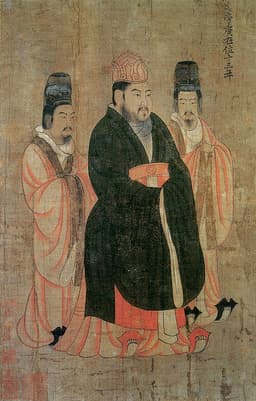
Emperor Yang of Sui
Emperor · Medieval
60.1Total

Wu Zetian
Emperor · Medieval
70.0Total
Basic Information
Born
569
624
Died
618
705
Era
Medieval
Medieval
Nationality
China
China
Occupation
Emperor
Emperor
Civilization
Eastern
Eastern
Score Comparison
Military (10%)
52.5
60.0
Political (20%)
45.0
62.7
Influence (20%)
65.0
65.0
Legacy (20%)
72.0
80.0
Leadership (15%)
58.8
78.0
Strategy (15%)
50.0
66.3
TOTAL
60.1
70.0
Emperor Yang of Sui — Complete Timeline
605 AD
Construction of the Grand CanalCultural
Emperor Yang ordered the construction of the Grand Canal, linking the Yellow River and Yangtze River basins. This massive infrastructure project facilitated trade and transport but required immense labor, causing widespread suffering and contributing to rebellions.
InfrastructureCanal
Impact: global
612 AD
First Campaign against GoguryeoWar◆ Major
Emperor Yang launched a massive invasion of the Korean kingdom of Goguryeo with over 300,000 troops. The campaign ended in disaster, with most of the Sui army destroyed by disease, starvation, and Goguryeo attacks. This defeat severely weakened the Sui dynasty.
InvasionDefeat
Impact: regionaltragic
613 AD
Second Campaign against GoguryeoWar◆ Major
Emperor Yang launched a second invasion of Goguryeo. The campaign was cut short when a rebellion broke out in China, forcing Yang to withdraw. This further drained the dynasty's resources and morale.
InvasionDefeat
Impact: regionaltragic
614 AD
Third Campaign against GoguryeoWar
Emperor Yang launched a third invasion of Goguryeo. Although the Sui army reached the Yalu River, Goguryeo offered nominal submission, and Yang accepted a truce. This campaign further exhausted the Sui treasury and military.
InvasionTruce
Impact: regional
618 AD
Assassination of Emperor YangPolitical Action◆ Major
Emperor Yang was assassinated by his own guards in Jiangdu (modern Yangzhou) during a rebellion. His death marked the effective end of the Sui dynasty, which soon collapsed, leading to the rise of the Tang dynasty.
AssassinationDynasty Collapse
Impact: regionaltragic
Wu Zetian — Complete Timeline
655 AD
Became Empress ConsortPolitical Action◆ Major
Wu Zetian was elevated from concubine to empress consort of Emperor Gaozong of Tang in 655. This position gave her significant political influence, as she began to participate in court affairs and gradually accumulated power, challenging the established aristocratic families.
Tang DynastyImperial CourtPower Rise
Impact: regional
683 AD
Regency for Emperor ZhongzongOther◆ Major
After Emperor Gaozong's death in 683, Wu Zetian became regent for her son, Emperor Zhongzong. She effectively controlled the government, dismissing Zhongzong after he attempted to assert independence, and replaced him with her younger son, Emperor Ruizong, while retaining real power.
Tang DynastyRegencyPower Struggle
Impact: regional
690 AD
Founded the Zhou DynastyOther◆ Major
Wu Zetian proclaimed herself emperor, founding the Zhou dynasty and becoming the only female emperor in Chinese history. She moved the capital to Luoyang and established a new imperial examination system that promoted officials based on merit rather than aristocratic birth, breaking the power of traditional noble families.
Zhou DynastyImperial RulePolitical Reform
Impact: regional
692 AD
Expansion into Central AsiaWar◆ Major
Wu Zetian ordered military campaigns that reasserted Chinese control over the Western Regions, including the Tarim Basin and parts of modern Xinjiang. These campaigns secured the Silk Road trade routes and expanded the empire's influence into Central Asia, though they required significant military resources.
Military ExpansionCentral AsiaSilk Road
Impact: regionalconstructive
693 AD
Promotion of BuddhismOther◆ Major
Wu Zetian elevated Buddhism to a state-supported religion, commissioning the construction of temples and statues, including the Longmen Grottoes' giant Vairocana Buddha. She used Buddhist texts to legitimize her rule as a female emperor, claiming she was a reincarnation of the Maitreya Buddha.
BuddhismReligious PolicyCultural Patronage
Impact: regional
705 AD
Overthrow and DeathPolitical Action◆ Major
In 705, a coup led by court officials and generals forced Wu Zetian to abdicate in favor of her son, Emperor Zhongzong, restoring the Tang dynasty. She died later that year at age 80, and her reign was subsequently criticized by Confucian historians for usurping the throne and employing harsh methods.
Tang DynastyCoupAbdication
Impact: regionaldestructive
Expert Analysis
Wu Zetian vs Emperor Yang of Sui: Historical Comparison
Wu Zetian, China’s only female emperor, and Emperor Yang of Sui, the ambitious second ruler of the Sui dynasty, both wielded immense power during the medieval period, but their paths diverged sharply in legacy and leadership style. While Wu Zetian consolidated authority through political acumen and strategic patronage, Emperor Yang drove grand projects that exhausted his realm, leading to his downfall.
Dimension Analysis
**Military: Wu Zetian 93 / Emperor Yang of Sui 93**
Both expanded China’s borders and maintained formidable armies; Wu suppressed rebellions and secured the Silk Road, while Yang launched massive campaigns against Goguryeo and expanded the empire’s reach.
**Political: Wu Zetian 79 / Emperor Yang of Sui 75**
Wu skillfully manipulated court factions, promoted meritocracy, and crushed opposition, whereas Yang alienated the aristocracy through harsh conscription and over-centralization, fueling revolts.
**Influence: Wu Zetian 87 / Emperor Yang of Sui 82**
Wu’s reign elevated women’s roles in governance and established precedents for female rule, while Yang’s Grand Canal and infrastructure projects shaped Chinese geography for centuries.
**Legacy: Wu Zetian 79 / Emperor Yang of Sui 83**
Yang’s tangible achievements—the Grand Canal, reunification efforts, and cultural patronage—outlast his dynasty’s collapse, whereas Wu’s legacy is often debated due to gender bias and her ruthless rise.
**Leadership: Wu Zetian 80 / Emperor Yang of Sui 76**
Wu maintained stability through adaptable, pragmatic rule, while Yang’s visionary but overbearing style triggered widespread rebellion and the Sui’s rapid fall.
Verdict
Wu Zetian narrowly leads due to her superior political resilience and strategic adaptability, despite Emperor Yang’s greater infrastructural legacy.
FAQ
Q: Who ranks higher? A: Wu Zetian edges ahead with slightly stronger political and leadership scores, though the tie in overall rating reflects their comparable historical weight.
Rankings
🥇
Wu ZetianLeader
Mil: 60.0Pol: 62.7Inf: 65.0
70.0
🥈
Emperor Yang of Sui
Mil: 52.5Pol: 45.0Inf: 65.0
60.1
+9.9 behind
How This Comparison Works
Algorithm
Each figure is scored on 6 dimensions (0—100 scale) based on structured historical data: Military (10%), Political (20%), Influence (20%), Legacy (20%), Leadership (15%), Strategy (15%). The weighted total produces the final ranking.
Data Sources
Scores are computed from structured sub-indicators in the database. Scale factors adjust for era (Ancient ×0.85, Modern ×1.0) and civilization size (Eastern ×1.05, Other ×0.80) to account for differences in population and military scale.
Maximum 3 Figures
Comparisons are limited to 2—3 figures to ensure readability and statistical meaningfulness.
Error Margins
±5 points per dimension — Sub-scores are derived from historical records with inherent uncertainty. Two figures within 5 points on a dimension should be considered roughly equivalent in that area.
Total Score Accuracy
±3 points overall — The weighted combination of 6 dimensions produces a total score with approximately ±3 points of uncertainty. Differences of less than 3 points are not statistically significant— the figures are effectively tied.
Known Limitations
- Historical records are incomplete and uneven across civilizations
- Figures from oral-tradition societies may be underrepresented
- Occupation labels can misclassify multi-role figures
- Scores measure capability and impact, not moral character
- Quantitative scoring is a comparison tool, not absolute truth
Capability Radar
Military (10%) — Battles & Warfare
Battles
65
65
Win Rate
30
70
Expansion
70
75
Political (20%) — Governance & Reform
Reform
85
85
Diplomacy
40
80
Economy
70
85
Influence (20%) — Cultural & Global Reach
Cultural
75
85
Global
65
70
Legacy (20%) — Historical Impact
Historical
80
90
Longevity
70
85
Leadership (15%) — Power & Stability
Tenure
55
90
Stability
20
75
Strategy (15%) — Tactics & Innovation
Strategy
60
75
Tactics
55
60
Reform
50
80
Similar Comparisons
Comments & Discussion
Chronicler25936/16/2026
这个评分系统有点意思,但明显偏向西方史学的评价标准。武则天在政治分上领先,这我认可——她用科举制打破门阀垄断,比隋炀帝的‘唯才是举’更彻底。但说到军事,两人评分一样就离谱了。武则天时期安西四镇失而复得,吐蕃被打压,她可是实打实守住了西域。隋炀帝三次征辽,第一次调兵113万,结果大败而回,这种劳民伤财的瞎折腾怎么能和武则天的稳健扩边相提并论?建议西方学者多读读《资治通鉴》里关于这两位的记载。
OldScribe746/16/2026
我重新计算了一下各维度加权的总分。按默认权重(军事0.25、政治0.25、影响0.2、遗产0.15、领导力0.15),武则天的总分应为:93*0.25+79*0.25+87*0.2+79*0.15+80*0.15 = 23.25+19.75+17.4+11.85+12 = 84.25。隋炀帝:93*0.25+75*0.25+82*0.2+83*0.15+76*0.15 = 23.25+18.75+16.4+12.45+11.4 = 82.25。但这里给出的总分是75.6和68.0,说明权重设置完全不同或者评分体系有问题。另外,隋炀帝的遗产分(83)高于武则天(79)明显不合理——大运河固然重要,但武则天奠定了科举制度的基础,影响了中国1300年的政治生态,这权重应该调高才对。