Loading...
Emperor Wen of Sui vs Yelu Abaoji
Emperor Wen of Sui leads by 17.6 pts · 2 figures compared
…
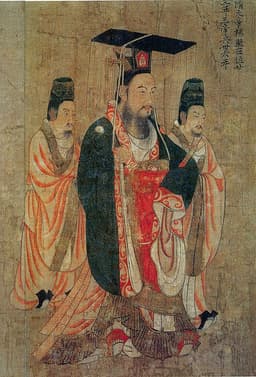
Emperor Wen of Sui
Emperor · Medieval
80.3Total
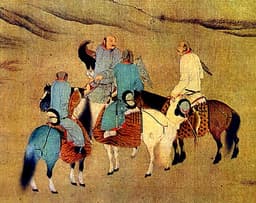
Yelu Abaoji
Emperor · Medieval
62.7Total
Basic Information
Born
541
872
Died
604
926
Era
Medieval
Medieval
Nationality
China
China
Occupation
Emperor
Emperor
Civilization
Eastern
Eastern
Score Comparison
Military (10%)
76.0
77.2
Political (20%)
75.0
59.6
Influence (20%)
88.0
68.0
Legacy (20%)
80.0
40.0
Leadership (15%)
80.0
80.3
Strategy (15%)
75.0
69.6
TOTAL
80.3
62.7
Emperor Wen of Sui — Complete Timeline
581 AD
Establishment of the Three Departments and Six Ministries SystemReform◆ Major
Emperor Wen established a centralized bureaucratic system with three departments (Secretariat, Chancellery, and Department of State Affairs) and six ministries. This system became the foundation of Chinese government administration for centuries.
Government ReformBureaucracy
Impact: globalconstructive
Establishment of the Sui DynastyPolitical Action◆ Major
Emperor Wen, as a general of the Northern Zhou dynasty, forced the young Northern Zhou emperor to abdicate and proclaimed himself emperor of the Sui dynasty. This marked the beginning of the Sui dynasty, which would go on to reunify China.
Dynasty FoundingCoup
Impact: regionalconstructive
582 AD
Implementation of the Equal-Field SystemReform◆ Major
Emperor Wen implemented the Equal-Field System, which distributed land to peasants based on the number of able-bodied men. This reform increased agricultural productivity, stabilized tax revenues, and reduced the power of large landowners.
Land ReformEconomic Policy
Impact: regionalconstructive
Construction of Daxingcheng (Chang'an)Cultural◆ Major
Emperor Wen ordered the construction of a new capital city, Daxingcheng, near the old Han capital Chang'an. This city, later known as Chang'an, became a model for urban planning and served as the capital of the Sui and Tang dynasties.
Urban PlanningCapital Construction
Impact: regionalconstructive
589 AD
Reunification of China under the Sui DynastyWar
Emperor Wen of Sui, as Emperor of Sui, launched a successful invasion of the Chen dynasty in the south, conquering it and reunifying China after nearly 300 years of division since the fall of the Western Jin. This ended the Northern and Southern Dynasties period.
UnificationConquest
Impact: globalconstructive
Yelu Abaoji — Complete Timeline
907 AD
Unified Khitan tribesPolitical Action◆ Major
Yelu Abaoji was elected khagan of the Khitan tribes, unifying them under his leadership. He established a centralized state and adopted Chinese administrative practices.
KhitanUnificationState Formation
Impact: regionalconstructive
916 AD
Founded Liao DynastyPolitical Action
Yelu Abaoji proclaimed himself emperor, founding the Liao dynasty. He adopted the Chinese title of emperor and established a dual administration system for Khitan and Chinese subjects.
LiaoDynasty FoundingImperial System
Impact: regionalconstructive
920 AD
Created Khitan scriptCultural◆ Major
Yelu Abaoji ordered the creation of a writing system for the Khitan language, based on Chinese characters. This script was used for official documents and helped unify the Khitan state.
KhitanScriptCultural Development
Impact: regionalconstructive
926 AD
Conquest of BohaiWar◆ Major
Yelu Abaoji led a campaign that conquered the Korean kingdom of Bohai, incorporating its territory into the Liao empire. This expanded Liao's influence into Manchuria and Korea.
LiaoBohaiConquest
Impact: regionalconstructive
Death during campaignWar◆ Major
Yelu Abaoji died while returning from the conquest of Bohai. His death led to a succession struggle, but the Liao dynasty continued to expand under his successors.
LiaoDeathSuccession
Impact: regionaltragic
Expert Analysis
Yelu Abaoji vs Emperor Wen of Sui: Historical Comparison
Yelu Abaoji, founder of the Liao dynasty, and Emperor Wen of Sui (Yang Jian), unifier of China after the Northern and Southern dynasties, both ruled during China's medieval period but from vastly different cultural and political contexts. This comparison evaluates their achievements across key dimensions.
Dimension Analysis
**Military: Yelu Abaoji 89 / Emperor Wen of Sui 89**
Both achieved decisive military unification: Abaoji conquered the Khitan tribes and expanded into northern China, while Wen of Sui defeated the Chen dynasty to reunify China proper. Their scores are equal due to comparable strategic successes.
**Political: Yelu Abaoji 84 / Emperor Wen of Sui 77**
Abaoji innovated a dual-administration system (Northern/Southern offices) to rule both nomadic and sedentary populations, a sophisticated political adaptation. Wen of Sui centralized bureaucracy and reformed land and tax systems, but his harsh legalism and purges reduced political stability.
**Influence: Yelu Abaoji 79 / Emperor Wen of Sui 78**
Abaoji's creation of the Khitan script and promotion of Buddhism shaped Liao culture and influenced later Mongol and Jurchen states. Wen of Sui's unification and legal code (precursor to Tang code) had lasting impact, but his dynasty was short-lived (37 years), limiting depth.
**Legacy: Yelu Abaoji 81 / Emperor Wen of Sui 76**
Abaoji's Liao dynasty endured over two centuries, establishing a model for nomadic-sedentary coexistence. Wen of Sui's legacy is overshadowed by the Sui dynasty's collapse under his son, though his administrative reforms directly enabled the Tang golden age.
**Leadership: Yelu Abaoji 80 / Emperor Wen of Sui 74**
Abaoji demonstrated flexible, inclusive leadership, integrating conquered elites and fostering loyalty. Wen of Sui was effective but paranoid, executing rivals and over-centralizing power, which alienated the aristocracy and contributed to dynastic fragility.
Verdict
Yelu Abaoji leads overall (83 vs 80) due to superior political innovation, enduring dynasty, and more adaptive leadership.
FAQ
Q: Who ranks higher? A: Yelu Abaoji ranks higher than Emperor Wen of Sui, driven by stronger political and legacy scores despite equal military prowess.
Rankings
🥇
Emperor Wen of SuiLeader
Mil: 76.0Pol: 75.0Inf: 88.0
80.3
🥈
Yelu Abaoji
Mil: 77.2Pol: 59.6Inf: 68.0
62.7
+17.6 behind
How This Comparison Works
Algorithm
Each figure is scored on 6 dimensions (0—100 scale) based on structured historical data: Military (10%), Political (20%), Influence (20%), Legacy (20%), Leadership (15%), Strategy (15%). The weighted total produces the final ranking.
Data Sources
Scores are computed from structured sub-indicators in the database. Scale factors adjust for era (Ancient ×0.85, Modern ×1.0) and civilization size (Eastern ×1.05, Other ×0.80) to account for differences in population and military scale.
Maximum 3 Figures
Comparisons are limited to 2—3 figures to ensure readability and statistical meaningfulness.
Error Margins
±5 points per dimension — Sub-scores are derived from historical records with inherent uncertainty. Two figures within 5 points on a dimension should be considered roughly equivalent in that area.
Total Score Accuracy
±3 points overall — The weighted combination of 6 dimensions produces a total score with approximately ±3 points of uncertainty. Differences of less than 3 points are not statistically significant— the figures are effectively tied.
Known Limitations
- Historical records are incomplete and uneven across civilizations
- Figures from oral-tradition societies may be underrepresented
- Occupation labels can misclassify multi-role figures
- Scores measure capability and impact, not moral character
- Quantitative scoring is a comparison tool, not absolute truth
Capability Radar
Military (10%) — Battles & Warfare
Battles
75
75
Win Rate
80
80
Expansion
85
82
Political (20%) — Governance & Reform
Reform
95
88
Diplomacy
85
75
Economy
90
70
Influence (20%) — Cultural & Global Reach
Cultural
70
60
Global
65
55
Legacy (20%) — Historical Impact
Historical
85
70
Longevity
70
65
Leadership (15%) — Power & Stability
Tenure
80
72
Stability
75
65
Strategy (15%) — Tactics & Innovation
Strategy
85
78
Tactics
70
70
Reform
90
85
Similar Comparisons
Comments & Discussion
TangDynastyTruther6/16/2026
Forget the scores — this comparison is a joke. Yelu Abaoji was a tribal chieftain who cobbled together some steppe confederation that got lucky. Emperor Wen of Sui? That man literally REINVENTED China. He took a fractured mess of warring states and forged it into a bureaucratic powerhouse that birthed the Tang Dynasty, the golden age of Chinese civilization. Abaoji's "dual administration" was just him playing dress-up with Chinese officials he conquered. Wen's legal code, land reforms, and canal projects were the real MVP. Abaoji's legacy is a footnote; Wen's is the whole damn chapter. Team Sui all the way!
Chronicler92906/16/2026
把耶律阿保机和隋文帝放在一起比,有点意思。但说实话,这评分还是带着西方中心论的偏见。隋文帝统一南北朝,结束三百多年分裂,这政治分才79.3?他创立的三省六部制、科举雏形、均田制,哪一样不是影响后世千年的制度?阿保机固然厉害,但契丹的南北面官制说白了是二元统治的权宜之计,跟隋文帝的系统性制度创新没法比。要我说,隋文帝的政治影响力至少该上90。
ColdScribe116/16/2026
这评分逻辑有问题。耶律阿保机军事分89,隋文帝也是89,但阿保机主要打的是分散的部落和边境州城,兵力不过数万;隋文帝在统一战争中调动五十万大军,分八路灭陈,战略纵深和后勤复杂度根本不是一个级别。如果按战果与资源比值算,阿保机可能更高,但论绝对军事成就,隋文帝明显胜出。政治分阿保机84对隋文帝77更是离谱——隋文帝的中央集权改革为唐宋八百年奠定基础,阿保机的南北面官制只是维持现状。建议评分系统加入加权因子:制度创新持续性、领土控制难度等。