Loading...
Emperor Wen of Sui vs Xu Da
Emperor Wen of Sui leads by 5.4 pts · 2 figures compared
…
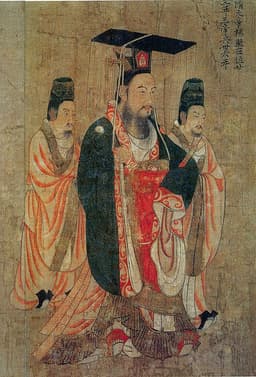
Emperor Wen of Sui
Emperor · Medieval
80.3Total
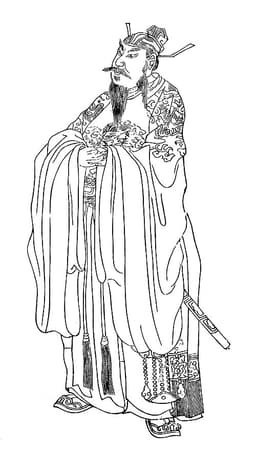
Xu Da
General · Medieval
74.9Total
Basic Information
Born
541
1332
Died
604
1385
Era
Medieval
Medieval
Nationality
China
China
Occupation
Emperor
General
Civilization
Eastern
Eastern
Score Comparison
Military (10%)
76.0
88.0
Political (20%)
75.0
68.0
Influence (20%)
88.0
82.0
Legacy (20%)
80.0
72.0
Leadership (15%)
80.0
62.0
Strategy (15%)
75.0
80.8
TOTAL
80.3
74.9
Emperor Wen of Sui — Complete Timeline
581 AD
Establishment of the Three Departments and Six Ministries SystemReform◆ Major
Emperor Wen established a centralized bureaucratic system with three departments (Secretariat, Chancellery, and Department of State Affairs) and six ministries. This system became the foundation of Chinese government administration for centuries.
Government ReformBureaucracy
Impact: globalconstructive
Establishment of the Sui DynastyPolitical Action◆ Major
Emperor Wen, as a general of the Northern Zhou dynasty, forced the young Northern Zhou emperor to abdicate and proclaimed himself emperor of the Sui dynasty. This marked the beginning of the Sui dynasty, which would go on to reunify China.
Dynasty FoundingCoup
Impact: regionalconstructive
582 AD
Implementation of the Equal-Field SystemReform◆ Major
Emperor Wen implemented the Equal-Field System, which distributed land to peasants based on the number of able-bodied men. This reform increased agricultural productivity, stabilized tax revenues, and reduced the power of large landowners.
Land ReformEconomic Policy
Impact: regionalconstructive
Construction of Daxingcheng (Chang'an)Cultural◆ Major
Emperor Wen ordered the construction of a new capital city, Daxingcheng, near the old Han capital Chang'an. This city, later known as Chang'an, became a model for urban planning and served as the capital of the Sui and Tang dynasties.
Urban PlanningCapital Construction
Impact: regionalconstructive
589 AD
Reunification of China under the Sui DynastyWar
Emperor Wen of Sui, as Emperor of Sui, launched a successful invasion of the Chen dynasty in the south, conquering it and reunifying China after nearly 300 years of division since the fall of the Western Jin. This ended the Northern and Southern Dynasties period.
UnificationConquest
Impact: globalconstructive
Xu Da — Complete Timeline
1368 AD
Capture of Dadu (Beijing)War
Xu Da led the Ming army in the capture of Dadu, the Yuan capital. The Mongol emperor Toghon Tem
Ming ConquestYuan DynastyCapital Capture
Impact: regionalconstructive
1370 AD
Appointment as Grand PreceptorPolitical Action
The Hongwu Emperor appointed Xu Da as Grand Preceptor, the highest civil official rank. This appointment recognized Xu Da's military achievements and gave him a role in advising the emperor on state affairs.
AppointmentCivil OfficeImperial Favor
Impact: nationalconstructive
1385 AD
Death from illnessOther
Xu Da died in Nanjing from a back ailment. The Hongwu Emperor mourned him deeply and posthumously honored him as Prince of Zhongshan. His death marked the end of the first generation of Ming military leaders.
DeathMing DynastyMilitary Leader
Impact: nationaltragic
Expert Analysis
Origins
Emperor Wen of Sui (Yang Jian) was born into a powerful military family during the chaotic Northern and Southern Dynasties period. His father was a general under the Northern Zhou, and Yang Jian himself rose through the ranks, eventually seizing power through a combination of political maneuvering and military support. In contrast, Xu Da was born into a poor peasant family in the late Yuan dynasty. He joined the Red Turban Rebellion led by Zhu Yuanzhang, the future Hongwu Emperor, and quickly distinguished himself through his martial prowess and loyalty. Both men emerged from turbulent times, but Wen’s noble birth gave him advantages in education and connections, while Xu Da’s rise was purely meritocratic.
Rise to Power
Emperor Wen of Sui’s path to power was marked by cunning and ruthlessness. As regent for the young Northern Zhou emperor, he eliminated rivals and consolidated control. In 581 CE, he forced the abdication of the Zhou emperor and proclaimed the Sui dynasty. He then spent years preparing for the conquest of the Chen dynasty in the south, finally achieving reunification in 589 CE. Xu Da’s rise was more straightforward: he joined Zhu Yuanzhang early and proved himself in battle. His greatest achievement came in 1368 when he led the Ming army to capture Dadu (Beijing), the Yuan capital, effectively ending Mongol rule over China. Xu Da was appointed Grand Preceptor, a high honor, but he remained a loyal general rather than seizing supreme power.
Leadership & Governance
Emperor Wen was a reformer and administrator. He implemented the Equal-Field System to distribute land and reduce inequality, and established the Three Departments and Six Ministries system, which became the model for Chinese bureaucracy for centuries. He also built Daxingcheng (Chang'an), a new capital that showcased his vision. However, his governance was authoritarian, with harsh punishments for corruption and dissent. Xu Da was primarily a military leader, known for his strategic brilliance and discipline. He treated conquered populations fairly, which helped pacify the north. His leadership style was collaborative, often consulting with fellow generals, but he lacked experience in civil administration. Thus, Wen’s governance scores higher (L=80 vs L=72) due to his comprehensive reforms.
Triumph & Tragedy
Emperor Wen’s greatest triumph was reunifying China, ending nearly 300 years of division. His reforms stabilized the economy and government. However, his later years were marred by paranoia and conflict with his son, Yang Guang, who eventually murdered him. The Sui dynasty collapsed shortly after his death, tarnishing his legacy. Xu Da’s triumph was the expulsion of the Mongols, a feat that restored Han Chinese rule. He also defeated Mongol remnants at the Battle of Lake Buir. His tragedy was dying from illness at age 54, before seeing the full consolidation of Ming rule. Both men achieved great victories but faced personal or dynastic tragedies.
Character & Destiny
Emperor Wen was intelligent, ambitious, and hardworking, but also suspicious and cruel. He trusted few and micromanaged his government. His destiny was to be a founding emperor, but his dynasty’s brevity undermines his reputation. Xu Da was humble, loyal, and prudent. He never sought power for himself, which allowed him to die naturally despite serving a paranoid emperor. His destiny was to be a consummate general, remembered for his integrity and skill. In character, Xu Da is more admirable, but Wen’s impact was greater.
Legacy
Emperor Wen’s legacy is mixed. He reunified China and created institutions that lasted, but his dynasty failed. He is often overshadowed by the Tang dynasty that followed. Xu Da is celebrated as a national hero in China, a symbol of loyalty and martial excellence. His descendants became prominent Ming officials. In terms of long-term influence, Wen’s administrative systems had a profound impact on Chinese governance, while Xu Da’s military campaigns were more immediate.
Conclusion
Emperor Wen of Sui scores higher overall (average 78.5 vs 73.1), reflecting his broader impact on Chinese history. His reunification and institutional reforms were foundational for the subsequent golden age of the Tang. Xu Da, while a brilliant general, operated within a framework set by others. Wen’s leadership and governance scores (L=80, I=88) surpass Xu Da’s military prowess (M=88). Therefore, Emperor Wen of Sui is the greater historical figure, despite the tragic end of his dynasty.
Rankings
🥇
Emperor Wen of SuiLeader
Mil: 76.0Pol: 75.0Inf: 88.0
80.3
🥈
Xu Da
Mil: 88.0Pol: 68.0Inf: 82.0
74.9
+5.4 behind
How This Comparison Works
Algorithm
Each figure is scored on 6 dimensions (0—100 scale) based on structured historical data: Military (10%), Political (20%), Influence (20%), Legacy (20%), Leadership (15%), Strategy (15%). The weighted total produces the final ranking.
Data Sources
Scores are computed from structured sub-indicators in the database. Scale factors adjust for era (Ancient ×0.85, Modern ×1.0) and civilization size (Eastern ×1.05, Other ×0.80) to account for differences in population and military scale.
Maximum 3 Figures
Comparisons are limited to 2—3 figures to ensure readability and statistical meaningfulness.
Error Margins
±5 points per dimension — Sub-scores are derived from historical records with inherent uncertainty. Two figures within 5 points on a dimension should be considered roughly equivalent in that area.
Total Score Accuracy
±3 points overall — The weighted combination of 6 dimensions produces a total score with approximately ±3 points of uncertainty. Differences of less than 3 points are not statistically significant— the figures are effectively tied.
Known Limitations
- Historical records are incomplete and uneven across civilizations
- Figures from oral-tradition societies may be underrepresented
- Occupation labels can misclassify multi-role figures
- Scores measure capability and impact, not moral character
- Quantitative scoring is a comparison tool, not absolute truth
Capability Radar
Military (10%) — Battles & Warfare
Battles
75
95
Win Rate
80
95
Expansion
85
95
Political (20%) — Governance & Reform
Reform
95
50
Diplomacy
85
65
Economy
90
55
Influence (20%) — Cultural & Global Reach
Cultural
70
70
Global
65
80
Legacy (20%) — Historical Impact
Historical
85
85
Longevity
70
75
Leadership (15%) — Power & Stability
Tenure
80
60
Stability
75
70
Strategy (15%) — Tactics & Innovation
Strategy
85
92
Tactics
70
90
Reform
90
70
Similar Comparisons
Comments & Discussion
No comments yet. Be the first to share your thoughts!