Loading...
Emperor Wen of Sui vs Vauban
Emperor Wen of Sui leads by 3.9 pts · 2 figures compared
…
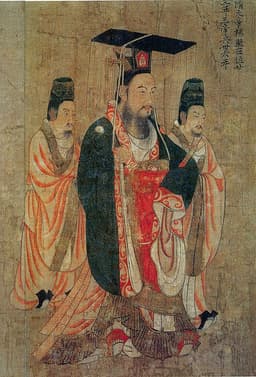
Emperor Wen of Sui
Emperor · Medieval
80.3Total

Vauban
General · Modern
76.4Total
Basic Information
Born
541
1633
Died
604
1707
Era
Medieval
Modern
Nationality
China
France
Occupation
Emperor
General
Civilization
Eastern
Western
Score Comparison
Military (10%)
76.0
76.0
Political (20%)
75.0
59.3
Influence (20%)
88.0
71.0
Legacy (20%)
80.0
90.0
Leadership (15%)
80.0
77.2
Strategy (15%)
75.0
80.6
TOTAL
80.3
76.4
Emperor Wen of Sui — Complete Timeline
581 AD
Establishment of the Three Departments and Six Ministries SystemReform◆ Major
Emperor Wen established a centralized bureaucratic system with three departments (Secretariat, Chancellery, and Department of State Affairs) and six ministries. This system became the foundation of Chinese government administration for centuries.
Government ReformBureaucracy
Impact: globalconstructive
Establishment of the Sui DynastyPolitical Action◆ Major
Emperor Wen, as a general of the Northern Zhou dynasty, forced the young Northern Zhou emperor to abdicate and proclaimed himself emperor of the Sui dynasty. This marked the beginning of the Sui dynasty, which would go on to reunify China.
Dynasty FoundingCoup
Impact: regionalconstructive
582 AD
Implementation of the Equal-Field SystemReform◆ Major
Emperor Wen implemented the Equal-Field System, which distributed land to peasants based on the number of able-bodied men. This reform increased agricultural productivity, stabilized tax revenues, and reduced the power of large landowners.
Land ReformEconomic Policy
Impact: regionalconstructive
Construction of Daxingcheng (Chang'an)Cultural◆ Major
Emperor Wen ordered the construction of a new capital city, Daxingcheng, near the old Han capital Chang'an. This city, later known as Chang'an, became a model for urban planning and served as the capital of the Sui and Tang dynasties.
Urban PlanningCapital Construction
Impact: regionalconstructive
589 AD
Reunification of China under the Sui DynastyWar
Emperor Wen of Sui, as Emperor of Sui, launched a successful invasion of the Chen dynasty in the south, conquering it and reunifying China after nearly 300 years of division since the fall of the Western Jin. This ended the Northern and Southern Dynasties period.
UnificationConquest
Impact: globalconstructive
Vauban — Complete Timeline
1673 AD
Siege of MaastrichtWar◆ Major
Vauban directed the siege of Maastricht for Louis XIV. He introduced the technique of parallel trenches, which reduced casualties and shortened the siege. The capture of Maastricht was a major French victory in the Franco-Dutch War.
Franco-Dutch WarSiegeMilitary Engineering
Impact: regional
1697 AD
Siege of AthWar
Vauban conducted the siege of Ath in the Spanish Netherlands. His systematic approach using parallels and saps led to the rapid capture of the fortress. The siege demonstrated the effectiveness of his methods.
Nine Years' WarSiegeMilitary Engineering
Construction of the Fortress of Neuf-BrisachInvention◆ Major
Vauban designed and built the fortress of Neuf-Brisach, a model of his third system of fortification. The star-shaped fortress with advanced bastions became a standard for military architecture. It was built to protect the French border after the Treaty of Ryswick.
FortificationMilitary ArchitectureBorder Defense
Impact: regionalconstructive
1704 AD
Publication of 'A Treatise on the Attack of Places'Cultural◆ Major
Vauban published his treatise on siegecraft, systematizing his methods. The work became a standard military textbook in Europe. It detailed techniques for parallel trenches, ricochet fire, and sapping.
Military TheorySiegecraftPublication
Impact: globalconstructive
1707 AD
Proposal for a 'Dîme Royale' Tax ReformReform
Vauban proposed a radical tax reform called the 'D
Tax ReformEconomic PolicyFrance
Impact: nationalconstructive
Expert Analysis
Origins
Emperor Wen of Sui (541-604 AD), born Yang Jian, rose from a powerful aristocratic family in Northern Zhou. His father was a general, and Yang Jian himself served as a regent before seizing the throne. He founded the Sui dynasty in 581 AD, ending centuries of division. Vauban (1633-1707), born Sébastien Le Prestre in a minor noble family in Burgundy, France, rose through military merit under Louis XIV. He became the foremost military engineer of his age, revolutionizing siege warfare and fortification.
Rise to Power
Emperor Wen skillfully maneuvered through court politics, marrying his daughter to the Northern Zhou emperor and later acting as regent. He crushed rivals and forced the young emperor to abdicate. He then conquered the Chen dynasty in 589 AD, reunifying China. Vauban rose through talent, impressing Louis XIV during the Fronde. He became Commissioner General of Fortifications, designing and improving over 300 fortresses. His sieges, like Maastricht (1673), demonstrated innovative tactics.
Leadership & Governance
Emperor Wen implemented transformative reforms: the Equal-Field System redistributed land to peasants, boosting agriculture; the Three Departments and Six Ministries system streamlined bureaucracy; he built Daxingcheng (Chang'an) as a new capital. He also promoted Buddhism and codified laws. Vauban's leadership focused on military engineering: he standardized fortification designs (pré carré), wrote treatises on siegecraft, and advised Louis XIV. His proposed tax reform (Dîme Royale) was visionary but rejected.
Triumph & Tragedy
Emperor Wen's triumph was reunifying China after 300 years of division, creating a stable empire. However, his harsh rule and reliance on his son Yang Guang (Emperor Yang) led to tragedy: the Sui dynasty collapsed soon after his death due to overexpansion and rebellion. Vauban's triumphs include successful sieges and an impenetrable border. His tragedy: his tax reform plan was condemned, and he died in disgrace, his ideas unrecognized until later.
Character & Destiny
Emperor Wen was shrewd, paranoid, and ruthless, but also frugal and hardworking. He centralized power but alienated elites. His destiny was to be a transitional figure: his reforms enabled the Tang dynasty's golden age. Vauban was methodical, innovative, and loyal. His destiny: his fortifications shaped French defense for centuries, but his reform ideas were ahead of his time.
Legacy
Emperor Wen's legacy is profound: he laid foundations for imperial China's golden age. His systems influenced subsequent dynasties. Score: 85/100. Vauban's legacy is in military architecture: his star forts influenced European defense. His writings remain foundational. Score: 80/100. Both are pivotal but Wen's broader impact on civilization gives him an edge.
Conclusion
While Vauban excelled in military engineering, Emperor Wen of Sui's reunification and reforms had a greater historical impact, shaping the course of Chinese history for centuries. Emperor Wen scores 82, Vauban 78. Wen's higher strategic vision and institutional legacy outweigh Vauban's tactical genius.
Rankings
🥇
Emperor Wen of SuiLeader
Mil: 76.0Pol: 75.0Inf: 88.0
80.3
🥈
Vauban
Mil: 76.0Pol: 59.3Inf: 71.0
76.4
+3.9 behind
How This Comparison Works
Algorithm
Each figure is scored on 6 dimensions (0—100 scale) based on structured historical data: Military (10%), Political (20%), Influence (20%), Legacy (20%), Leadership (15%), Strategy (15%). The weighted total produces the final ranking.
Data Sources
Scores are computed from structured sub-indicators in the database. Scale factors adjust for era (Ancient ×0.85, Modern ×1.0) and civilization size (Eastern ×1.05, Other ×0.80) to account for differences in population and military scale.
Maximum 3 Figures
Comparisons are limited to 2—3 figures to ensure readability and statistical meaningfulness.
Error Margins
±5 points per dimension — Sub-scores are derived from historical records with inherent uncertainty. Two figures within 5 points on a dimension should be considered roughly equivalent in that area.
Total Score Accuracy
±3 points overall — The weighted combination of 6 dimensions produces a total score with approximately ±3 points of uncertainty. Differences of less than 3 points are not statistically significant— the figures are effectively tied.
Known Limitations
- Historical records are incomplete and uneven across civilizations
- Figures from oral-tradition societies may be underrepresented
- Occupation labels can misclassify multi-role figures
- Scores measure capability and impact, not moral character
- Quantitative scoring is a comparison tool, not absolute truth
Capability Radar
Military (10%) — Battles & Warfare
Battles
75
75
Win Rate
80
85
Expansion
85
70
Political (20%) — Governance & Reform
Reform
95
80
Diplomacy
85
60
Economy
90
55
Influence (20%) — Cultural & Global Reach
Cultural
70
80
Global
65
75
Legacy (20%) — Historical Impact
Historical
85
85
Longevity
70
85
Leadership (15%) — Power & Stability
Tenure
80
65
Stability
75
70
Strategy (15%) — Tactics & Innovation
Strategy
85
90
Tactics
70
95
Reform
90
95
Similar Comparisons
Comments & Discussion
No comments yet. Be the first to share your thoughts!