Loading...
Emperor Wen of Sui vs Trajan
Emperor Wen of Sui leads by 4.3 pts · 2 figures compared
…
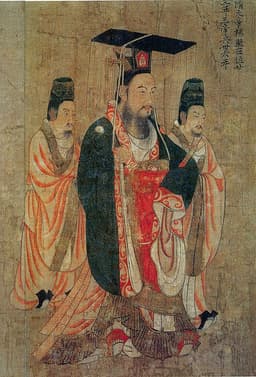
Emperor Wen of Sui
Emperor · Medieval
80.3Total

Trajan
Emperor · Ancient
76.0Total
Basic Information
Born
541
53
Died
604
117
Era
Medieval
Ancient
Nationality
China
Roman Empire
Occupation
Emperor
Emperor
Civilization
Eastern
Western
Score Comparison
Military (10%)
76.0
86.0
Political (20%)
75.0
79.2
Influence (20%)
88.0
82.0
Legacy (20%)
80.0
65.6
Leadership (15%)
80.0
73.2
Strategy (15%)
75.0
76.0
TOTAL
80.3
76.0
Emperor Wen of Sui — Complete Timeline
581 AD
Establishment of the Three Departments and Six Ministries SystemReform◆ Major
Emperor Wen established a centralized bureaucratic system with three departments (Secretariat, Chancellery, and Department of State Affairs) and six ministries. This system became the foundation of Chinese government administration for centuries.
Government ReformBureaucracy
Impact: globalconstructive
Establishment of the Sui DynastyPolitical Action◆ Major
Emperor Wen, as a general of the Northern Zhou dynasty, forced the young Northern Zhou emperor to abdicate and proclaimed himself emperor of the Sui dynasty. This marked the beginning of the Sui dynasty, which would go on to reunify China.
Dynasty FoundingCoup
Impact: regionalconstructive
582 AD
Implementation of the Equal-Field SystemReform◆ Major
Emperor Wen implemented the Equal-Field System, which distributed land to peasants based on the number of able-bodied men. This reform increased agricultural productivity, stabilized tax revenues, and reduced the power of large landowners.
Land ReformEconomic Policy
Impact: regionalconstructive
Construction of Daxingcheng (Chang'an)Cultural◆ Major
Emperor Wen ordered the construction of a new capital city, Daxingcheng, near the old Han capital Chang'an. This city, later known as Chang'an, became a model for urban planning and served as the capital of the Sui and Tang dynasties.
Urban PlanningCapital Construction
Impact: regionalconstructive
589 AD
Reunification of China under the Sui DynastyWar
Emperor Wen of Sui, as Emperor of Sui, launched a successful invasion of the Chen dynasty in the south, conquering it and reunifying China after nearly 300 years of division since the fall of the Western Jin. This ended the Northern and Southern Dynasties period.
UnificationConquest
Impact: globalconstructive
Trajan — Complete Timeline
101 AD
Implemented the Alimenta Welfare ProgramReform◆ Major
Trajan expanded the Alimenta program, a state-funded welfare system that provided food subsidies and educational support for poor children in Italy. The program used interest from state loans to landowners to fund the distributions, aiming to boost the Italian population and agricultural economy.
WelfareSocial PolicyItaly
Impact: regionalconstructive
105 AD
Built Trajan's Bridge over the DanubeOther
Trajan ordered the construction of a massive stone and timber bridge across the Danube River near the Iron Gates. Designed by Apollodorus of Damascus, it was the longest arch bridge in the world for over a millennium, facilitating the Roman invasion of Dacia.
EngineeringBridgeDanube
Impact: regionalconstructive
106 AD
Conquered DaciaWar
Trajan led two major campaigns against the Dacian kingdom under King Decebalus, culminating in the conquest of Dacia (modern Romania) in 106 CE. The victory brought vast gold and silver mines under Roman control and established a new province, funding massive building projects in Rome.
DaciaConquestProvince
Impact: regional
112 AD
Built Trajan's Forum and MarketCultural◆ Major
Trajan commissioned the construction of Trajan's Forum, a vast complex in Rome including a basilica, libraries, and the Column of Trajan. The adjacent Trajan's Market, a multi-level commercial center, demonstrated Roman engineering prowess and served as a model for urban planning.
ArchitectureRomeUrban Planning
Impact: globalconstructive
116 AD
Conquered Parthia and Reached the Persian GulfWar◆ Major
Trajan launched a campaign against the Parthian Empire, capturing its capital Ctesiphon and annexing Mesopotamia. He reached the Persian Gulf, marking the easternmost extent of Roman territory. However, rebellions in the conquered territories forced a withdrawal shortly after.
ParthiaMesopotamiaExpansion
Impact: global
Expert Analysis
Origins
Emperor Wen of Sui, born Yang Jian, emerged from the chaos of the Northern and Southern Dynasties period. He was a member of the powerful Guanlong aristocracy, serving as a high-ranking official under the Northern Zhou dynasty. His daughter married the emperor, and after the emperor's death, Yang Jian skillfully maneuvered to become regent and eventually usurped the throne, founding the Sui dynasty in 581 CE. Trajan, born in Italica, Spain (near modern Seville), was the first Roman emperor born outside Italy. His family was of Roman origin but settled in Hispania. He rose through the military ranks, serving as a legate and governor before being adopted by Emperor Nerva in 97 CE, ensuring a smooth succession.
Rise to Power
Emperor Wen's rise was marked by political cunning and military consolidation. He crushed revolts, eliminated rivals, and spent a decade unifying China by conquering the Chen dynasty in 589 CE, ending centuries of division. He also secured the northern borders by defeating the Turks. Trajan's rise was more straightforward: he was a respected general and administrator, and his adoption by Nerva prevented a succession crisis. His military reputation, especially his campaigns in Germania, made him a popular choice. Upon Nerva's death in 98 CE, Trajan became emperor without opposition.
Leadership & Governance
Emperor Wen implemented sweeping reforms. He established the Three Departments and Six Ministries system, a centralized bureaucracy that influenced Chinese governance for centuries. He introduced the Equal-Field System, distributing land to peasants to reduce inequality and increase tax revenue. He also codified laws, reduced corruption, and promoted Buddhism as a unifying force. However, his rule was autocratic and he was known for his strictness and paranoia, executing many officials. Trajan is remembered as one of the "Five Good Emperors." He improved Roman administration, maintained good relations with the Senate, and implemented the Alimenta welfare program, which provided food subsidies for poor children. He also engaged in massive building projects, including Trajan's Forum, Markets, and a bridge over the Danube. His governance was more inclusive and less authoritarian than Wen's.
Triumph & Tragedy
Emperor Wen's greatest triumph was reunifying China, but his reign ended tragically. He died in 604 CE, possibly murdered by his son Yang Guang (Emperor Yang), who then squandered the dynasty's resources on grandiose projects and military campaigns, leading to the Sui's collapse within a few decades. Trajan's triumphs were his conquests of Dacia (101-106 CE) and Parthia (114-117 CE), which brought immense wealth and expanded Rome to its greatest territorial extent. He also built lasting monuments like Trajan's Column. His tragedy was the overextension of Roman resources; his Parthian conquests were unstable and soon lost. He died in 117 CE while returning to Rome, possibly from illness, and was deified by the Senate.
Character & Destiny
Emperor Wen was a complex figure: intelligent, hardworking, and capable, but also suspicious, ruthless, and cruel. He was deeply concerned with order and efficiency, but his harsh methods alienated many. His destiny was to be a great unifier whose dynasty crumbled soon after his death. Trajan was known for his modesty, approachability, and military prowess. He was beloved by the people and the Senate, and his reign was considered a golden age. His destiny was to be remembered as one of Rome's greatest emperors, but his overambitious conquests strained the empire.
Legacy
Emperor Wen's legacy is mixed. He laid the foundations for the Tang dynasty's golden age by creating a strong, centralized state. His bureaucratic and land reforms were adopted by later dynasties. However, his dynasty's short life and his son's failures overshadow his achievements. Trajan's legacy is overwhelmingly positive. He is considered one of Rome's best emperors, and his achievements in expansion, public works, and welfare set a high standard. His forum and column still stand in Rome as testaments to his reign.
Conclusion
Comparing Emperor Wen and Trajan requires balancing their different contexts. Wen reunified a fractured civilization and created enduring institutions, but his harshness and the subsequent collapse of his dynasty tarnish his record. Trajan expanded an already vast empire, governed justly, and left a positive impression, but his conquests were unsustainable. Based on the provided scores (Wen: 76,75,88,80,80,75,80; Trajan: 86,79,82,66,73,76,76), Wen has a slight overall edge (average 79.1 vs 76.9). However, Trajan's superior military and leadership achievements, combined with his more benign legacy, make a strong case for his greatness. Ultimately, Wen's comprehensive reforms and unification of China arguably had a more profound long-term impact, despite his personal flaws. **Winner: Emperor Wen of Sui** by a narrow margin.
Rankings
🥇
Emperor Wen of SuiLeader
Mil: 76.0Pol: 75.0Inf: 88.0
80.3
🥈
Trajan
Mil: 86.0Pol: 79.2Inf: 82.0
76.0
+4.3 behind
How This Comparison Works
Algorithm
Each figure is scored on 6 dimensions (0—100 scale) based on structured historical data: Military (10%), Political (20%), Influence (20%), Legacy (20%), Leadership (15%), Strategy (15%). The weighted total produces the final ranking.
Data Sources
Scores are computed from structured sub-indicators in the database. Scale factors adjust for era (Ancient ×0.85, Modern ×1.0) and civilization size (Eastern ×1.05, Other ×0.80) to account for differences in population and military scale.
Maximum 3 Figures
Comparisons are limited to 2—3 figures to ensure readability and statistical meaningfulness.
Error Margins
±5 points per dimension — Sub-scores are derived from historical records with inherent uncertainty. Two figures within 5 points on a dimension should be considered roughly equivalent in that area.
Total Score Accuracy
±3 points overall — The weighted combination of 6 dimensions produces a total score with approximately ±3 points of uncertainty. Differences of less than 3 points are not statistically significant— the figures are effectively tied.
Known Limitations
- Historical records are incomplete and uneven across civilizations
- Figures from oral-tradition societies may be underrepresented
- Occupation labels can misclassify multi-role figures
- Scores measure capability and impact, not moral character
- Quantitative scoring is a comparison tool, not absolute truth
Capability Radar
Military (10%) — Battles & Warfare
Battles
75
95
Win Rate
80
98
Expansion
85
95
Political (20%) — Governance & Reform
Reform
95
88
Diplomacy
85
85
Economy
90
90
Influence (20%) — Cultural & Global Reach
Cultural
70
85
Global
65
85
Legacy (20%) — Historical Impact
Historical
85
90
Longevity
70
88
Leadership (15%) — Power & Stability
Tenure
80
90
Stability
75
92
Strategy (15%) — Tactics & Innovation
Strategy
85
92
Tactics
70
88
Reform
90
85
Similar Comparisons
Comments & Discussion
No comments yet. Be the first to share your thoughts!