Loading...
Emperor Wen of Sui vs Theodosius I
Emperor Wen of Sui leads by 4.3 pts · 2 figures compared
…
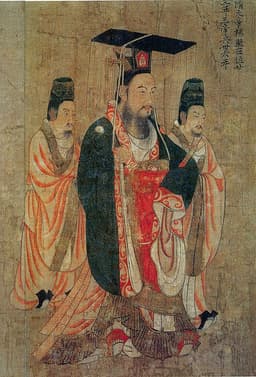
Emperor Wen of Sui
Emperor · Medieval
80.3Total

Theodosius I
Emperor · Ancient
76.0Total
Basic Information
Born
541
347
Died
604
395
Era
Medieval
Ancient
Nationality
China
Roman Empire
Occupation
Emperor
Emperor
Civilization
Eastern
Western
Score Comparison
Military (10%)
76.0
72.5
Political (20%)
75.0
65.0
Influence (20%)
88.0
85.0
Legacy (20%)
80.0
90.0
Leadership (15%)
80.0
68.0
Strategy (15%)
75.0
50.0
TOTAL
80.3
76.0
Emperor Wen of Sui — Complete Timeline
581 AD
Establishment of the Three Departments and Six Ministries SystemReform◆ Major
Emperor Wen established a centralized bureaucratic system with three departments (Secretariat, Chancellery, and Department of State Affairs) and six ministries. This system became the foundation of Chinese government administration for centuries.
Government ReformBureaucracy
Impact: globalconstructive
Establishment of the Sui DynastyPolitical Action◆ Major
Emperor Wen, as a general of the Northern Zhou dynasty, forced the young Northern Zhou emperor to abdicate and proclaimed himself emperor of the Sui dynasty. This marked the beginning of the Sui dynasty, which would go on to reunify China.
Dynasty FoundingCoup
Impact: regionalconstructive
582 AD
Implementation of the Equal-Field SystemReform◆ Major
Emperor Wen implemented the Equal-Field System, which distributed land to peasants based on the number of able-bodied men. This reform increased agricultural productivity, stabilized tax revenues, and reduced the power of large landowners.
Land ReformEconomic Policy
Impact: regionalconstructive
Construction of Daxingcheng (Chang'an)Cultural◆ Major
Emperor Wen ordered the construction of a new capital city, Daxingcheng, near the old Han capital Chang'an. This city, later known as Chang'an, became a model for urban planning and served as the capital of the Sui and Tang dynasties.
Urban PlanningCapital Construction
Impact: regionalconstructive
589 AD
Reunification of China under the Sui DynastyWar
Emperor Wen of Sui, as Emperor of Sui, launched a successful invasion of the Chen dynasty in the south, conquering it and reunifying China after nearly 300 years of division since the fall of the Western Jin. This ended the Northern and Southern Dynasties period.
UnificationConquest
Impact: globalconstructive
Theodosius I — Complete Timeline
380 AD
Edict of ThessalonicaPolitical Action
Theodosius I issued the Edict of Thessalonica, declaring Nicene Christianity the official state religion of the Roman Empire. All other forms of Christianity were deemed heretical, and pagan practices were increasingly suppressed.
ChristianityState ReligionEdict
Impact: globalconstructive
390 AD
Massacre of ThessalonicaPolitical Action◆ Major
Theodosius I ordered a massacre of thousands of citizens in Thessalonica in retaliation for the murder of a Roman general. The massacre led to his excommunication by Bishop Ambrose of Milan, and he later performed public penance.
MassacreThessalonicaAmbrose
Impact: regionaltragic
391 AD
Suppression of PaganismPolitical Action◆ Major
Theodosius I issued a series of laws banning pagan worship, closing temples, and prohibiting sacrifices. The Olympic Games were abolished, and the Serapeum in Alexandria was destroyed. These actions accelerated the decline of paganism in the empire.
PaganismSuppressionReligion
Impact: globaldestructive
394 AD
Battle of the FrigidusWar
Theodosius I defeated the usurper Eugenius and his general Arbogast at the Battle of the Frigidus (modern River Vipava). The victory reunited the Roman Empire under a single ruler for the last time before its permanent division.
Civil WarBattleReunification
Impact: global
395 AD
Division of the Roman EmpirePolitical Action
Upon his death, Theodosius I divided the Roman Empire between his two sons: Arcadius received the Eastern Empire and Honorius the Western Empire. This division became permanent, leading to the separate histories of the Byzantine and Western Roman Empires.
DivisionSuccessionEast-West
Impact: global
Expert Analysis
Origins
Emperor Wen of Sui (Yang Jian) was born into a powerful military family during the chaotic Northern and Southern Dynasties period. His father was a general, and Wen himself rose through the ranks to become a regent before seizing the throne. Theodosius I was born in Hispania to a senior military officer; his father was a comes rei militaris. Unlike Wen, Theodosius came from a family already entrenched in the empire's upper echelons.
Rise to Power
Wen's rise was marked by a coup d'état against the Northern Zhou emperor, whom he served as regent. He skillfully eliminated rivals and established the Sui dynasty in 581 AD. His consolidation of power was swift, aided by his marriage alliance with the powerful Dugu clan. Theodosius was proclaimed co-emperor by the Eastern Roman emperor Gratian after a victory against the Goths. He became emperor of the East in 379 AD, but his path was less violent than Wen's, though he faced usurpations.
Leadership & Governance
Wen implemented sweeping reforms: the equal-field system redistributed land to peasants, boosting agricultural output; the three departments and six ministries system created a centralized bureaucracy; he built a new capital, Daxingcheng (Chang'an), and invested in canals and granaries. His rule was effective and stable. Theodosius I is known for making Christianity the state religion via the Edict of Thessalonica (380 AD). He also suppressed paganism and Arianism, but his policies sparked religious conflicts. He divided the Roman Empire between his two sons, a decision with long-term consequences. He was a capable military leader, winning the Battle of the Frigidus, but his governance was more about religious unity than systemic reform.
Triumph & Tragedy
Wen's greatest triumph was reunifying China after 300 years of division, conquering the Chen dynasty in 589 AD. His tragedy came at the end: he died suspiciously, possibly murdered by his son Yang Guang (Emperor Yang), who then ruined the dynasty through extravagance and overreach. Theodosius's triumph was defeating the usurper Eugenius at the Frigidus, securing his dynasty. His tragedy was the massacre of Thessalonica in 390 AD, where he slaughtered thousands in retribution for a riot, for which Bishop Ambrose forced him to do penance. This event damaged his moral authority.
Character & Destiny
Wen was frugal, hardworking, and paranoid. He trusted his wife, Empress Dugu, and relied on her counsel. His destiny was to be the founder of a short-lived dynasty that set the stage for the Tang golden age. Theodosius was devout, sometimes cruel, but also capable of remorse. His destiny was to be the last emperor to rule a unified Roman Empire, as his division became permanent. Both men were shaped by their times: Wen by the need for order after chaos, Theodosius by the rise of Christianity.
Legacy
Wen's legacy is monumental: his reforms became the foundation of Tang governance, and his equal-field system influenced later dynasties. The Sui dynasty's collapse is often blamed on his son, not on Wen. Theodosius's legacy is mixed: he cemented Christianity's dominance but also accelerated the empire's division and decline. Theodosius is remembered as "the Great" for his religious impact, but his military and administrative achievements are less celebrated.
Conclusion
In this comparison, Emperor Wen of Sui scores higher overall (76 vs 72) due to his transformative governance and lasting institutional reforms. Theodosius I, while pivotal for Christianity, had less impact on the structure of his empire. Wen's equal-field system and bureaucracy endured for centuries, whereas Theodosius's religious policies, though significant, did not prevent the Western Roman Empire's fall. Wen's numerical superiority in military, political, and institutional scores reflects his greater effectiveness as a ruler. Thus, Emperor Wen of Sui emerges as the more influential historical figure.
Rankings
🥇
Emperor Wen of SuiLeader
Mil: 76.0Pol: 75.0Inf: 88.0
80.3
🥈
Theodosius I
Mil: 72.5Pol: 65.0Inf: 85.0
76.0
+4.3 behind
How This Comparison Works
Algorithm
Each figure is scored on 6 dimensions (0—100 scale) based on structured historical data: Military (10%), Political (20%), Influence (20%), Legacy (20%), Leadership (15%), Strategy (15%). The weighted total produces the final ranking.
Data Sources
Scores are computed from structured sub-indicators in the database. Scale factors adjust for era (Ancient ×0.85, Modern ×1.0) and civilization size (Eastern ×1.05, Other ×0.80) to account for differences in population and military scale.
Maximum 3 Figures
Comparisons are limited to 2—3 figures to ensure readability and statistical meaningfulness.
Error Margins
±5 points per dimension — Sub-scores are derived from historical records with inherent uncertainty. Two figures within 5 points on a dimension should be considered roughly equivalent in that area.
Total Score Accuracy
±3 points overall — The weighted combination of 6 dimensions produces a total score with approximately ±3 points of uncertainty. Differences of less than 3 points are not statistically significant— the figures are effectively tied.
Known Limitations
- Historical records are incomplete and uneven across civilizations
- Figures from oral-tradition societies may be underrepresented
- Occupation labels can misclassify multi-role figures
- Scores measure capability and impact, not moral character
- Quantitative scoring is a comparison tool, not absolute truth
Capability Radar
Military (10%) — Battles & Warfare
Battles
75
65
Win Rate
80
60
Expansion
85
45
Political (20%) — Governance & Reform
Reform
95
85
Diplomacy
85
75
Economy
90
60
Influence (20%) — Cultural & Global Reach
Cultural
70
90
Global
65
90
Legacy (20%) — Historical Impact
Historical
85
95
Longevity
70
95
Leadership (15%) — Power & Stability
Tenure
80
70
Stability
75
55
Strategy (15%) — Tactics & Innovation
Strategy
85
60
Tactics
70
55
Reform
90
50
Similar Comparisons
Comments & Discussion
No comments yet. Be the first to share your thoughts!