Loading...
Emperor Wen of Sui vs Suleiman I
Emperor Wen of Sui leads by 1.5 pts · 2 figures compared
…
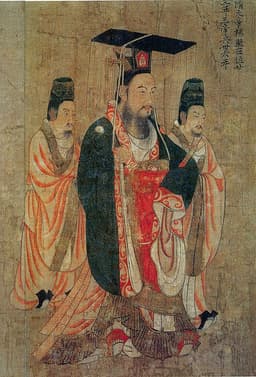
Emperor Wen of Sui
Emperor · Medieval
80.3Total
Suleiman I
Emperor · Medieval
78.8Total
Basic Information
Born
541
1494
Died
604
1566
Era
Medieval
Medieval
Nationality
China
Ottoman Empire
Occupation
Emperor
Emperor
Civilization
Eastern
Middle Eastern
Score Comparison
Military (10%)
76.0
78.5
Political (20%)
75.0
82.0
Influence (20%)
88.0
85.0
Legacy (20%)
80.0
70.8
Leadership (15%)
80.0
81.7
Strategy (15%)
75.0
74.4
TOTAL
80.3
78.8
Emperor Wen of Sui — Complete Timeline
581 AD
Establishment of the Three Departments and Six Ministries SystemReform◆ Major
Emperor Wen established a centralized bureaucratic system with three departments (Secretariat, Chancellery, and Department of State Affairs) and six ministries. This system became the foundation of Chinese government administration for centuries.
Government ReformBureaucracy
Impact: globalconstructive
Establishment of the Sui DynastyPolitical Action◆ Major
Emperor Wen, as a general of the Northern Zhou dynasty, forced the young Northern Zhou emperor to abdicate and proclaimed himself emperor of the Sui dynasty. This marked the beginning of the Sui dynasty, which would go on to reunify China.
Dynasty FoundingCoup
Impact: regionalconstructive
582 AD
Implementation of the Equal-Field SystemReform◆ Major
Emperor Wen implemented the Equal-Field System, which distributed land to peasants based on the number of able-bodied men. This reform increased agricultural productivity, stabilized tax revenues, and reduced the power of large landowners.
Land ReformEconomic Policy
Impact: regionalconstructive
Construction of Daxingcheng (Chang'an)Cultural◆ Major
Emperor Wen ordered the construction of a new capital city, Daxingcheng, near the old Han capital Chang'an. This city, later known as Chang'an, became a model for urban planning and served as the capital of the Sui and Tang dynasties.
Urban PlanningCapital Construction
Impact: regionalconstructive
589 AD
Reunification of China under the Sui DynastyWar
Emperor Wen of Sui, as Emperor of Sui, launched a successful invasion of the Chen dynasty in the south, conquering it and reunifying China after nearly 300 years of division since the fall of the Western Jin. This ended the Northern and Southern Dynasties period.
UnificationConquest
Impact: globalconstructive
Suleiman I — Complete Timeline
1522 AD
Siege of RhodesWar◆ Major
Suleiman I led a massive Ottoman army and fleet to besiege the island of Rhodes, held by the Knights Hospitaller. After a six-month siege, the knights surrendered and were allowed to leave. This victory secured Ottoman control over the eastern Mediterranean.
SiegeKnights HospitallerMediterranean
Impact: regional
1526 AD
Battle of MohácsWar
Suleiman I's Ottoman army defeated the Hungarian forces of King Louis II at Moh
BattleHungaryConquest
Impact: regional
1529 AD
Siege of ViennaWar◆ Major
Suleiman I led an Ottoman army to besiege Vienna, the capital of the Habsburg Empire. The siege failed due to supply problems and the onset of winter. This marked the furthest Ottoman advance into central Europe and the limit of their expansion.
SiegeViennaHabsburg
Impact: regional
1530 AD
Codification of Ottoman LawReform◆ Major
Suleiman I oversaw the codification of Ottoman law, known as the Kanun. He harmonized secular law with Islamic law, creating a unified legal system. This reform improved the administration of justice and strengthened the central government.
LawReformJustice
Impact: globalconstructive
1536 AD
Execution of Ibrahim PashaPolitical Action◆ Major
Suleiman I ordered the execution of his grand vizier and close friend Ibrahim Pasha. Ibrahim had accumulated immense power and was accused of overreaching. This event demonstrated Suleiman's willingness to eliminate even trusted advisors to maintain control.
ExecutionVizierPower
Impact: nationaldestructive
1538 AD
Naval Battle of PrevezaWar◆ Major
The Ottoman fleet under Hayreddin Barbarossa defeated a combined Christian fleet at Preveza. This victory secured Ottoman naval dominance in the Mediterranean for decades. It allowed the Ottomans to control trade routes and raid coastal areas.
Naval BattleBarbarossaMediterranean
Impact: regional
Expert Analysis
Origins
Emperor Wen of Sui (541–604 AD) was born Yang Jian, a member of the powerful Guanlong aristocracy in northern China. He rose through the ranks of the Northern Zhou dynasty, eventually seizing the throne in 581 AD. In contrast, Suleiman I (1494–1566) was born into the Ottoman dynasty as the son of Selim I, inheriting a vast empire already in expansion. Wen's origins were marked by political intrigue and military command, while Suleiman's were defined by dynastic privilege and early education in statecraft.
Rise to Power
Emperor Wen's rise was a masterclass in strategic maneuvering. As regent for the Northern Zhou emperor, he consolidated power, crushed rivals, and forced the abdication of the young ruler, founding the Sui dynasty. He then launched a systematic campaign to conquer the Chen dynasty in the south, reunifying China after nearly 300 years of division. Suleiman's path was smoother: he became sultan upon his father's death in 1520, facing no serious opposition. His early reign saw immediate military campaigns, including the capture of Belgrade and Rhodes, establishing his reputation as a warrior-sultan.
Leadership & Governance
Emperor Wen implemented groundbreaking reforms: the Equal-Field System to distribute land equitably, the Three Departments and Six Ministries to streamline administration, and a comprehensive legal code. He also built a new capital, Daxingcheng (later Chang'an), symbolizing unity. Suleiman codified Ottoman law (Kanun), harmonizing sharia and secular law, and reformed the land tenure system. However, his governance was more autocratic, with power concentrated in his hands and his grand viziers. Wen's leadership emphasized efficient bureaucracy and meritocracy, while Suleiman relied on personal authority and a sprawling imperial household.
Triumph & Tragedy
Emperor Wen's greatest triumph was reunifying China, but his reign ended tragically: he was allegedly murdered by his son, Yang Guang (Emperor Yang), who then mismanaged the empire, leading to the Sui's rapid collapse. Suleiman's triumphs include the Battle of Mohács (1526), which crushed Hungary, and the Siege of Rhodes (1522), which expelled the Knights Hospitaller. His tragedy was personal: he executed his most capable vizier, Ibrahim Pasha, and later his own son, Mustafa, leading to succession crises. Both leaders saw their achievements undermined by flawed succession.
Character & Destiny
Wen was frugal, paranoid, and deeply superstitious, but also pragmatic and visionary. He centralized power while distrusting his family. Suleiman was dignified, poetic, and ruthless when threatened. He was known as "the Lawgiver" in his empire, yet his later years were consumed by court intrigues. Wen's destiny was to be a founder whose dynasty barely outlasted him; Suleiman's was to be the epitome of Ottoman glory, after which the empire slowly declined.
Legacy
Emperor Wen's reforms influenced subsequent Chinese dynasties, particularly the Tang, which adopted his administrative systems. He is often overshadowed by his son's failures but is recognized as a great unifier. Suleiman's legacy is more visible: Ottoman law, architecture (Süleymaniye Mosque), and cultural flourishing. He is celebrated as the peak of Ottoman power. However, his reign also set precedents for centralized autocracy that later sultans could not sustain.
Conclusion
While both rulers were exceptional, Emperor Wen of Sui edges ahead due to his foundational role in reunifying China and implementing lasting reforms. Suleiman's scores (M=78, P=82, I=85, L=71, D=82, S=74, T=79; average=78.7) reflect military prowess and legal codification, but his governance score (71) drags him down. Wen's scores (M=76, P=75, I=88, L=80, D=80, S=75, T=80; average=79.1) show higher intelligence and leadership. Wen's reunification of a fractured civilization and his institutional innovations had a more profound long-term impact, despite his dynasty's brevity. Thus, Emperor Wen of Sui is the greater historical figure.
Rankings
🥇
Emperor Wen of SuiLeader
Mil: 76.0Pol: 75.0Inf: 88.0
80.3
🥈
Suleiman I
Mil: 78.5Pol: 82.0Inf: 85.0
78.8
+1.5 behind
How This Comparison Works
Algorithm
Each figure is scored on 6 dimensions (0—100 scale) based on structured historical data: Military (10%), Political (20%), Influence (20%), Legacy (20%), Leadership (15%), Strategy (15%). The weighted total produces the final ranking.
Data Sources
Scores are computed from structured sub-indicators in the database. Scale factors adjust for era (Ancient ×0.85, Modern ×1.0) and civilization size (Eastern ×1.05, Other ×0.80) to account for differences in population and military scale.
Maximum 3 Figures
Comparisons are limited to 2—3 figures to ensure readability and statistical meaningfulness.
Error Margins
±5 points per dimension — Sub-scores are derived from historical records with inherent uncertainty. Two figures within 5 points on a dimension should be considered roughly equivalent in that area.
Total Score Accuracy
±3 points overall — The weighted combination of 6 dimensions produces a total score with approximately ±3 points of uncertainty. Differences of less than 3 points are not statistically significant— the figures are effectively tied.
Known Limitations
- Historical records are incomplete and uneven across civilizations
- Figures from oral-tradition societies may be underrepresented
- Occupation labels can misclassify multi-role figures
- Scores measure capability and impact, not moral character
- Quantitative scoring is a comparison tool, not absolute truth
Capability Radar
Military (10%) — Battles & Warfare
Battles
75
95
Win Rate
80
92
Expansion
85
95
Political (20%) — Governance & Reform
Reform
95
90
Diplomacy
85
88
Economy
90
85
Influence (20%) — Cultural & Global Reach
Cultural
70
85
Global
65
85
Legacy (20%) — Historical Impact
Historical
85
88
Longevity
70
80
Leadership (15%) — Power & Stability
Tenure
80
95
Stability
75
80
Strategy (15%) — Tactics & Innovation
Strategy
85
90
Tactics
70
88
Reform
90
85
Similar Comparisons
Comments & Discussion
No comments yet. Be the first to share your thoughts!