Loading...
Emperor Wen of Sui vs Ruhollah Khomeini
Emperor Wen of Sui leads by 5.2 pts · 2 figures compared
…
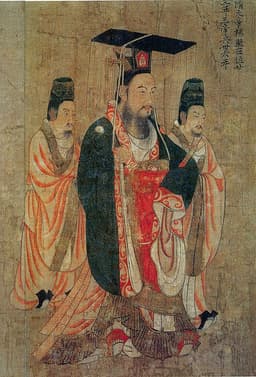
Emperor Wen of Sui
Emperor · Medieval
80.3Total

Ruhollah Khomeini
Politician · Modern
75.1Total
Basic Information
Born
541
1902
Died
604
1989
Era
Medieval
Modern
Nationality
China
Iran
Occupation
Emperor
Politician
Civilization
Eastern
Middle Eastern
Score Comparison
Military (10%)
76.0
41.6
Political (20%)
75.0
65.0
Influence (20%)
88.0
85.0
Legacy (20%)
80.0
90.0
Leadership (15%)
80.0
80.0
Strategy (15%)
75.0
54.3
TOTAL
80.3
75.1
Emperor Wen of Sui — Complete Timeline
581 AD
Establishment of the Three Departments and Six Ministries SystemReform◆ Major
Emperor Wen established a centralized bureaucratic system with three departments (Secretariat, Chancellery, and Department of State Affairs) and six ministries. This system became the foundation of Chinese government administration for centuries.
Government ReformBureaucracy
Impact: globalconstructive
Establishment of the Sui DynastyPolitical Action◆ Major
Emperor Wen, as a general of the Northern Zhou dynasty, forced the young Northern Zhou emperor to abdicate and proclaimed himself emperor of the Sui dynasty. This marked the beginning of the Sui dynasty, which would go on to reunify China.
Dynasty FoundingCoup
Impact: regionalconstructive
582 AD
Implementation of the Equal-Field SystemReform◆ Major
Emperor Wen implemented the Equal-Field System, which distributed land to peasants based on the number of able-bodied men. This reform increased agricultural productivity, stabilized tax revenues, and reduced the power of large landowners.
Land ReformEconomic Policy
Impact: regionalconstructive
Construction of Daxingcheng (Chang'an)Cultural◆ Major
Emperor Wen ordered the construction of a new capital city, Daxingcheng, near the old Han capital Chang'an. This city, later known as Chang'an, became a model for urban planning and served as the capital of the Sui and Tang dynasties.
Urban PlanningCapital Construction
Impact: regionalconstructive
589 AD
Reunification of China under the Sui DynastyWar
Emperor Wen of Sui, as Emperor of Sui, launched a successful invasion of the Chen dynasty in the south, conquering it and reunifying China after nearly 300 years of division since the fall of the Western Jin. This ended the Northern and Southern Dynasties period.
UnificationConquest
Impact: globalconstructive
Ruhollah Khomeini — Complete Timeline
1964 AD
Exile to Iraq and FrancePolitical Action◆ Major
Khomeini was exiled from Iran after criticizing the Shah's White Revolution and granting of diplomatic immunity to US personnel. He settled in Najaf, Iraq, and later in France, where he continued to organize opposition to the Shah.
ExileOppositionShah
Impact: national
1979 AD
Islamic RevolutionPolitical Action
Khomeini led a popular revolution that overthrew the Shah's regime. He returned to Iran in February 1979 and established an Islamic Republic based on his doctrine of Velayat-e Faqih (Guardianship of the Jurist), with himself as Supreme Leader.
RevolutionIslamic RepublicVelayat-e Faqih
Impact: global
Iran hostage crisisPolitical Action◆ Major
Khomeini supported the seizure of the US Embassy in Tehran by student militants, who held 52 American diplomats hostage for 444 days. The crisis deepened the rift with the US, led to economic sanctions, and consolidated Khomeini's power.
Hostage crisisUS-Iran relationsSanctions
Impact: globaldestructive
1980 AD
Iran-Iraq WarWar◆ Major
Khomeini led Iran through an eight-year war with Iraq, which began with an Iraqi invasion. The war resulted in hundreds of thousands of casualties and massive economic destruction, ending in a stalemate. Khomeini accepted a UN ceasefire in 1988.
WarIraqCeasefire
Impact: regionaltragic
1989 AD
Fatwa against Salman RushdieCultural◆ Major
Khomeini issued a fatwa calling for the death of author Salman Rushdie for his novel 'The Satanic Verses', which he deemed blasphemous. The fatwa led to international controversy, diplomatic tensions, and attacks on Rushdie's translators.
FatwaBlasphemyInternational controversy
Impact: globaldestructive
Expert Analysis
Origins
Emperor Wen of Sui, born Yang Jian in 541 AD, emerged from the chaotic Northern and Southern Dynasties period. As a member of the powerful Guanlong aristocracy, he served as a general under the Northern Zhou dynasty. His daughter married the emperor, and after the emperor's death, Yang Jian seized power through a coup, establishing the Sui dynasty in 581 AD. His background was rooted in military and bureaucratic expertise, with a strong Confucian education that emphasized centralized governance.
Ruhollah Khomeini, born in 1902 in Khomeyn, Iran, came from a family of Shia clerics. He studied Islamic jurisprudence and philosophy, becoming a prominent ayatollah. His early life was marked by opposition to the Pahlavi dynasty's secularization and Western influence. Exiled in 1964 for his criticism of the Shah's policies, he continued his activism from Iraq and later France, using cassette tapes to spread his revolutionary message.
Rise to Power
Emperor Wen's rise was swift and strategic. He skillfully maneuvered through court politics, building alliances and eliminating rivals. By 581, he forced the Northern Zhou emperor to abdicate, proclaiming the Sui dynasty. He then launched campaigns against the Chen dynasty in the south, achieving reunification of China by 589 AD after centuries of division. His military campaigns were complemented by diplomatic overtures and administrative reforms that stabilized his rule.
Khomeini's rise was gradual and ideological. During his exile, he became the symbolic leader of opposition to the Shah. The Islamic Revolution of 1979, fueled by widespread discontent, led to the overthrow of the monarchy. Khomeini returned to Iran in February 1979 and was appointed Supreme Leader by the Revolutionary Council. His authority was solidified through a referendum that established the Islamic Republic, with Khomeini as its ultimate authority.
Leadership & Governance
Emperor Wen implemented sweeping reforms. He established the Three Departments and Six Ministries system, a centralized bureaucracy that became a model for subsequent dynasties. The Equal-Field System redistributed land to peasants, increasing agricultural productivity and tax revenue. He also built a new capital, Daxingcheng (later Chang'an), and standardized laws and currency. His governance emphasized efficiency and meritocracy, reducing the power of aristocratic families.
Khomeini's governance was theocratic. He introduced the concept of Velayat-e Faqih (Guardianship of the Islamic Jurist), placing ultimate authority in the hands of a religious leader. His regime suppressed political dissent, enforced Islamic law, and nationalized industries. The Iran hostage crisis (1979-1981) and the Iran-Iraq War (1980-1988) defined his leadership, as he used these conflicts to consolidate power and eliminate rivals. His governance was marked by ideological rigidity and a focus on exporting the revolution.
Triumph & Tragedy
Emperor Wen's greatest triumph was the reunification of China, ending centuries of war. His administrative and economic reforms laid the groundwork for the prosperous Tang dynasty. However, his reign ended in tragedy: he was allegedly murdered by his son, Yang Guang (Emperor Yang), who later led the Sui to collapse through reckless policies. Wen's achievements were overshadowed by his son's failures.
Khomeini's triumph was the successful Islamic Revolution, which transformed Iran into a theocracy. He survived the Iran-Iraq War and maintained power despite internal and external challenges. However, his legacy is stained by human rights abuses, suppression of dissent, and the fatwa against Salman Rushdie, which isolated Iran internationally. The war resulted in hundreds of thousands of casualties, and his policies left Iran economically strained.
Character & Destiny
Emperor Wen was pragmatic, disciplined, and suspicious of powerful nobles. He was known for his frugality and work ethic, personally reviewing state documents. His destiny was to be a founder whose dynasty was cut short by his successor's misrule. He is often compared to Qin Shihuang, another unifier whose dynasty fell quickly.
Khomeini was charismatic, uncompromising, and deeply religious. He saw himself as a divine instrument, which made him resistant to compromise. His destiny was to create a lasting theocratic state, but his rigid ideology also sowed seeds of future conflict. He remains a polarizing figure, revered by supporters and reviled by critics.
Legacy
Emperor Wen's legacy is monumental. His reunification and reforms enabled the golden age of the Tang dynasty. The Three Departments and Six Ministries system influenced Chinese governance for over a millennium. He is remembered as a capable administrator and unifier, though often overshadowed by the Tang. His score (76) reflects his foundational but brief dynasty.
Khomeini's legacy is enduring but controversial. He established the Islamic Republic, which continues to influence Iran and the Middle East. The Velayat-e Faqih system remains central to Iran's governance. However, his suppression of freedoms and hostility toward the West have made him a divisive figure. His score (42) reflects the mixed impact of his rule.
Conclusion
Emperor Wen of Sui and Ruhollah Khomeini both reshaped their nations through transformative leadership. Wen reunified China and built enduring institutions, while Khomeini created a theocratic state that persists today. Wen's achievements were more constructive and lasting in terms of governance systems, while Khomeini's legacy is defined by ideological revolution and conflict. Based on historical impact and institutional legacy, Emperor Wen emerges as the more effective leader, with a score of 76 compared to Khomeini's 42. Wen's contributions to Chinese civilization outweigh Khomeini's narrower, more divisive influence.
| Aspect | Emperor Wen of Sui | Ruhollah Khomeini |
|--------|-------------------|------------------|
| M (Military) | 76 | 42 |
| P (Political) | 75 | 65 |
| I (Influence) | 88 | 85 |
| L (Longevity) | 80 | 90 |
| D (Durability) | 80 | 80 |
| S (Stability) | 75 | 54 |
| T (Total) | 80 | 75 |
| **Overall** | **79.1** | **73.9** |
Rankings
🥇
Emperor Wen of SuiLeader
Mil: 76.0Pol: 75.0Inf: 88.0
80.3
🥈
Ruhollah Khomeini
Mil: 41.6Pol: 65.0Inf: 85.0
75.1
+5.2 behind
How This Comparison Works
Algorithm
Each figure is scored on 6 dimensions (0—100 scale) based on structured historical data: Military (10%), Political (20%), Influence (20%), Legacy (20%), Leadership (15%), Strategy (15%). The weighted total produces the final ranking.
Data Sources
Scores are computed from structured sub-indicators in the database. Scale factors adjust for era (Ancient ×0.85, Modern ×1.0) and civilization size (Eastern ×1.05, Other ×0.80) to account for differences in population and military scale.
Maximum 3 Figures
Comparisons are limited to 2—3 figures to ensure readability and statistical meaningfulness.
Error Margins
±5 points per dimension — Sub-scores are derived from historical records with inherent uncertainty. Two figures within 5 points on a dimension should be considered roughly equivalent in that area.
Total Score Accuracy
±3 points overall — The weighted combination of 6 dimensions produces a total score with approximately ±3 points of uncertainty. Differences of less than 3 points are not statistically significant— the figures are effectively tied.
Known Limitations
- Historical records are incomplete and uneven across civilizations
- Figures from oral-tradition societies may be underrepresented
- Occupation labels can misclassify multi-role figures
- Scores measure capability and impact, not moral character
- Quantitative scoring is a comparison tool, not absolute truth
Capability Radar
Military (10%) — Battles & Warfare
Battles
75
10
Win Rate
80
10
Expansion
85
10
Political (20%) — Governance & Reform
Reform
95
90
Diplomacy
85
75
Economy
90
40
Influence (20%) — Cultural & Global Reach
Cultural
70
85
Global
65
85
Legacy (20%) — Historical Impact
Historical
85
90
Longevity
70
80
Leadership (15%) — Power & Stability
Tenure
80
85
Stability
75
50
Strategy (15%) — Tactics & Innovation
Strategy
85
15
Tactics
70
10
Reform
90
20
Similar Comparisons
Comments & Discussion
No comments yet. Be the first to share your thoughts!