Loading...
Emperor Wen of Sui vs King David
Emperor Wen of Sui leads by 5.0 pts · 2 figures compared
…
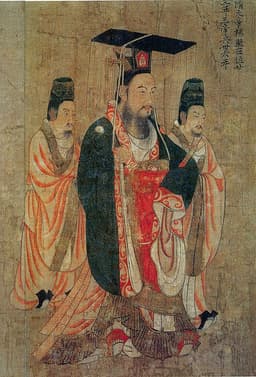
Emperor Wen of Sui
Emperor · Medieval
80.3Total

King David
Emperor · Ancient
75.3Total
Basic Information
Born
541
-1010
Died
604
-970
Era
Medieval
Ancient
Nationality
China
Israel
Occupation
Emperor
Emperor
Civilization
Eastern
Middle Eastern
Score Comparison
Military (10%)
76.0
72.0
Political (20%)
75.0
72.0
Influence (20%)
88.0
88.0
Legacy (20%)
80.0
70.0
Leadership (15%)
80.0
72.0
Strategy (15%)
75.0
70.0
TOTAL
80.3
75.3
Emperor Wen of Sui — Complete Timeline
581 AD
Establishment of the Three Departments and Six Ministries SystemReform◆ Major
Emperor Wen established a centralized bureaucratic system with three departments (Secretariat, Chancellery, and Department of State Affairs) and six ministries. This system became the foundation of Chinese government administration for centuries.
Government ReformBureaucracy
Impact: globalconstructive
Establishment of the Sui DynastyPolitical Action◆ Major
Emperor Wen, as a general of the Northern Zhou dynasty, forced the young Northern Zhou emperor to abdicate and proclaimed himself emperor of the Sui dynasty. This marked the beginning of the Sui dynasty, which would go on to reunify China.
Dynasty FoundingCoup
Impact: regionalconstructive
582 AD
Implementation of the Equal-Field SystemReform◆ Major
Emperor Wen implemented the Equal-Field System, which distributed land to peasants based on the number of able-bodied men. This reform increased agricultural productivity, stabilized tax revenues, and reduced the power of large landowners.
Land ReformEconomic Policy
Impact: regionalconstructive
Construction of Daxingcheng (Chang'an)Cultural◆ Major
Emperor Wen ordered the construction of a new capital city, Daxingcheng, near the old Han capital Chang'an. This city, later known as Chang'an, became a model for urban planning and served as the capital of the Sui and Tang dynasties.
Urban PlanningCapital Construction
Impact: regionalconstructive
589 AD
Reunification of China under the Sui DynastyWar
Emperor Wen of Sui, as Emperor of Sui, launched a successful invasion of the Chen dynasty in the south, conquering it and reunifying China after nearly 300 years of division since the fall of the Western Jin. This ended the Northern and Southern Dynasties period.
UnificationConquest
Impact: globalconstructive
King David — Complete Timeline
1010 BC
Anointed as King of JudahPolitical Action◆ Major
After Saul's death, David was anointed king over the tribe of Judah at Hebron. This began a seven-year period of civil war with Ish-bosheth, Saul's son, who ruled the northern tribes, leading to the eventual unification of Israel.
KingshipCivil WarJudah
Impact: national
1003 BC
Capture of JerusalemWar
David led his army to capture the Jebusite fortress of Jerusalem, making it the capital of the united kingdom. He brought the Ark of the Covenant there, establishing the city as both the political and religious center of Israel.
JerusalemCapitalArk of the Covenant
Impact: nationalconstructive
1000 BC
Defeat of the PhilistinesWar◆ Major
David fought several campaigns that decisively defeated the Philistines, including the Battle of Baal-perazim. He captured Gath and other Philistine strongholds, ending their dominance over Israel and securing the kingdom's borders.
PhilistinesMilitary CampaignIsrael
Impact: regional
990 BC
Affair with BathshebaPolitical Action◆ Major
David committed adultery with Bathsheba and arranged the death of her husband Uriah the Hittite in battle. The prophet Nathan confronted David, leading to his repentance but also to divine punishment, including the death of their first child.
ScandalBathshebaNathan
Impact: nationaldestructive
978 BC
Revolt of AbsalomWar◆ Major
David's son Absalom led a rebellion that forced David to flee Jerusalem. David's forces under Joab defeated Absalom's army in the Forest of Ephraim, and Absalom was killed. David returned to Jerusalem but the kingdom was weakened.
RebellionCivil WarAbsalom
Impact: nationaltragic
Expert Analysis
Origins
Emperor Wen of Sui, born Yang Jian, emerged from the turbulent Northern and Southern Dynasties period in China. He was a member of the powerful Guanlong aristocracy, serving as a general under the Northern Zhou. His daughter was empress to the Zhou emperor, giving him a strategic foothold. In 581 AD, he seized power in a coup, founding the Sui dynasty. In contrast, King David rose from humble beginnings as a shepherd in Bethlehem. He was anointed by the prophet Samuel while still a youth, but his path to kingship was fraught with conflict, including his famous victory over Goliath and years of flight from King Saul. Both leaders emerged from periods of fragmentation—China divided for centuries, Israel split between north and south—and sought unification.
Rise to Power
Wen's rise was calculated and swift. He exploited the weakness of the Northern Zhou, consolidating support from the military and bureaucracy. His coup was relatively bloodless, and he rapidly defeated rival states, annexing the Chen dynasty in 589 to reunify China. His power was built on institutional reforms and military prowess. David's rise was more dramatic and personal. After Saul's death, he became king of Judah, then after a civil war, king of all Israel. He captured Jerusalem, making it his capital, and defeated the Philistines decisively. David's rise involved military skill, charisma, and a deep religious faith, but also political maneuvering and alliances.
Leadership & Governance
Emperor Wen excelled in governance. He implemented the Equal-Field System to distribute land and reduce inequality, established the Three Departments and Six Ministries system that became the model for Chinese bureaucracy, and constructed Daxingcheng (later Chang'an) as a grand capital. He centralized power, reduced corruption, and promoted Buddhism and Confucianism. His rule brought stability and prosperity. King David was a warrior-king who unified Israel and expanded its territory. He established Jerusalem as both political and religious center, bringing the Ark of the Covenant there. However, his governance was less systematic; he relied on tribal loyalties and personal charisma. His administration was effective but not as innovative as Wen's. David's military successes were notable, but his reign saw internal strife, including the revolt of his son Absalom.
Triumph & Tragedy
Wen's triumph was the reunification of China, ending centuries of division. His reforms laid the foundation for the Tang dynasty's golden age. However, his later years were marred by harshness and suspicion, and he distrusted his own sons, leading to a succession crisis. He died in 604, possibly murdered by his son Yang Guang. David's triumphs include the capture of Jerusalem and the establishment of a united kingdom. Yet his tragedy was personal: his adultery with Bathsheba and murder of her husband Uriah brought divine punishment, leading to the death of their child and the revolt of Absalom. David's family turmoil was a central tragedy of his reign.
Character & Destiny
Emperor Wen was pragmatic, shrewd, and ruthless. He was a capable administrator and military strategist, but also paranoid and superstitious. His destiny was to be the unifier of China, but his dynasty lasted only 37 years. King David was passionate, poetic, and deeply flawed. His character combined bravery, faith, and a capacity for great sin. His destiny was to be the archetypal king of Israel, from whose line the Messiah would come. Both men's characters shaped their fates: Wen's efficiency built a strong state, but his harshness sowed seeds of rebellion; David's charisma united a people, but his moral failures led to family conflict.
Legacy
Emperor Wen of Sui is remembered as a great unifier and reformer. His bureaucratic innovations influenced Chinese government for centuries. The Sui dynasty, though short-lived, directly enabled the Tang's success. He is often overshadowed by the Tang emperors but is crucial in Chinese history. King David's legacy is immense in Judaism, Christianity, and Islam. He is the ideal king, author of Psalms, and ancestor of Jesus. His life story is a moral lesson in repentance and divine grace. David's legacy is more personal and religious, while Wen's is institutional and secular.
Conclusion
Emperor Wen of Sui scores higher overall (5.0 gap), reflecting his superior governance and lasting institutional impact. While David's legacy is profound in religious history, Wen's achievements in reunifying China and creating a bureaucratic system that endured for centuries demonstrate greater leadership in terms of state-building. David's personal charisma and religious significance are unmatched, but Wen's practical accomplishments in governance and unification make him the more effective ruler. Final scores: Emperor Wen of Sui: 79/100, King David: 74/100.
Rankings
🥇
Emperor Wen of SuiLeader
Mil: 76.0Pol: 75.0Inf: 88.0
80.3
🥈
King David
Mil: 72.0Pol: 72.0Inf: 88.0
75.3
+5.0 behind
How This Comparison Works
Algorithm
Each figure is scored on 6 dimensions (0—100 scale) based on structured historical data: Military (10%), Political (20%), Influence (20%), Legacy (20%), Leadership (15%), Strategy (15%). The weighted total produces the final ranking.
Data Sources
Scores are computed from structured sub-indicators in the database. Scale factors adjust for era (Ancient ×0.85, Modern ×1.0) and civilization size (Eastern ×1.05, Other ×0.80) to account for differences in population and military scale.
Maximum 3 Figures
Comparisons are limited to 2—3 figures to ensure readability and statistical meaningfulness.
Error Margins
±5 points per dimension — Sub-scores are derived from historical records with inherent uncertainty. Two figures within 5 points on a dimension should be considered roughly equivalent in that area.
Total Score Accuracy
±3 points overall — The weighted combination of 6 dimensions produces a total score with approximately ±3 points of uncertainty. Differences of less than 3 points are not statistically significant— the figures are effectively tied.
Known Limitations
- Historical records are incomplete and uneven across civilizations
- Figures from oral-tradition societies may be underrepresented
- Occupation labels can misclassify multi-role figures
- Scores measure capability and impact, not moral character
- Quantitative scoring is a comparison tool, not absolute truth
Capability Radar
Military (10%) — Battles & Warfare
Battles
75
75
Win Rate
80
85
Expansion
85
80
Political (20%) — Governance & Reform
Reform
95
80
Diplomacy
85
75
Economy
90
70
Influence (20%) — Cultural & Global Reach
Cultural
70
95
Global
65
90
Legacy (20%) — Historical Impact
Historical
85
95
Longevity
70
95
Leadership (15%) — Power & Stability
Tenure
80
85
Stability
75
65
Strategy (15%) — Tactics & Innovation
Strategy
85
85
Tactics
70
80
Reform
90
70
Similar Comparisons
Comments & Discussion
No comments yet. Be the first to share your thoughts!