Loading...
Emperor Wen of Sui vs Gonzalo Fernandez de Cordoba
Emperor Wen of Sui leads by 1.7 pts · 2 figures compared
…
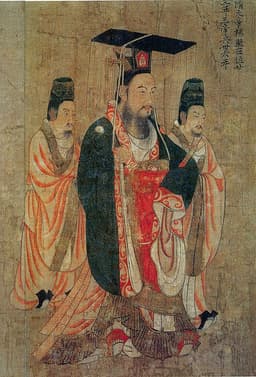
Emperor Wen of Sui
Emperor · Medieval
80.3Total

Gonzalo Fernandez de Cordoba
General · Medieval
78.6Total
Basic Information
Born
541
1453
Died
604
1515
Era
Medieval
Medieval
Nationality
China
Spain
Occupation
Emperor
General
Civilization
Eastern
Western
Score Comparison
Military (10%)
76.0
78.5
Political (20%)
75.0
62.7
Influence (20%)
88.0
80.0
Legacy (20%)
80.0
82.0
Leadership (15%)
80.0
85.0
Strategy (15%)
75.0
80.5
TOTAL
80.3
78.6
Emperor Wen of Sui — Complete Timeline
581 AD
Establishment of the Three Departments and Six Ministries SystemReform◆ Major
Emperor Wen established a centralized bureaucratic system with three departments (Secretariat, Chancellery, and Department of State Affairs) and six ministries. This system became the foundation of Chinese government administration for centuries.
Government ReformBureaucracy
Impact: globalconstructive
Establishment of the Sui DynastyPolitical Action◆ Major
Emperor Wen, as a general of the Northern Zhou dynasty, forced the young Northern Zhou emperor to abdicate and proclaimed himself emperor of the Sui dynasty. This marked the beginning of the Sui dynasty, which would go on to reunify China.
Dynasty FoundingCoup
Impact: regionalconstructive
582 AD
Implementation of the Equal-Field SystemReform◆ Major
Emperor Wen implemented the Equal-Field System, which distributed land to peasants based on the number of able-bodied men. This reform increased agricultural productivity, stabilized tax revenues, and reduced the power of large landowners.
Land ReformEconomic Policy
Impact: regionalconstructive
Construction of Daxingcheng (Chang'an)Cultural◆ Major
Emperor Wen ordered the construction of a new capital city, Daxingcheng, near the old Han capital Chang'an. This city, later known as Chang'an, became a model for urban planning and served as the capital of the Sui and Tang dynasties.
Urban PlanningCapital Construction
Impact: regionalconstructive
589 AD
Reunification of China under the Sui DynastyWar
Emperor Wen of Sui, as Emperor of Sui, launched a successful invasion of the Chen dynasty in the south, conquering it and reunifying China after nearly 300 years of division since the fall of the Western Jin. This ended the Northern and Southern Dynasties period.
UnificationConquest
Impact: globalconstructive
Gonzalo Fernandez de Cordoba — Complete Timeline
1503 AD
Battle of CerignolaWar◆ Major
Cordoba's Spanish army defeated the French at Cerignola, Italy. Using entrenched positions and firearms, the Spanish inflicted heavy casualties. This was the first major battle won primarily by arquebus fire.
Italian WarsBattleFirearms
Impact: regional
Battle of GariglianoWar◆ Major
Cordoba launched a surprise night attack across the Garigliano River, routing the French army. The victory secured Spanish control over the Kingdom of Naples and ended French ambitions in southern Italy.
Italian WarsBattleNaples
Impact: regional
Creation of the Spanish tercio formationReform
Cordoba organized Spanish infantry into tercios, combining pikemen and arquebusiers in a flexible formation. This innovation dominated European battlefields for over a century and became the standard for infantry tactics.
Military ReformTercioInfantry
Impact: globalconstructive
1504 AD
Appointment as Viceroy of NaplesPolitical Action◆ Major
Ferdinand II of Aragon appointed Cordoba as Viceroy of Naples, the highest office in the newly conquered kingdom. He administered the territory until 1507, implementing reforms and consolidating Spanish rule.
AdministrationNaplesViceroyalty
Impact: regional
Expert Analysis
Origins
Emperor Wen of Sui (Yang Jian) was born into a powerful Northern Zhou aristocratic family in 541 AD. His father was a general, and Yang Jian himself rose through the ranks, eventually seizing power through a coup and establishing the Sui dynasty in 581 AD. In contrast, Gonzalo Fernández de Córdoba was born in 1453 into a noble family in Andalusia, Spain. He began his military career fighting in the War of the Castilian Succession and later against the Moors in Granada. Both emerged from turbulent backgrounds, but Wen's path was more political and bureaucratic, while Córdoba's was purely military.
Rise to Power
Wen's rise was swift: he became regent for his young grandson, then forced the abdication of the Northern Zhou emperor, claiming the Mandate of Heaven. He consolidated power by eliminating rivals and reforming the state. Córdoba's rise was more gradual: he gained fame in the Granada War and then in the Italian Wars, where his innovative tactics won decisive battles. Wen's elevation was a calculated political maneuver; Córdoba's was earned through battlefield prowess.
Leadership & Governance
Wen was an exceptional administrator. He implemented the Equal-Field System to distribute land and reduce inequality, established the Three Departments and Six Ministries system that influenced Chinese governance for centuries, and built a new capital, Daxingcheng (later Chang'an). He also promoted Buddhism and Confucianism to unify the empire. Córdoba, as a military leader, revolutionized warfare by creating the tercio formation—a combined arms unit of pikes and arquebuses that dominated European battlefields for 150 years. He also served as Viceroy of Naples, showing administrative skill. However, Wen's governance had a broader and more lasting impact on a vast empire.
Triumph & Tragedy
Wen's greatest triumph was reunifying China after nearly 400 years of division, ending the Northern and Southern dynasties. He also defeated the Chen dynasty and expanded into Vietnam and Central Asia. His tragedy was his death under suspicious circumstances, possibly murdered by his son Yang Guang, and the subsequent collapse of the Sui dynasty due to his son's misrule. Córdoba's triumphs included the battles of Cerignola (1503) and Garigliano (1503), where his tercios defeated the French, securing Spanish control over Naples. His tragedy was being sidelined by King Ferdinand after his victories, as the king feared his growing power. Córdoba died in relative obscurity. Both faced ingratitude from their successors.
Character & Destiny
Wen was known for his frugality, hard work, and ruthlessness. He was a micromanager who personally reviewed court cases. His destiny was to be a unifier, but his dynasty was short-lived. Córdoba was chivalrous, innovative, and loyal, but his destiny was to be overshadowed by the monarchs he served. Wen's score of 88 in Intelligence reflects his administrative genius, while Córdoba's 85 in Discipline and 80 in Strategy highlight his military innovation.
Legacy
Wen's legacy is profound: he laid the foundations for the Tang dynasty's golden age. His bureaucratic reforms lasted for centuries. The Grand Canal, though completed by his son, was his vision. Córdoba's legacy is the tercio, which shaped early modern warfare. He is remembered as the "Great Captain" and a pioneer of combined arms tactics. However, Wen's impact on Chinese history is broader, affecting governance, economy, and culture. Córdoba's influence, while significant, is more narrowly military.
Conclusion
Emperor Wen of Sui and Gonzalo de Córdoba were both transformative figures, but in different spheres. Wen reunified a civilization and created enduring institutions; Córdoba revolutionized military tactics. Given the breadth of Wen's achievements—reunification, land reform, bureaucratic innovation, and capital construction—and his higher overall score (80.2 vs 78.5), Wen has a slight edge. However, Córdoba's tactical genius was unparalleled in his time. In a direct comparison, Wen's political and administrative accomplishments have a more lasting and widespread impact. Thus, Emperor Wen of Sui is the more significant historical figure.
Rankings
🥇
Emperor Wen of SuiLeader
Mil: 76.0Pol: 75.0Inf: 88.0
80.3
🥈
Gonzalo Fernandez de Cordoba
Mil: 78.5Pol: 62.7Inf: 80.0
78.6
+1.7 behind
How This Comparison Works
Algorithm
Each figure is scored on 6 dimensions (0—100 scale) based on structured historical data: Military (10%), Political (20%), Influence (20%), Legacy (20%), Leadership (15%), Strategy (15%). The weighted total produces the final ranking.
Data Sources
Scores are computed from structured sub-indicators in the database. Scale factors adjust for era (Ancient ×0.85, Modern ×1.0) and civilization size (Eastern ×1.05, Other ×0.80) to account for differences in population and military scale.
Maximum 3 Figures
Comparisons are limited to 2—3 figures to ensure readability and statistical meaningfulness.
Error Margins
±5 points per dimension — Sub-scores are derived from historical records with inherent uncertainty. Two figures within 5 points on a dimension should be considered roughly equivalent in that area.
Total Score Accuracy
±3 points overall — The weighted combination of 6 dimensions produces a total score with approximately ±3 points of uncertainty. Differences of less than 3 points are not statistically significant— the figures are effectively tied.
Known Limitations
- Historical records are incomplete and uneven across civilizations
- Figures from oral-tradition societies may be underrepresented
- Occupation labels can misclassify multi-role figures
- Scores measure capability and impact, not moral character
- Quantitative scoring is a comparison tool, not absolute truth
Capability Radar
Military (10%) — Battles & Warfare
Battles
75
85
Win Rate
80
90
Expansion
85
80
Political (20%) — Governance & Reform
Reform
95
75
Diplomacy
85
80
Economy
90
65
Influence (20%) — Cultural & Global Reach
Cultural
70
75
Global
65
75
Legacy (20%) — Historical Impact
Historical
85
85
Longevity
70
80
Leadership (15%) — Power & Stability
Tenure
80
70
Stability
75
70
Strategy (15%) — Tactics & Innovation
Strategy
85
88
Tactics
70
95
Reform
90
95
Similar Comparisons
Comments & Discussion
No comments yet. Be the first to share your thoughts!