Loading...
This comparison has not been analyzed yet.
One-time AI generation (~1 minute). Scores and timeline are already available below.
Emir of Kano vs Kamehameha V
Emir of Kano leads by 2.6 pts · 2 figures compared
…

Emir of Kano
Emperor · Modern
47.6Total
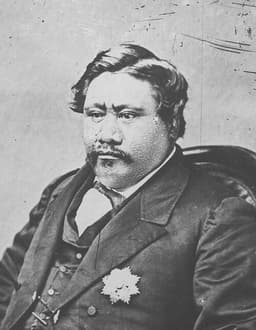
Kamehameha V
Emperor · Modern
45.0Total
Basic Information
Born
1800
1830
Died
1860
1872
Era
Modern
Modern
Nationality
Nigeria
Hawaii
Occupation
Emperor
Emperor
Civilization
Other
Other
Score Comparison
Military (10%)
30.0
11.3
Political (20%)
68.0
46.6
Influence (20%)
52.5
50.2
Legacy (20%)
43.3
42.5
Leadership (15%)
40.0
74.0
Strategy (15%)
45.0
26.5
TOTAL
47.6
45.0
Emir of Kano — Complete Timeline
1820 AD
Ascended as Emir of KanoPolitical Action◆ Major
The Emir became the ruler of Kano, a major commercial and political center in the Sokoto Caliphate. His reign oversaw Kano's peak as a trans-Saharan trade hub, exporting textiles, leather, and agricultural goods.
Kano EmirateCoronationSokoto Caliphate
Impact: regional
1830 AD
Expanded Kano's Trade NetworksReform◆ Major
The Emir strengthened Kano's commercial links with North Africa and the Sahel, increasing trade in kola nuts, salt, and slaves. This economic expansion made Kano one of the wealthiest cities in West Africa during the 19th century.
TradeEconomyTrans-Saharan
Impact: regionalconstructive
1840 AD
Implemented Islamic Legal ReformsReform
The Emir enforced Sharia law across Kano, establishing Islamic courts and schools. These reforms consolidated the Sokoto Caliphate's religious authority and standardized legal practices in the emirate.
Islamic LawLegal ReformEducation
Impact: regional
Kamehameha V — Complete Timeline
1863 AD
Ascended to the Throne as Kamehameha VPolitical Action◆ Major
Lot Kapuāiwa became King Kamehameha V after the death of his brother Kamehameha IV. He was the last monarch of the Kamehameha dynasty.
Impact: national
1864 AD
Promulgated the 1864 ConstitutionReform◆ Major
Kamehameha V abrogated the 1852 constitution and promulgated a new one that increased royal power. The 1864 constitution abolished the office of kuhina nui (premier), gave the king veto power, and restricted suffrage to property owners.
Impact: national
1865 AD
Oversaw Economic Growth and Public WorksReform
Kamehameha V promoted economic development, including the expansion of the sugar industry, construction of roads and harbors, and the establishment of the Hawaiian Board of Health. His reign saw increased foreign investment and trade.
Impact: nationalconstructive
1867 AD
Refused to Sign the Reciprocity TreatyPolitical Action◆ Major
Kamehameha V refused to sign a reciprocity treaty with the United States that would have reduced tariffs on Hawaiian sugar. He believed the treaty would compromise Hawaiian sovereignty and lead to American domination.
Impact: national
1872 AD
Died Without an HeirOther◆ Major
Kamehameha V died without naming an heir, ending the Kamehameha dynasty. His death triggered a succession crisis that led to the election of Lunalilo as the next king.
Impact: nationaltragic
This comparison has not been analyzed yet.
One-time AI generation (~1 minute). Scores and timeline are already available below.
Rankings
🥇
Emir of KanoLeader
Mil: 30.0Pol: 68.0Inf: 52.5
47.6
🥈
Kamehameha V
Mil: 11.3Pol: 46.6Inf: 50.2
45.0
+2.6 behind
How This Comparison Works
Algorithm
Each figure is scored on 6 dimensions (0—100 scale) based on structured historical data: Military (10%), Political (20%), Influence (20%), Legacy (20%), Leadership (15%), Strategy (15%). The weighted total produces the final ranking.
Data Sources
Scores are computed from structured sub-indicators in the database. Scale factors adjust for era (Ancient ×0.85, Modern ×1.0) and civilization size (Eastern ×1.05, Other ×0.80) to account for differences in population and military scale.
Maximum 3 Figures
Comparisons are limited to 2—3 figures to ensure readability and statistical meaningfulness.
Error Margins
±5 points per dimension — Sub-scores are derived from historical records with inherent uncertainty. Two figures within 5 points on a dimension should be considered roughly equivalent in that area.
Total Score Accuracy
±3 points overall — The weighted combination of 6 dimensions produces a total score with approximately ±3 points of uncertainty. Differences of less than 3 points are not statistically significant— the figures are effectively tied.
Known Limitations
- Historical records are incomplete and uneven across civilizations
- Figures from oral-tradition societies may be underrepresented
- Occupation labels can misclassify multi-role figures
- Scores measure capability and impact, not moral character
- Quantitative scoring is a comparison tool, not absolute truth
Capability Radar
Military (10%) — Battles & Warfare
Battles
40
4
Win Rate
45
9
Expansion
45
11
Political (20%) — Governance & Reform
Reform
40
20
Diplomacy
45
30
Economy
50
35
Influence (20%) — Cultural & Global Reach
Cultural
35
30
Global
20
10
Legacy (20%) — Historical Impact
Historical
40
35
Longevity
30
20
Leadership (15%) — Power & Stability
Tenure
50
40
Stability
45
25
Strategy (15%) — Tactics & Innovation
Strategy
40
15
Tactics
35
15
Reform
30
21
Similar Comparisons
Comments & Discussion
No comments yet. Be the first to share your thoughts!