Loading...
Elizabeth I vs Napoleon Bonaparte
Napoleon Bonaparte leads by 5.2 pts · 2 figures compared
…
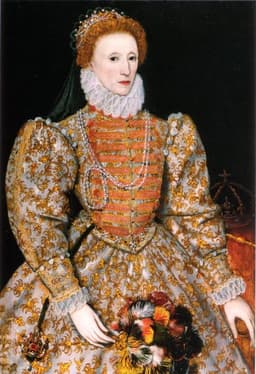
Elizabeth I
Politician · Modern
65.7Total

Napoleon Bonaparte
General · Modern
70.9Total
Basic Information
Born
1533
1769
Died
1603
1821
Era
Modern
Modern
Nationality
England
France
Occupation
Politician
General
Civilization
Western
Western
Score Comparison
Military (10%)
45.0
94.0
Political (20%)
78.0
72.0
Influence (20%)
65.0
40.0
Legacy (20%)
68.0
80.0
Leadership (15%)
75.0
78.0
Strategy (15%)
50.0
90.0
TOTAL
65.7
70.9
Elizabeth I — Complete Timeline
1559 AD
Act of Supremacy 1559Political Action◆ Major
Elizabeth I re-established the Church of England's independence from Rome, declaring herself Supreme Governor. This act, part of the Elizabethan Religious Settlement, restored Protestantism while maintaining some Catholic traditions, creating a via media that aimed to unify the nation.
Religious SettlementProtestantismChurch of England
Impact: nationalconstructive
1587 AD
Execution of Mary, Queen of ScotsPolitical Action◆ Major
After years of imprisonment, Elizabeth I signed the death warrant for Mary, Queen of Scots, who had been implicated in the Babington Plot to assassinate Elizabeth and claim the English throne. Mary's execution removed a major Catholic rival and solidified Elizabeth's position.
ExecutionCatholic RivalPlot
Impact: nationaltragic
1588 AD
Defeat of the Spanish ArmadaWar
The English navy under Lord Howard and Sir Francis Drake defeated the Spanish Armada, a massive invasion fleet sent by Philip II. Storms and English fireships scattered the Spanish fleet, preventing the invasion and establishing England as a major naval power.
Naval BattleSpainProtestantism
Impact: globalconstructive
1600 AD
Chartering of the East India CompanyPolitical Action◆ Major
Elizabeth I granted a royal charter to the East India Company, giving it a monopoly on English trade with Asia. This company would become a powerful instrument of British imperialism, eventually controlling large parts of India and shaping global trade.
TradeColonialismCharter
Impact: globalconstructive
1601 AD
Golden SpeechPolitical Action
In her final address to Parliament, Elizabeth I delivered the 'Golden Speech,' expressing her love for her subjects and her dedication to the realm. She addressed grievances over monopolies, promising reform, and cemented her image as a beloved monarch devoted to her people.
SpeechParliamentMonarchy
Impact: nationalconstructive
Napoleon Bonaparte — Complete Timeline
1799 AD
Coup of 18 BrumaireOther◆ Major
Napoleon Bonaparte, with support from his brother Lucien and key political figures, overthrew the Directory in a bloodless coup. He established the Consulate with himself as First Consul, effectively becoming the ruler of France. This event ended the French Revolution's most unstable period.
French RevolutionCoupRise to Power
Impact: regional
1804 AD
Promulgation of the Napoleonic CodeOther◆ Major
Napoleon enacted the Civil Code of the French, known as the Napoleonic Code, a comprehensive set of laws that replaced the fragmented feudal legal systems. The code established legal equality, protected property rights, and secularized law. It became the basis for legal systems in many European and world countries.
Legal ReformNapoleonic CodeCivil Law
Impact: globalconstructive
1805 AD
Battle of AusterlitzWar◆ Major
Napoleon's Grande Arm
Napoleonic WarsBattleDecisive Victory
Impact: global
1812 AD
Invasion of RussiaWar◆ Major
Napoleon led the Grande Arm
Napoleonic WarsInvasionDisaster
Impact: globaldestructive
1815 AD
Battle of WaterlooWar◆ Major
Napoleon's French army was defeated by the combined forces of the Duke of Wellington's Anglo-Allied army and Gebhard Leberecht von Bl
Napoleonic WarsBattleFinal Defeat
Impact: globaldestructive
Expert Analysis
Napoleon Bonaparte vs Elizabeth I
# The Throne and the Sword
On a winter morning in 1603, an aging queen lay dying in Richmond Palace, her fingers tracing the outline of a crown she had worn for forty-five years. Across the Channel, a young artillery officer from Corsica had not yet been born, but the world he would remake was already taking shape. Elizabeth I and Napoleon Bonaparte—one who never married, the other who married for empire; one who ruled by consent, the other by conquest. They never met, yet together they define two poles of leadership: the sovereign who holds power by the force of her presence, and the general who seizes it by the force of his will. What made them so different, and what drove their utterly divergent outcomes?
Origins
Elizabeth was born into danger. The year was 1533, and her father, Henry VIII, had broken with Rome to marry her mother, Anne Boleyn. By the time Elizabeth was three, her mother was dead—executed on charges of treason. The princess learned early that survival meant silence, that a clever word could save a life or end it. She grew up in the shadow of the Tower, translating Latin texts and listening to the whispers of courtiers who would have seen her dead. Her education was rigorous, her isolation profound. When she became queen at twenty-five, she had already mastered the art of saying everything while committing to nothing.
Napoleon was born into chaos. The year was 1769, and the island of Corsica had just been sold to France by Genoa. His family were minor nobles, but their world was one of vendettas and foreign occupation. As a boy, Napoleon dreamed of liberating his homeland. He studied at French military academies, where his accent marked him as an outsider. While Elizabeth learned to read people, Napoleon learned to read maps. Where she saw power as a web of relationships, he saw it as a series of equations: force, distance, timing. The French Revolution shattered the old order, and for a man of ambition without pedigree, it was an open door.
Rise to Power
Elizabeth’s rise was slow, cautious, and nearly fatal. Her half-sister Mary I, a Catholic, imprisoned her in the Tower of London in 1554 on suspicion of plotting rebellion. Elizabeth survived by playing the penitent, by writing letters full of elaborate humility. When Mary died in 1558, Elizabeth was proclaimed queen. She entered London not as a conqueror but as a deliverer. Her power came not from armies but from the careful management of expectations. She was the Virgin Queen, married to England—a myth she cultivated with precision.
Napoleon’s rise was explosive. In 1793, at the age of twenty-four, he recaptured the port of Toulon from British and royalist forces with a brilliant artillery plan. By 1796, he was commanding the Army of Italy, where he won six victories in as many months. Each battle was a gamble, and each gamble paid off. In 1799, he returned from Egypt to find France in political chaos. He staged a coup d'état, becoming First Consul. By 1804, he crowned himself Emperor in Notre-Dame Cathedral, taking the crown from the pope’s hands and placing it on his own head. Elizabeth had waited for power to be given; Napoleon took it.
Leadership & Governance
Elizabeth governed through the Privy Council and Parliament, but she was no figurehead. She controlled her ministers by playing them against each other, by withholding her favor, by never revealing her full intentions. She was a master of delay. When the Spanish Armada sailed in 1588, she rode to Tilbury in full armor and told her troops, "I know I have the body but of a weak and feeble woman; but I have the heart and stomach of a king." It was a performance, but it was also true. She had no standing army, no professional bureaucracy. Her power was personal, fragile, and real.
Napoleon governed through the sword and the code. He centralized the state, created the Bank of France, and reformed the legal system with the Napoleonic Code—a framework that abolished feudalism, protected property, and established equality before the law. But he also created a police state, censored the press, and placed his relatives on thrones across Europe. His military genius was undeniable: at Austerlitz in 1805, he destroyed an Austro-Russian army with a feigned retreat that remains a textbook maneuver. But he could not stop. Victory demanded more victory. Where Elizabeth knew when to stop, Napoleon never learned.
Triumph & Tragedy
Elizabeth’s greatest moment was the defeat of the Spanish Armada in 1588. Philip II’s invasion fleet was the largest Europe had ever seen—130 ships, 30,000 men. The English navy, smaller and less experienced, harried the Armada up the Channel, scattered it with fireships, and watched storms finish the work. It was not a decisive naval victory; it was a providential escape. But Elizabeth turned it into a myth of divine favor. Her tragedy was the execution of Mary, Queen of Scots in 1587—a cousin she had kept prisoner for nineteen years, whose death she signed with agonized reluctance. It was necessary, but it haunted her.
Napoleon’s greatest moment was Austerlitz, where he crushed the combined armies of Austria and Russia. It was called the Battle of the Three Emperors, and Napoleon was the only one who left the field victorious. His tragedy was the invasion of Russia in 1812. He marched with 600,000 men; he returned with fewer than 100,000. The Russian winter, the scorched earth, the endless retreat—it broke his army and his legend. He was exiled to Elba in 1814, escaped in 1815, and was finally defeated at Waterloo. He died in exile on Saint Helena, a prisoner of the British, dictating memoirs to justify his life.
Character & Destiny
Elizabeth’s character was shaped by the constant threat of death. She was cautious to the point of paralysis, but she was also fiercely intelligent, deeply learned, and capable of genuine affection for her people. She never married, partly because marriage meant submission, and partly because she understood that her power depended on being desired but unavailable. Her indecision was a strategy. She delayed, she equivocated, she survived. Her destiny was to embody a nation at its moment of emergence.
Napoleon’s character was shaped by boundless ambition. He was restless, brilliant, and utterly convinced of his own destiny. "Impossible is a word to be found only in the dictionary of fools," he said. He worked eighteen-hour days, dictated letters to multiple secretaries simultaneously, and trusted no one completely. His downfall came from the same qualities that made his rise possible: he could not stop, could not compromise, could not accept limits. His destiny was to conquer the world and lose it.
Legacy
Elizabeth left a stable, Protestant England, a flourishing of culture that included Shakespeare and Marlowe, and the foundations of an empire. She is remembered as Gloriana, the Virgin Queen, the symbol of a golden age. Napoleon left the Napoleonic Code, a redrawn map of Europe, and the idea of the modern nation-state. He is remembered as the man who rode from Corsica to Moscow and back again, a genius of war who could not master peace.
Conclusion
In the end, Elizabeth and Napoleon represent two answers to the same question: how does a single person change history? Elizabeth changed it by holding still, by letting the currents of history flow around her, by being the rock that the waves could not move. Napoleon changed it by becoming the wave itself, by sweeping everything before him until he crashed against a shore he could not cross. One built a throne that lasted; the other built an empire that burned. Which was greater? Perhaps the question is wrong. Perhaps the real lesson is that power, like water, takes the shape of the vessel that contains it—and that the vessel, in the end, is always the person who holds it.
Rankings
🥇
Napoleon BonaparteLeader
Mil: 94.0Pol: 72.0Inf: 40.0
70.9
🥈
Elizabeth I
Mil: 45.0Pol: 78.0Inf: 65.0
65.7
+5.2 behind
How This Comparison Works
Algorithm
Each figure is scored on 6 dimensions (0—100 scale) based on structured historical data: Military (10%), Political (20%), Influence (20%), Legacy (20%), Leadership (15%), Strategy (15%). The weighted total produces the final ranking.
Data Sources
Scores are computed from structured sub-indicators in the database. Scale factors adjust for era (Ancient ×0.85, Modern ×1.0) and civilization size (Eastern ×1.05, Other ×0.80) to account for differences in population and military scale.
Maximum 3 Figures
Comparisons are limited to 2—3 figures to ensure readability and statistical meaningfulness.
Error Margins
±5 points per dimension — Sub-scores are derived from historical records with inherent uncertainty. Two figures within 5 points on a dimension should be considered roughly equivalent in that area.
Total Score Accuracy
±3 points overall — The weighted combination of 6 dimensions produces a total score with approximately ±3 points of uncertainty. Differences of less than 3 points are not statistically significant— the figures are effectively tied.
Known Limitations
- Historical records are incomplete and uneven across civilizations
- Figures from oral-tradition societies may be underrepresented
- Occupation labels can misclassify multi-role figures
- Scores measure capability and impact, not moral character
- Quantitative scoring is a comparison tool, not absolute truth
Capability Radar
Military (10%) — Battles & Warfare
Battles
45
95
Win Rate
70
90
Expansion
55
95
Political (20%) — Governance & Reform
Reform
80
95
Diplomacy
85
80
Economy
80
85
Influence (20%) — Cultural & Global Reach
Cultural
85
85
Global
80
90
Legacy (20%) — Historical Impact
Historical
85
95
Longevity
85
90
Leadership (15%) — Power & Stability
Tenure
90
85
Stability
75
70
Strategy (15%) — Tactics & Innovation
Strategy
75
95
Tactics
60
98
Reform
65
92
Similar Comparisons
Comments & Discussion
ArtilleryArchitect6/16/2026
Napoleon wasn't just a conqueror; he was a state-builder who codified law, centralized education, and created the administrative DNA of modern Europe. Elizabeth inherited a fractured kingdom and skillfully navigated it. Napoleon inherited chaos and reshaped it. The difference? She preserved; he created. That's why the Napoleonic Code still governs France, Spain, and Louisiana, while Elizabeth's Prayer Book is mostly a historical footnote.
白银长矛6/16/2026
Elizabeth I于1588年击退西班牙无敌舰队,靠的不是拿破仑式的火力和机动,而是政治手腕和天气。她深知英格兰海军虽弱,但风暴是盟友。这种“靠天吃饭”的战略,与拿破仑在奥斯特里茨用炮兵和步兵速决战形成鲜明对比。她懂时势,他造时势。但在北爱尔兰,她派埃塞克斯伯爵平叛失败,最终靠烧杀迫使奥尼尔投降——冷酷无情,与拿破仑无二。
EmpressOfEvasions6/16/2026
Stop romanticizing Elizabeth's "virgin queen" myth. She weaponized chastity as a diplomatic dodge, keeping suitors from Spain, France, and Austria endlessly dangling hope, buying time for England's treasury and navy. That's not divine wisdom; it's calculated stall tactics. Napoleon married Marie Louise for a Habsburg alliance, got a son, and still fell. Elizabeth married no one, produced no heir, and left England to the Stuarts, who plunged it into civil war. Which legacy was more stable?
炮火与纹章6/16/2026
拿破仑在1807年提尔西特和约后掌控欧洲大陆,但1812年征俄毁了他。Elizabeth的1588年无敌舰队胜利看似辉煌,但真正稳固英格兰的是1570年代她在苏格兰边境的持续消耗战。两人都懂权力本质:拿破仑依赖速决战,Elizabeth擅长持久战。但拿破仑的滑铁卢是最终失败,而Elizabeth的晚年却面对爱尔兰叛乱和埃塞克斯处决的惨痛——权力终归有毒,无人全身而退。