Loading...
Ehud Olmert vs Francois Mitterrand
Francois Mitterrand leads by 10.2 pts · 2 figures compared
…

Ehud Olmert
Politician · Modern
52.9Total
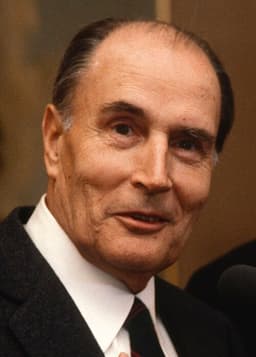
Francois Mitterrand
Politician · Modern
63.1Total
Basic Information
Born
1945
1916
Died
—
1996
Era
Modern
Modern
Nationality
Israel
France
Occupation
Politician
Politician
Civilization
Middle Eastern
Western
Score Comparison
Military (10%)
49.0
36.6
Political (20%)
68.0
72.0
Influence (20%)
51.8
72.0
Legacy (20%)
38.3
58.0
Leadership (15%)
74.0
72.0
Strategy (15%)
41.8
53.5
TOTAL
52.9
63.1
Ehud Olmert — Complete Timeline
1993 AD
Elected Mayor of JerusalemPolitical Action◆ Major
Olmert was elected Mayor of Jerusalem, serving until 2003. He focused on infrastructure development and unifying the city, but faced criticism over handling of Palestinian neighborhoods.
JerusalemMayorUrban Development
constructive
2006 AD
Launched Second Lebanon WarWar◆ Major
Olmert authorized a military campaign against Hezbollah in Lebanon following a cross-border raid. The 34-day conflict ended with UN Resolution 1701 but was widely criticized for its conduct and outcomes.
Lebanon WarHezbollahMilitary
Impact: regionaldestructive
Became Prime Minister of IsraelPolitical Action
Olmert became Prime Minister after Ariel Sharon suffered a stroke. He led the government until 2009, overseeing the 2006 Lebanon War and continuing peace negotiations with Palestinians.
Prime MinisterLeadershipIsrael
Impact: national
2014 AD
Convicted of Corruption and ImprisonedPolitical Action◆ Major
Olmert was convicted of bribery in the Holyland real estate scandal and sentenced to six years in prison. He served 16 months before being released on parole in 2017, becoming the first Israeli PM to be imprisoned.
CorruptionImprisonmentScandal
Impact: nationaltragic
Francois Mitterrand — Complete Timeline
1981 AD
Abolition of the Death PenaltyReform◆ Major
Mitterrand signed the law abolishing the death penalty in France, fulfilling a campaign promise. The law was championed by Justice Minister Robert Badinter and made France the last Western European country to abolish capital punishment.
Human RightsJudicial ReformAbolition
Impact: nationalprogressive
Election as President of FrancePolitical Action◆ Major
Mitterrand was elected President of France, defeating incumbent Val
ElectionSocialismFifth Republic
Impact: nationalconstructive
1992 AD
Maastricht Treaty RatificationPolitical Action◆ Major
Mitterrand pushed for the ratification of the Maastricht Treaty, which deepened European integration. The treaty was approved by a narrow French referendum, establishing the European Union and paving the way for the euro.
European UnionMaastrichtIntegration
Impact: globalconstructive
Expert Analysis
Origins
Ehud Olmert was born in 1945 in Binyamina, Israel, into a family of early Zionist settlers. His father, Mordechai Olmert, was a member of the Irgun and later a Knesset member. Olmert studied psychology and law at Hebrew University, then practiced law before entering politics. He was elected to the Knesset in 1973 as a member of the right-wing Likud party.
Francois Mitterrand was born in 1916 in Jarnac, France, into a conservative Catholic family. He studied law and political science in Paris, served in World War II, and was captured and escaped from a German POW camp. After the war, he became a prominent figure in the French Resistance and entered politics, holding various ministerial positions under the Fourth Republic.
Rise to Power
Olmert rose through the ranks of Likud, serving as Minister of Health and Minister of Justice in the 1990s. His political ascent accelerated when he was elected Mayor of Jerusalem in 1993, a position he held for a decade. He focused on infrastructure and unifying the city, but faced criticism over housing policies. In 2003, he became Vice Prime Minister under Ariel Sharon. When Sharon suffered a stroke in 2006, Olmert became Prime Minister, succeeding the incapacitated leader.
Mitterrand's rise was longer and more complex. After serving in the Resistance, he was elected to the National Assembly in 1946 and held 11 ministerial posts under the Fourth Republic. He opposed Charles de Gaulle's Fifth Republic and ran for president in 1965, forcing a runoff. He rebuilt the Socialist Party and formed the Union of the Left with the Communist Party. In 1981, he defeated Valéry Giscard d'Estaing to become the first socialist president of the Fifth Republic. He scored 72.0 in political skill, reflecting his strategic coalition-building.
Leadership & Governance
Olmert's leadership was characterized by pragmatism and a shift from his earlier hawkish stance. As Prime Minister, he pursued the convergence plan, unilaterally withdrawing from parts of the West Bank. He continued Sharon's policy of disengagement but faced a major test in the 2006 Lebanon War. The war against Hezbollah lasted 34 days and ended inconclusively, with UN Resolution 1701. Olmert's approval ratings plummeted. His governance was marred by corruption investigations, culminating in the Holyland real estate scandal.
Mitterrand governed with a mix of socialist reforms and pragmatic economic adjustments. He nationalized banks and industries in 1981-82, but reversed course with austerity measures in 1983 to stay in the European Monetary System. He abolished the death penalty in 1981, a landmark human rights achievement. He pushed for the Maastricht Treaty, which created the European Union and introduced the euro. His leadership score of 72.0 reflects his ability to balance ideology with realpolitik.
Triumph & Tragedy
Olmert's greatest success was his role in the convergence plan and disengagement from the Gaza Strip, though the plan was largely initiated by Sharon. He also oversaw infrastructure development in Jerusalem. His greatest failure was the 2006 Lebanon War, which was widely criticized as poorly planned and executed. He also failed to achieve peace with the Palestinians. His legacy was destroyed by his conviction for bribery in the Holyland affair, receiving a six-year prison sentence (served 16 months). His influence score of 51.8 reflects this collapse.
Mitterrand's triumphs include the abolition of the death penalty, the Maastricht Treaty, and the construction of the Bastille Opera and the Grand Louvre. He also presided over the end of the Cold War and German reunification. However, his legacy is tainted by the Rainbow Warrior bombing, his role in the affair, and revelations of his Vichy past. He also faced criticism for his socialist economic policies that initially failed. His legacy score of 58.0 reflects these mixed outcomes.
Character & Destiny
Olmert was known as a pragmatic and ambitious politician, but his character was marred by corruption. He was convicted of accepting bribes, showing a willingness to exploit his position for personal gain. His decision-making during the Lebanon War was seen as reactive and indecisive. His destiny was to be the first Israeli prime minister to be imprisoned, a stark fall from power. His total score of 52.9 reflects his flawed leadership.
Mitterrand was a masterful political strategist, skilled in maneuvering and coalition-building. He was secretive and maintained a dual image: a socialist reformer and a pragmatic statesman. His character was shaped by his wartime experiences and his long political career. He died of cancer in 1996, shortly after leaving office. His total score of 63.1 indicates a more effective and impactful leader.
Legacy
Olmert's legacy is overshadowed by his corruption conviction. He is remembered as a transitional figure who failed to achieve lasting peace or military success. His policies on Jerusalem and settlements had limited long-term impact. His historical assessment is largely negative.
Mitterrand's legacy is more substantial. He transformed France's economy and society, abolished the death penalty, and deepened European integration. The Maastricht Treaty and the euro remain enduring achievements. However, his legacy is complicated by his authoritarian tendencies and scandals. He is remembered as a complex figure who shaped modern France and Europe.
Conclusion
Francois Mitterrand had a greater impact than Ehud Olmert. Mitterrand's political skill (72.0) and influence (72.0) were higher than Olmert's (68.0 and 51.8 respectively). Mitterrand's legacy (58.0) also surpasses Olmert's (38.3). While Olmert's leadership score (74.0) is slightly higher than Mitterrand's (72.0), his failures in war and corruption undermine his overall effectiveness. Mitterrand's achievements in abolishing the death penalty and advancing European integration have had lasting global significance, whereas Olmert's tenure was marred by scandal and failed military campaigns. Therefore, Mitterrand is the more consequential leader.
Rankings
🥇
Francois MitterrandLeader
Mil: 36.6Pol: 72.0Inf: 72.0
63.1
🥈
Ehud Olmert
Mil: 49.0Pol: 68.0Inf: 51.8
52.9
+10.2 behind
How This Comparison Works
Algorithm
Each figure is scored on 6 dimensions (0—100 scale) based on structured historical data: Military (10%), Political (20%), Influence (20%), Legacy (20%), Leadership (15%), Strategy (15%). The weighted total produces the final ranking.
Data Sources
Scores are computed from structured sub-indicators in the database. Scale factors adjust for era (Ancient ×0.85, Modern ×1.0) and civilization size (Eastern ×1.05, Other ×0.80) to account for differences in population and military scale.
Maximum 3 Figures
Comparisons are limited to 2—3 figures to ensure readability and statistical meaningfulness.
Error Margins
±5 points per dimension — Sub-scores are derived from historical records with inherent uncertainty. Two figures within 5 points on a dimension should be considered roughly equivalent in that area.
Total Score Accuracy
±3 points overall — The weighted combination of 6 dimensions produces a total score with approximately ±3 points of uncertainty. Differences of less than 3 points are not statistically significant— the figures are effectively tied.
Known Limitations
- Historical records are incomplete and uneven across civilizations
- Figures from oral-tradition societies may be underrepresented
- Occupation labels can misclassify multi-role figures
- Scores measure capability and impact, not moral character
- Quantitative scoring is a comparison tool, not absolute truth
Capability Radar
Military (10%) — Battles & Warfare
Battles
19
5
Win Rate
27
5
Expansion
29
5
Political (20%) — Governance & Reform
Reform
40
75
Diplomacy
55
80
Economy
50
70
Influence (20%) — Cultural & Global Reach
Cultural
20
60
Global
30
65
Legacy (20%) — Historical Impact
Historical
20
70
Longevity
10
55
Leadership (15%) — Power & Stability
Tenure
60
85
Stability
30
65
Strategy (15%) — Tactics & Innovation
Strategy
32
10
Tactics
35
5
Reform
35
15
Similar Comparisons
Comments & Discussion
No comments yet. Be the first to share your thoughts!