Loading...
Eduardo Frei Ruiz-Tagle vs Ioannis Kapodistrias
Ioannis Kapodistrias leads by 2.4 pts · 2 figures compared
…
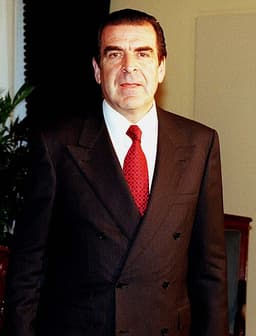
Eduardo Frei Ruiz-Tagle
Politician · Modern
51.1Total
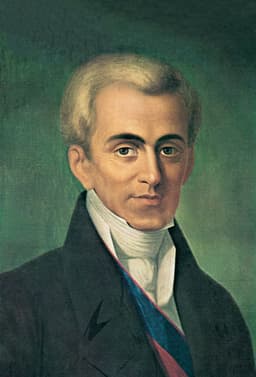
Ioannis Kapodistrias
Politician · Modern
53.5Total
Basic Information
Born
1942
1776
Died
—
1831
Era
Modern
Modern
Nationality
Chile
Greece
Occupation
Politician
Politician
Civilization
Western
Western
Score Comparison
Military (10%)
50.0
41.6
Political (20%)
45.0
65.0
Influence (20%)
55.7
55.0
Legacy (20%)
45.0
58.0
Leadership (15%)
66.0
40.0
Strategy (15%)
42.9
53.8
TOTAL
51.1
53.5
Eduardo Frei Ruiz-Tagle — Complete Timeline
1994 AD
Elected President of ChilePolitical Action◆ Major
Frei Ruiz-Tagle won the presidency as the candidate of the Concertaci
ElectionChileDemocracy
Impact: nationalconstructive
1996 AD
Signed free trade agreementsPolitical Action◆ Major
Frei's government signed free trade agreements with Canada, Mexico, and the European Union. These agreements boosted Chilean exports and integrated the country into the global economy.
TradeChileGlobalization
Impact: globalconstructive
1997 AD
Reformed the judicial systemReform◆ Major
Frei's government implemented a major judicial reform, replacing the inquisitorial system with an adversarial one. The reform aimed to increase transparency and efficiency in the courts.
Judicial ReformChileRule of Law
Impact: nationalconstructive
Ioannis Kapodistrias — Complete Timeline
1827 AD
Elected First Governor of GreecePolitical Action◆ Major
The Third National Assembly at Troezen elected Kapodistrias as Governor of Greece for a seven-year term. He arrived in Greece in January 1828 to lead the newly independent state, which was still fighting the Ottoman Empire for full independence.
IndependenceGovernorshipState Building
Impact: nationalconstructive
1828 AD
Established the Hellenic StateReform◆ Major
Kapodistrias organized the first administrative system of independent Greece, creating ministries, a national bank, and a postal service. He also established the Philekpaideutiki Etaireia (Educational Society) to promote education and founded the first orphanage.
AdministrationEducationState Building
Impact: nationalconstructive
1830 AD
Negotiated the London ProtocolPolitical Action◆ Major
Kapodistrias secured the London Protocol of 1830, which recognized Greece as an independent sovereign state under the protection of Great Britain, France, and Russia. This diplomatic achievement ended the Greek War of Independence and established Greece's borders.
DiplomacyIndependenceTreaty
Impact: regionalconstructive
1831 AD
Assassination of KapodistriasPolitical Action◆ Major
Kapodistrias was assassinated on the steps of the Church of Saint Spyridon in Nafplio by members of the Mavromichalis family, a powerful Maniot clan. His death plunged Greece into a period of civil war and instability, leading to the imposition of a monarchy.
AssassinationPolitical CrisisCivil War
Impact: nationaltragic
Expert Analysis
Origins
Eduardo Frei Ruiz-Tagle was born on June 24, 1942, in Santiago, Chile, into a prominent political family. His father, Eduardo Frei Montalva, served as president of Chile from 1964 to 1970. Frei studied civil engineering at the University of Chile and later earned a degree in industrial engineering. He worked in the private sector before entering politics in the 1980s, as Chile transitioned from the Pinochet dictatorship to democracy.
Ioannis Kapodistrias was born on February 10, 1776, on the island of Corfu, then part of the Venetian Republic. He came from a noble family and studied medicine, philosophy, and law at the University of Padua. He served as a physician and later entered the diplomatic service of the Russian Empire, eventually becoming foreign minister under Tsar Alexander I. His experience in European diplomacy shaped his vision for an independent Greece.
Rise to Power
Frei entered politics as a member of the Christian Democratic Party. After the return to democracy in 1990, he served as a senator and then as president from 1994 to 2000. His election continued the Concertación coalition's rule, which had defeated Pinochet's regime in the 1988 plebiscite. Frei's presidency built on the democratic transition initiated by Patricio Aylwin.
Kapodistrias rose to prominence as a diplomat for Russia, representing the empire at the Congress of Vienna in 1815. He became a key figure in the European diplomatic system. The Greek War of Independence broke out in 1821, and Kapodistrias was elected Governor of Greece by the Third National Assembly at Troezen in 1827. He arrived in Greece in January 1828 to lead the fledgling state.
Leadership & Governance
Frei's leadership focused on economic liberalization and institutional modernization. He signed free trade agreements with Canada (1996), Mexico (1998), and the European Union (1996). These agreements boosted Chilean exports and integrated the country into global markets. Frei also implemented a major judicial reform, replacing the inquisitorial system with an adversarial one. This reform aimed to increase transparency and efficiency. His political score of 45.0 reflects his steady but not transformative governance.
Kapodistrias established the first administrative system of independent Greece, creating ministries, a national bank, and a postal service. He also founded the first modern Greek university, the National and Kapodistrian University of Athens. His leadership was authoritarian and centralized, which generated opposition from powerful local factions. He scored 65.0 in political skill, higher than Frei, but his inability to build consensus led to conflict.
Triumph & Tragedy
Frei's greatest success was the consolidation of Chile's democratic institutions and economic growth. During his term, GDP grew at an average of 7% per year, and poverty rates fell. However, his failure to reform the 1980 constitution, which contained authoritarian enclaves, limited his legacy. The Pinochet-era constitution remained largely intact until 2005. Frei also faced criticism for not addressing social inequality more aggressively.
Kapodistrias's triumph was securing the London Protocol of 1830, which recognized Greece as an independent sovereign state under the protection of Great Britain, France, and Russia. He also organized the first census and land distribution. His tragedy was his assassination on October 9, 1831, on the steps of the Church of Saint Spyridon in Nafplio by members of the Mavromichalis family. His death plunged Greece into civil war and delayed state consolidation.
Character & Destiny
Frei was methodical and consensus-oriented, reflecting his engineering background. He avoided confrontation and worked within the coalition framework. His leadership score of 66.0 indicates competent but cautious management. His destiny was to be a transitional figure, consolidating democracy rather than transforming it.
Kapodistrias was visionary but rigid. He believed in top-down reform and clashed with local elites. His strategy score of 53.8 suggests moderate strategic ability, but his political score of 65.0 shows he understood systems. His character—principled and uncompromising—led to his downfall. He scored 40.0 in leadership, reflecting his failure to manage opposition.
Legacy
Frei's legacy is the modernization of Chile's economy and judicial system. The free trade agreements he signed laid the foundation for Chile's export boom. His judicial reform is still in use. However, his total score of 51.1 ranks him as a mid-tier president. He is remembered as a capable administrator but not a transformative leader.
Kapodistrias is revered as the founder of modern Greece. The National and Kapodistrian University of Athens bears his name. His administrative structures shaped the Greek state. He scored 58.0 in legacy, higher than Frei's 45.0. His assassination made him a martyr, but his authoritarian methods limited his immediate impact.
Conclusion
Ioannis Kapodistrias had greater impact than Eduardo Frei Ruiz-Tagle. Despite a narrow total score gap of 2.4 points (Kapodistrias 53.5 vs Frei 51.1), Kapodistrias's role in founding a nation and shaping its institutions is historically more significant. Frei's reforms were important for Chile's development, but they occurred within an established democratic framework. Kapodistrias created a state from nothing, a task of greater magnitude and lasting consequence.
Rankings
🥇
Ioannis KapodistriasLeader
Mil: 41.6Pol: 65.0Inf: 55.0
53.5
🥈
Eduardo Frei Ruiz-Tagle
Mil: 50.0Pol: 45.0Inf: 55.7
51.1
+2.4 behind
How This Comparison Works
Algorithm
Each figure is scored on 6 dimensions (0—100 scale) based on structured historical data: Military (10%), Political (20%), Influence (20%), Legacy (20%), Leadership (15%), Strategy (15%). The weighted total produces the final ranking.
Data Sources
Scores are computed from structured sub-indicators in the database. Scale factors adjust for era (Ancient ×0.85, Modern ×1.0) and civilization size (Eastern ×1.05, Other ×0.80) to account for differences in population and military scale.
Maximum 3 Figures
Comparisons are limited to 2—3 figures to ensure readability and statistical meaningfulness.
Error Margins
±5 points per dimension — Sub-scores are derived from historical records with inherent uncertainty. Two figures within 5 points on a dimension should be considered roughly equivalent in that area.
Total Score Accuracy
±3 points overall — The weighted combination of 6 dimensions produces a total score with approximately ±3 points of uncertainty. Differences of less than 3 points are not statistically significant— the figures are effectively tied.
Known Limitations
- Historical records are incomplete and uneven across civilizations
- Figures from oral-tradition societies may be underrepresented
- Occupation labels can misclassify multi-role figures
- Scores measure capability and impact, not moral character
- Quantitative scoring is a comparison tool, not absolute truth
Capability Radar
Military (10%) — Battles & Warfare
Battles
30
10
Win Rate
30
10
Expansion
35
10
Political (20%) — Governance & Reform
Reform
55
70
Diplomacy
60
75
Economy
65
60
Influence (20%) — Cultural & Global Reach
Cultural
30
55
Global
35
50
Legacy (20%) — Historical Impact
Historical
40
65
Longevity
30
60
Leadership (15%) — Power & Stability
Tenure
60
55
Stability
55
40
Strategy (15%) — Tactics & Innovation
Strategy
36
10
Tactics
43
10
Reform
45
15
Similar Comparisons
Comments & Discussion
No comments yet. Be the first to share your thoughts!