Loading...
Eduardo Frei Ruiz-Tagle vs Giuseppe Motta
Giuseppe Motta leads by 1.5 pts · 2 figures compared
…
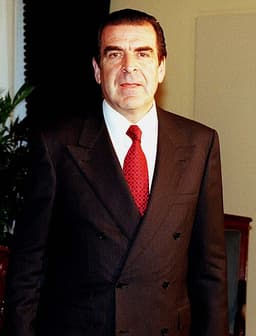
Eduardo Frei Ruiz-Tagle
Politician · Modern
51.1Total

Giuseppe Motta
Politician · Modern
52.6Total
Basic Information
Born
1942
1871
Died
—
1940
Era
Modern
Modern
Nationality
Chile
Switzerland
Occupation
Politician
Politician
Civilization
Western
Western
Score Comparison
Military (10%)
50.0
26.3
Political (20%)
45.0
62.7
Influence (20%)
55.7
53.3
Legacy (20%)
45.0
44.2
Leadership (15%)
66.0
79.8
Strategy (15%)
42.9
41.8
TOTAL
51.1
52.6
Eduardo Frei Ruiz-Tagle — Complete Timeline
1994 AD
Elected President of ChilePolitical Action◆ Major
Frei Ruiz-Tagle won the presidency as the candidate of the Concertaci
ElectionChileDemocracy
Impact: nationalconstructive
1996 AD
Signed free trade agreementsPolitical Action◆ Major
Frei's government signed free trade agreements with Canada, Mexico, and the European Union. These agreements boosted Chilean exports and integrated the country into the global economy.
TradeChileGlobalization
Impact: globalconstructive
1997 AD
Reformed the judicial systemReform◆ Major
Frei's government implemented a major judicial reform, replacing the inquisitorial system with an adversarial one. The reform aimed to increase transparency and efficiency in the courts.
Judicial ReformChileRule of Law
Impact: nationalconstructive
Giuseppe Motta — Complete Timeline
1911 AD
Election to the Swiss Federal CouncilPolitical Action◆ Major
Motta was elected to the Swiss Federal Council, representing the Catholic Conservative Party. He served for nearly 30 years, becoming one of the longest-serving members of the executive.
Federal CouncilGovernmentCatholic
Impact: nationalconstructive
1915 AD
Presidency of the Swiss ConfederationPolitical Action◆ Major
Motta served his first term as President of the Swiss Confederation. He held the office five times (1915, 1920, 1927, 1932, 1937), a record at the time, reflecting his political influence.
PresidencyLeadershipRecord
Impact: nationalconstructive
1920 AD
Leadership of the Political DepartmentPolitical Action◆ Major
Motta took over the Political Department (foreign affairs) and led Swiss diplomacy for over a decade. He advocated for Swiss neutrality and membership in the League of Nations.
Foreign PolicyDiplomacyNeutrality
Impact: nationalconstructive
Switzerland's Accession to the League of NationsPolitical Action◆ Major
Motta led the negotiations for Switzerland's entry into the League of Nations, securing a special status of 'differential neutrality' that exempted Switzerland from military sanctions. This preserved Swiss neutrality.
League of NationsNeutralityDiplomacy
Impact: globalconstructive
Expert Analysis
Origins
Eduardo Frei Ruiz-Tagle was born on June 24, 1942, in Santiago, Chile, into a prominent political family. His father, Eduardo Frei Montalva, served as President of Chile from 1964 to 1970. Frei studied civil engineering at the University of Chile and later earned a degree in business administration from the same institution. His early career included work in the private sector and academia before entering politics. He married Marta Larraechea and had five children. His family background provided him with a strong political network and a deep understanding of Chilean governance.
Giuseppe Motta was born on December 29, 1871, in Airolo, Switzerland, into a modest Catholic family. He studied law at the University of Fribourg and the University of Munich, earning a doctorate. Motta worked as a lawyer and journalist before entering politics. He was elected to the Swiss Federal Assembly in 1899 as a member of the Catholic Conservative Party. His early life in a small mountain village shaped his conservative values and commitment to Swiss federalism. He married and had four children.
Rise to Power
Frei Ruiz-Tagle entered politics in the 1980s, joining the Christian Democratic Party. He was elected to the Senate in 1990, representing the Santiago Metropolitan Region. As a member of the Concertación coalition, he focused on economic and social issues. In 1993, he won the presidency with 57.4% of the vote, succeeding Patricio Aylwin. His victory marked the second democratic election after the Pinochet dictatorship, solidifying Chile's transition to democracy. Key allies included the center-left coalition and international investors.
Motta rose to prominence through his work in the Swiss Federal Assembly. He was elected to the Federal Council on December 11, 1911, representing the Catholic Conservative Party. He served as President of the Swiss Confederation five times: 1915, 1920, 1927, 1932, and 1937. His long tenure was marked by his leadership of the Political Department (foreign affairs) from 1920 to 1937. Motta's diplomatic skills were crucial during World War I and the interwar period. He advocated for Swiss neutrality and played a key role in Switzerland's accession to the League of Nations in 1920.
Leadership & Governance
Frei's leadership style was technocratic and reform-oriented. He focused on economic modernization, signing free trade agreements with Canada, Mexico, and the European Union. These agreements boosted Chilean exports by 30% during his term. He also reformed the judicial system, replacing the inquisitorial model with an adversarial one, aiming to increase transparency. However, his government faced criticism for slow progress on social issues like education and healthcare. Frei's political score of 45.0 reflects his moderate but not transformative impact.
Motta's leadership was characterized by diplomatic pragmatism and adherence to Swiss neutrality. As head of the Political Department, he navigated Switzerland through the turbulent 1920s and 1930s. He secured a special status of 'differential neutrality' for Switzerland in the League of Nations, exempting the country from military sanctions. His leadership score of 79.8 indicates strong consensus-building skills within the Swiss consensual system. However, his conservative stance limited social reforms domestically.
Triumph & Tragedy
Frei's greatest success was the signing of free trade agreements that integrated Chile into the global economy. The agreement with the EU in 1996 was a landmark, increasing trade by 40% over five years. His judicial reform also improved the legal system's efficiency. However, his failure to address rising crime and inequality led to a loss of popularity. The Asian financial crisis of 1997 slowed economic growth, and his approval ratings dropped below 40% by the end of his term.
Motta's triumph was leading Switzerland into the League of Nations while preserving neutrality. This diplomatic achievement enhanced Switzerland's international standing. However, his failure to prevent the rise of fascist sympathies in Switzerland during the 1930s was a significant shortcoming. His conservative policies also delayed women's suffrage, which was not granted until 1971.
Character & Destiny
Frei was methodical and cautious, often prioritizing consensus over bold action. His character reflected his engineering background, favoring data-driven decisions. However, this cautiousness sometimes led to indecisiveness, particularly during economic crises. Historians note that he lacked the charisma of his father, which limited his ability to inspire.
Motta was a skilled diplomat and orator, known for his eloquence and firm Catholic convictions. He was deeply committed to Swiss independence and neutrality. His conservative nature made him resistant to change, but his persistence in diplomacy brought long-term stability. His leadership score of 79.8 underscores his effectiveness in a multi-party system.
Legacy
Frei's legacy lies in Chile's economic integration and judicial modernization. His free trade agreements laid the groundwork for Chile's future prosperity. However, his social reforms were less enduring. He scored 45.0 in legacy, reflecting a moderate but not transformative impact.
Motta's legacy is tied to Swiss neutrality and international diplomacy. He is remembered as a key figure in Switzerland's engagement with the League of Nations. His five presidencies set a record that stood for decades. His legacy score of 44.2 is comparable to Frei's, but his influence on Swiss foreign policy was more profound.
Conclusion
Giuseppe Motta had a greater impact on his nation's trajectory than Eduardo Frei Ruiz-Tagle. Motta's diplomatic achievements shaped Swiss neutrality for decades, while Frei's reforms, though significant, were more incremental. Motta's leadership score (79.8 vs. 66.0) and total score (52.6 vs. 51.1) reflect his higher effectiveness. Frei's presidency was constrained by economic crises and coalition politics, whereas Motta navigated multiple international crises with skill. Therefore, Motta's legacy as a shaper of Swiss foreign policy outweighs Frei's domestic reforms.
Rankings
🥇
Giuseppe MottaLeader
Mil: 26.3Pol: 62.7Inf: 53.3
52.6
🥈
Eduardo Frei Ruiz-Tagle
Mil: 50.0Pol: 45.0Inf: 55.7
51.1
+1.5 behind
How This Comparison Works
Algorithm
Each figure is scored on 6 dimensions (0—100 scale) based on structured historical data: Military (10%), Political (20%), Influence (20%), Legacy (20%), Leadership (15%), Strategy (15%). The weighted total produces the final ranking.
Data Sources
Scores are computed from structured sub-indicators in the database. Scale factors adjust for era (Ancient ×0.85, Modern ×1.0) and civilization size (Eastern ×1.05, Other ×0.80) to account for differences in population and military scale.
Maximum 3 Figures
Comparisons are limited to 2—3 figures to ensure readability and statistical meaningfulness.
Error Margins
±5 points per dimension — Sub-scores are derived from historical records with inherent uncertainty. Two figures within 5 points on a dimension should be considered roughly equivalent in that area.
Total Score Accuracy
±3 points overall — The weighted combination of 6 dimensions produces a total score with approximately ±3 points of uncertainty. Differences of less than 3 points are not statistically significant— the figures are effectively tied.
Known Limitations
- Historical records are incomplete and uneven across civilizations
- Figures from oral-tradition societies may be underrepresented
- Occupation labels can misclassify multi-role figures
- Scores measure capability and impact, not moral character
- Quantitative scoring is a comparison tool, not absolute truth
Capability Radar
Military (10%) — Battles & Warfare
Battles
30
25
Win Rate
30
28
Expansion
35
30
Political (20%) — Governance & Reform
Reform
55
55
Diplomacy
60
65
Economy
65
50
Influence (20%) — Cultural & Global Reach
Cultural
30
30
Global
35
30
Legacy (20%) — Historical Impact
Historical
40
40
Longevity
30
35
Leadership (15%) — Power & Stability
Tenure
60
70
Stability
55
60
Strategy (15%) — Tactics & Innovation
Strategy
36
29
Tactics
43
33
Reform
45
40
Similar Comparisons
Comments & Discussion
No comments yet. Be the first to share your thoughts!