Loading...
Eduard Shevardnadze vs Thaksin Shinawatra
Eduard Shevardnadze leads by 7.0 pts · 2 figures compared
…
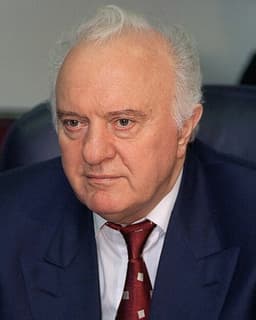
Eduard Shevardnadze
Politician · Modern
57.7Total
Thaksin Shinawatra
Politician · Modern
50.7Total
Basic Information
Born
1928
1949
Died
—
—
Era
Modern
Modern
Nationality
Georgia
Thailand
Occupation
Politician
Politician
Civilization
Western
Eastern
Score Comparison
Military (10%)
50.0
16.0
Political (20%)
70.0
55.0
Influence (20%)
55.0
60.0
Legacy (20%)
56.0
47.5
Leadership (15%)
68.0
74.0
Strategy (15%)
42.1
29.0
TOTAL
57.7
50.7
Eduard Shevardnadze — Complete Timeline
1985 AD
Appointed Soviet Foreign MinisterPolitical Action◆ Major
Mikhail Gorbachev appointed Shevardnadze as Soviet Foreign Minister. Shevardnadze played a key role in shaping the 'New Thinking' foreign policy, which emphasized de-escalation of the Cold War, arms reduction agreements, and improved relations with the West.
Cold WarSoviet UnionDiplomacy
Impact: globalconstructive
1987 AD
Signed the Intermediate-Range Nuclear Forces TreatyPolitical Action
Shevardnadze, as Soviet Foreign Minister, signed the INF Treaty with U.S. Secretary of State George Shultz. The treaty eliminated an entire class of nuclear missiles (500-5,500 km range) from Europe, marking a major step in ending the Cold War.
Nuclear Arms ControlCold WarTreaty
Impact: globalconstructive
1990 AD
Resigned as Soviet Foreign MinisterPolitical Action◆ Major
Shevardnadze resigned as Soviet Foreign Minister, warning of an impending dictatorship under Gorbachev. His resignation was a dramatic protest against the conservative backlash and the slow pace of reforms, highlighting the internal crisis of the Soviet Union.
Soviet UnionResignationPolitical Crisis
Impact: nationaltragic
1992 AD
Elected Chairman of the Georgian ParliamentPolitical Action◆ Major
After the ouster of President Zviad Gamsakhurdia, Shevardnadze returned to Georgia and was elected Chairman of the Parliament, effectively becoming the head of state. He was tasked with stabilizing the country amid civil war and economic collapse.
GeorgiaPost-SovietLeadership
Impact: national
1995 AD
Survived Assassination AttemptPolitical Action◆ Major
Shevardnadze survived a car bomb assassination attempt in Tbilisi. The attack, which killed several people, was widely attributed to opponents of his policies. It underscored the violent political struggles in post-Soviet Georgia.
Assassination AttemptGeorgiaViolence
Impact: nationaltragic
2003 AD
Rose RevolutionPolitical Action
Shevardnadze was forced to resign as President of Georgia following the Rose Revolution, a peaceful protest against disputed parliamentary elections. The revolution, led by Mikheil Saakashvili, ended Shevardnadze's rule and ushered in a new pro-Western government.
RevolutionGeorgiaRegime Change
Impact: national
Thaksin Shinawatra — Complete Timeline
2001 AD
Election as Prime MinisterPolitical Action◆ Major
Thaksin Shinawatra's Thai Rak Thai party won a landslide victory in the 2001 general election, making him Prime Minister. His populist policies, including universal healthcare and debt relief for farmers, gained widespread support.
ElectionPopulismThailand
Impact: nationalconstructive
2003 AD
War on Drugs campaignPolitical Action◆ Major
Thaksin launched a highly controversial anti-drug campaign that resulted in over 2,500 extrajudicial killings. The campaign was criticized by human rights groups but was popular among the public for reducing drug crime.
Human RightsDrug PolicyThailand
Impact: nationaldestructive
2006 AD
Overthrow in military coupPolitical Action
While attending the UN General Assembly in New York, Thaksin was overthrown by a military coup led by General Sonthi Boonyaratglin. The coup was justified by allegations of corruption, abuse of power, and disrespect to the monarchy.
CoupExileThailand
Impact: nationaldestructive
2008 AD
Conviction for abuse of powerPolitical Action◆ Major
Thaksin was convicted in absentia by the Thai Supreme Court for abuse of power in a land purchase case involving his wife. He was sentenced to two years in prison, remaining in self-exile to avoid serving the sentence.
CorruptionLegalThailand
Impact: nationaldestructive
Expert Analysis
Origins
Eduard Shevardnadze was born on January 25, 1928, in Mamati, Georgia, into a peasant family. He joined the Communist Party and rose through the ranks of the Komsomol, eventually becoming First Secretary of the Georgian Communist Party in 1972. His early career was marked by anti-corruption campaigns and economic reforms within the Soviet system.
Thaksin Shinawatra was born on July 26, 1949, in San Kamphaeng, Thailand, into a wealthy Chinese-Thai family. He studied criminal justice in Thailand and the United States, earning a PhD. He joined the police force before entering business, founding the telecommunications company Shin Corporation in 1983. His business success made him a billionaire.
Rise to Power
Shevardnadze's rise culminated in his appointment as Soviet Minister of Foreign Affairs in 1985 by Mikhail Gorbachev. He became a key architect of the "New Thinking" foreign policy, which prioritized diplomacy over confrontation. He played a central role in arms control negotiations with the United States, signing the Intermediate-Range Nuclear Forces (INF) Treaty on December 8, 1987, which eliminated an entire class of nuclear missiles.
Thaksin entered politics in the 1990s, serving as a minister in various governments. In 1998, he founded the Thai Rak Thai party, which won a landslide victory in the 2001 general election. His populist platform, including universal healthcare and low-interest loans for villages, resonated with rural voters. He became Prime Minister on February 9, 2001.
Leadership & Governance
Shevardnadze's leadership style was diplomatic and reformist. As Soviet Foreign Minister, he advocated for reducing tensions with the West, supporting the reunification of Germany, and withdrawing Soviet troops from Afghanistan. His governance as President of Georgia (1995–2003) was less successful; he struggled with corruption and economic stagnation, scoring a political score of 70.0 but a strategy score of only 42.1.
Thaksin was a decisive and populist leader. He implemented policies that boosted economic growth and reduced poverty, but also centralized power, undermined democratic institutions, and launched a "War on Drugs" that led to over 2,500 extrajudicial killings. His leadership score of 74.0 reflects his effectiveness, but his influence score of 60.0 was marred by authoritarian tendencies.
Triumph & Tragedy
Shevardnadze's greatest triumph was the INF Treaty, a milestone in arms control. He also helped end the Cold War peacefully. His tragedy came as President of Georgia: he failed to curb corruption and was ousted in the peaceful Rose Revolution of November 2003 after disputed elections. His legacy score of 56.0 reflects this mixed record.
Thaksin's triumph was his transformative economic policies: Thailand's GDP grew by an average of 4.5% during his tenure, and poverty fell from 21% to 11%. His tragedy was his downfall: he was overthrown in a military coup on September 19, 2006, while in New York for the UN General Assembly. He was later convicted in absentia for abuse of power, scoring a legacy of 47.5.
Character & Destiny
Shevardnadze was a pragmatic reformer who believed in gradual change. His decision to resign as Soviet Foreign Minister in 1990, warning of an impending dictatorship, showed his principled stance. However, his inability to transform Georgia reflected a cautious nature that struggled with rapid change.
Thaksin was a charismatic but polarizing figure. His business acumen and populist appeal made him popular among the poor, but his authoritarian tendencies and corruption alienated elites. His character—ambitious and risk-taking—led to both his success and his overthrow.
Legacy
Shevardnadze is remembered as a key figure in ending the Cold War, with a political score of 70.0. His reforms in Soviet foreign policy had global impact. In Georgia, his legacy is more mixed: he stabilized the country after civil war but failed to build strong institutions. His total score of 57.7 reflects this duality.
Thaksin's legacy is deeply divisive. He reshaped Thai politics, creating a lasting cleavage between rural and urban voters. His populist policies are still emulated, but his abuses of power and the 2006 coup set a precedent for military intervention. His total score of 50.7 is lower due to his military score of 16.0.
Conclusion
Eduard Shevardnadze had a greater impact on global history due to his role in ending the Cold War and reducing nuclear tensions. While Thaksin transformed Thailand, his influence was limited to one country and tainted by authoritarianism. Shevardnadze's political score of 70.0 and legacy of 56.0 exceed Thaksin's 55.0 and 47.5, respectively. The 7.0-point gap in total scores reflects Shevardnadze's broader historical significance.
Rankings
🥇
Eduard ShevardnadzeLeader
Mil: 50.0Pol: 70.0Inf: 55.0
57.7
🥈
Thaksin Shinawatra
Mil: 16.0Pol: 55.0Inf: 60.0
50.7
+7.0 behind
How This Comparison Works
Algorithm
Each figure is scored on 6 dimensions (0—100 scale) based on structured historical data: Military (10%), Political (20%), Influence (20%), Legacy (20%), Leadership (15%), Strategy (15%). The weighted total produces the final ranking.
Data Sources
Scores are computed from structured sub-indicators in the database. Scale factors adjust for era (Ancient ×0.85, Modern ×1.0) and civilization size (Eastern ×1.05, Other ×0.80) to account for differences in population and military scale.
Maximum 3 Figures
Comparisons are limited to 2—3 figures to ensure readability and statistical meaningfulness.
Error Margins
±5 points per dimension — Sub-scores are derived from historical records with inherent uncertainty. Two figures within 5 points on a dimension should be considered roughly equivalent in that area.
Total Score Accuracy
±3 points overall — The weighted combination of 6 dimensions produces a total score with approximately ±3 points of uncertainty. Differences of less than 3 points are not statistically significant— the figures are effectively tied.
Known Limitations
- Historical records are incomplete and uneven across civilizations
- Figures from oral-tradition societies may be underrepresented
- Occupation labels can misclassify multi-role figures
- Scores measure capability and impact, not moral character
- Quantitative scoring is a comparison tool, not absolute truth
Capability Radar
Military (10%) — Battles & Warfare
Battles
26
12
Win Rate
31
17
Expansion
36
21
Political (20%) — Governance & Reform
Reform
80
70
Diplomacy
85
55
Economy
40
75
Influence (20%) — Cultural & Global Reach
Cultural
40
50
Global
65
50
Legacy (20%) — Historical Impact
Historical
70
55
Longevity
50
40
Leadership (15%) — Power & Stability
Tenure
75
60
Stability
30
30
Strategy (15%) — Tactics & Innovation
Strategy
35
23
Tactics
40
29
Reform
46
32
Similar Comparisons
Comments & Discussion
No comments yet. Be the first to share your thoughts!