Loading...
Eduard Shevardnadze vs Napoleon Bonaparte
Napoleon Bonaparte leads by 13.2 pts · 2 figures compared
…
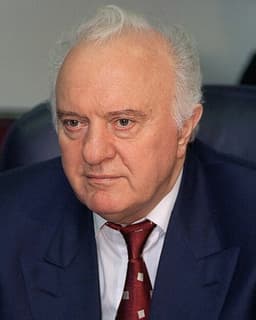
Eduard Shevardnadze
Politician · Modern
57.7Total

Napoleon Bonaparte
General · Modern
70.9Total
Basic Information
Born
1928
1769
Died
—
1821
Era
Modern
Modern
Nationality
Georgia
France
Occupation
Politician
General
Civilization
Western
Western
Score Comparison
Military (10%)
50.0
94.0
Political (20%)
70.0
72.0
Influence (20%)
55.0
40.0
Legacy (20%)
56.0
80.0
Leadership (15%)
68.0
78.0
Strategy (15%)
42.1
90.0
TOTAL
57.7
70.9
Eduard Shevardnadze — Complete Timeline
1985 AD
Appointed Soviet Foreign MinisterPolitical Action◆ Major
Mikhail Gorbachev appointed Shevardnadze as Soviet Foreign Minister. Shevardnadze played a key role in shaping the 'New Thinking' foreign policy, which emphasized de-escalation of the Cold War, arms reduction agreements, and improved relations with the West.
Cold WarSoviet UnionDiplomacy
Impact: globalconstructive
1987 AD
Signed the Intermediate-Range Nuclear Forces TreatyPolitical Action
Shevardnadze, as Soviet Foreign Minister, signed the INF Treaty with U.S. Secretary of State George Shultz. The treaty eliminated an entire class of nuclear missiles (500-5,500 km range) from Europe, marking a major step in ending the Cold War.
Nuclear Arms ControlCold WarTreaty
Impact: globalconstructive
1990 AD
Resigned as Soviet Foreign MinisterPolitical Action◆ Major
Shevardnadze resigned as Soviet Foreign Minister, warning of an impending dictatorship under Gorbachev. His resignation was a dramatic protest against the conservative backlash and the slow pace of reforms, highlighting the internal crisis of the Soviet Union.
Soviet UnionResignationPolitical Crisis
Impact: nationaltragic
1992 AD
Elected Chairman of the Georgian ParliamentPolitical Action◆ Major
After the ouster of President Zviad Gamsakhurdia, Shevardnadze returned to Georgia and was elected Chairman of the Parliament, effectively becoming the head of state. He was tasked with stabilizing the country amid civil war and economic collapse.
GeorgiaPost-SovietLeadership
Impact: national
1995 AD
Survived Assassination AttemptPolitical Action◆ Major
Shevardnadze survived a car bomb assassination attempt in Tbilisi. The attack, which killed several people, was widely attributed to opponents of his policies. It underscored the violent political struggles in post-Soviet Georgia.
Assassination AttemptGeorgiaViolence
Impact: nationaltragic
2003 AD
Rose RevolutionPolitical Action
Shevardnadze was forced to resign as President of Georgia following the Rose Revolution, a peaceful protest against disputed parliamentary elections. The revolution, led by Mikheil Saakashvili, ended Shevardnadze's rule and ushered in a new pro-Western government.
RevolutionGeorgiaRegime Change
Impact: national
Napoleon Bonaparte — Complete Timeline
1799 AD
Coup of 18 BrumaireOther◆ Major
Napoleon Bonaparte, with support from his brother Lucien and key political figures, overthrew the Directory in a bloodless coup. He established the Consulate with himself as First Consul, effectively becoming the ruler of France. This event ended the French Revolution's most unstable period.
French RevolutionCoupRise to Power
Impact: regional
1804 AD
Promulgation of the Napoleonic CodeOther◆ Major
Napoleon enacted the Civil Code of the French, known as the Napoleonic Code, a comprehensive set of laws that replaced the fragmented feudal legal systems. The code established legal equality, protected property rights, and secularized law. It became the basis for legal systems in many European and world countries.
Legal ReformNapoleonic CodeCivil Law
Impact: globalconstructive
1805 AD
Battle of AusterlitzWar◆ Major
Napoleon's Grande Arm
Napoleonic WarsBattleDecisive Victory
Impact: global
1812 AD
Invasion of RussiaWar◆ Major
Napoleon led the Grande Arm
Napoleonic WarsInvasionDisaster
Impact: globaldestructive
1815 AD
Battle of WaterlooWar◆ Major
Napoleon's French army was defeated by the combined forces of the Duke of Wellington's Anglo-Allied army and Gebhard Leberecht von Bl
Napoleonic WarsBattleFinal Defeat
Impact: globaldestructive
Expert Analysis
eduard-shevardnadze-vs-napoleon-bonaparte
# The Emperor and the Peacemaker: Napoleon and Shevardnadze's Divergent Paths
On a June morning in 1815, Napoleon Bonaparte stood on a muddy field near Waterloo, watching his Imperial Guard march toward certain death. On a November evening in 2003, Eduard Shevardnadze sat in a Tbilisi office, watching protesters flood the streets with roses. Both men faced the end of their political lives—one chose annihilation, the other chose surrender. What drove such different responses to the same fundamental question of power?
Origins
Napoleon Bonaparte, born in 1769 on the island of Corsica, emerged from a minor noble family into a world convulsed by revolution. France in the 1790s was a crucible of chaos and opportunity, where a young artillery officer could rise faster than any king's favor could allow. The old order had collapsed, and Napoleon's genius was to ride the wave of that collapse, not to restore what was lost but to forge something new from the wreckage.
Eduard Shevardnadze, born in 1928 in the Georgian village of Mamati, came of age under Stalin's shadow. The Soviet Union was a system of rigid hierarchies and ideological conformity, where survival required subtlety and patience. Shevardnadze rose through the Komsomol and Communist Party ranks, learning the arts of compromise and coalition-building in a world where open ambition was dangerous. His era was one of stagnation, not revolution—and it shaped a leader who understood that change must be negotiated, not conquered.
Rise to Power
Napoleon's ascent was meteoric and violent. In 1795, he saved the revolutionary government from a royalist uprising with a "whiff of grapeshot"—a brutal, decisive act that announced his arrival. By 1796, at age twenty-six, he commanded the Army of Italy, where his lightning campaigns humiliated Austria and made him a national hero. The Egyptian expedition of 1798-1799 was a gambit that failed militarily but burnished his legend. When he returned to France, the Directory's corruption had made the republic ripe for a takeover. The coup of 18 Brumaire in November 1799 placed him at the head of the state.
Shevardnadze's rise was gradual and institutional. He became First Secretary of the Georgian Communist Party in 1972, a position he held for thirteen years, learning to balance Moscow's demands with local interests. His breakthrough came in 1985, when Mikhail Gorbachev appointed him Soviet Foreign Minister—a move that surprised many, as Shevardnadze had no diplomatic experience. But Gorbachev saw in him a reformer who understood that the Soviet system needed fundamental change. Where Napoleon seized power through personal brilliance and battlefield glory, Shevardnadze climbed through bureaucratic competence and ideological flexibility.
Leadership & Governance
Napoleon governed as he conquered: with speed, audacity, and an iron will. The Napoleonic Code, introduced in 1804, standardized French law across his empire, establishing principles of meritocracy, secular authority, and legal equality that would influence legal systems worldwide. He centralized the state, reformed education, and built infrastructure that connected his domains. But his governance was fundamentally autocratic: he crowned himself Emperor in 1804, suppressed dissent, and treated conquered territories as sources of men and money for his endless wars.
Shevardnadze's leadership style was the opposite. As Soviet Foreign Minister from 1985 to 1990, he was the architect of the "New Thinking" that transformed Cold War diplomacy. In 1987, he signed the Intermediate-Range Nuclear Forces Treaty with U.S. Secretary of State George Shultz—the first treaty to eliminate an entire class of nuclear weapons. He withdrew Soviet troops from Afghanistan and allowed Eastern Europe to break free. His approach was one of negotiation, transparency, and strategic retreat, not conquest. When he resigned in 1990, he warned of an impending dictatorship under Gorbachev—a prescient move that showed his willingness to sacrifice position for principle.
Triumph & Tragedy
Napoleon's greatest triumph was Austerlitz in 1805, where he destroyed the combined armies of Austria and Russia in a single day of perfect maneuvering. His tragedy was the invasion of Russia in 1812, where he lost half a million men to winter, hunger, and guerilla warfare. Even then, he returned to raise new armies, only to be defeated by the Sixth Coalition and exiled to Elba. His final tragedy was Waterloo in 1815, where he gambled everything on a single battle and lost to Wellington's defensive genius and Prussian intervention.
Shevardnadze's triumph was his role in ending the Cold War without a shot fired. His tragedy came later, as President of Georgia from 1995 to 2003. He survived a car bomb assassination attempt in 1995 that killed several people, but his government became increasingly corrupt and authoritarian. The Rose Revolution of 2003 forced his resignation—a peaceful uprising that exposed how far he had drifted from the democratic ideals he once championed. Where Napoleon's tragedy was military defeat, Shevardnadze's was moral compromise.
Character & Destiny
Napoleon was driven by an insatiable hunger for glory and control. "I am not a man, but a thing," he once said—a force of nature that could not be stopped. His personality was magnetic, his energy boundless, but his hubris was fatal. He believed his will could overcome any obstacle, that he could outrun geography, logistics, and the limits of human endurance. That belief made him great and destroyed him.
Shevardnadze was a survivor, a pragmatist who understood that power was about relationships and timing. He was known for his silver hair, his calm demeanor, and his ability to read a room. Where Napoleon charged forward, Shevardnadze waited. Where Napoleon demanded loyalty, Shevardnadze built alliances. His destiny was not to conquer but to dismantle—to take apart the Soviet empire piece by piece, and then to fail at building something new in its place.
Legacy
Napoleon's legacy is written in the legal codes of Europe, the military doctrines of the world, and the very shape of modern nationalism. He is remembered as both a genius and a tyrant, a liberator who brought revolution's ideals to conservative monarchies and a conqueror who bled Europe dry for his ambition. His scores—Military 94, Political 75, Influence 82—reflect a man who reshaped history through force.
Shevardnadze's legacy is quieter but profound. He helped end the nuclear standoff that threatened humanity, and his role in the INF Treaty and the peaceful dissolution of the Soviet Union changed the world's trajectory. His scores—Political 68, Influence 78, Legacy 66—are lower than Napoleon's, but they measure a different kind of achievement: not conquest, but cooperation; not glory, but peace.
Conclusion
Napoleon and Shevardnadze stand at opposite ends of the spectrum of power. One believed that history is made by force of will, the other that it is shaped by patient negotiation. One died in exile on a remote island, the other in retirement in his homeland. Their lives remind us that there is no single path to significance—only choices that reflect who we are and the times we inhabit. Napoleon's question was "How much can I take?" Shevardnadze's was "How much can I give up?" The answer to both questions, it turns out, is the same: everything.
Rankings
🥇
Napoleon BonaparteLeader
Mil: 94.0Pol: 72.0Inf: 40.0
70.9
🥈
Eduard Shevardnadze
Mil: 50.0Pol: 70.0Inf: 55.0
57.7
+13.2 behind
How This Comparison Works
Algorithm
Each figure is scored on 6 dimensions (0—100 scale) based on structured historical data: Military (10%), Political (20%), Influence (20%), Legacy (20%), Leadership (15%), Strategy (15%). The weighted total produces the final ranking.
Data Sources
Scores are computed from structured sub-indicators in the database. Scale factors adjust for era (Ancient ×0.85, Modern ×1.0) and civilization size (Eastern ×1.05, Other ×0.80) to account for differences in population and military scale.
Maximum 3 Figures
Comparisons are limited to 2—3 figures to ensure readability and statistical meaningfulness.
Error Margins
±5 points per dimension — Sub-scores are derived from historical records with inherent uncertainty. Two figures within 5 points on a dimension should be considered roughly equivalent in that area.
Total Score Accuracy
±3 points overall — The weighted combination of 6 dimensions produces a total score with approximately ±3 points of uncertainty. Differences of less than 3 points are not statistically significant— the figures are effectively tied.
Known Limitations
- Historical records are incomplete and uneven across civilizations
- Figures from oral-tradition societies may be underrepresented
- Occupation labels can misclassify multi-role figures
- Scores measure capability and impact, not moral character
- Quantitative scoring is a comparison tool, not absolute truth
Capability Radar
Military (10%) — Battles & Warfare
Battles
26
95
Win Rate
31
90
Expansion
36
95
Political (20%) — Governance & Reform
Reform
80
95
Diplomacy
85
80
Economy
40
85
Influence (20%) — Cultural & Global Reach
Cultural
40
85
Global
65
90
Legacy (20%) — Historical Impact
Historical
70
95
Longevity
50
90
Leadership (15%) — Power & Stability
Tenure
75
85
Stability
30
70
Strategy (15%) — Tactics & Innovation
Strategy
35
95
Tactics
40
98
Reform
46
92
Similar Comparisons
Comments & Discussion
Waterloo's Butcher6/17/2026
Napoleon was a tactical genius who threw away his last chance at negotiated peace by refusing to surrender after Leipzig. Waterloo wasn't about honor—it was about pathological ego. He could have lived to fight another day politically, but instead he chose to sacrifice 50,000 men for a gambit that had zero chance of success against combined Allied forces. Shevardnadze understood that power sometimes means knowing when to walk away.
玫瑰先生6/17/2026
拿坡仑的失败源于他对绝对权力的痴迷,而谢瓦尔德纳泽的勇气在于他承认民主比独裁更强大。2003年玫瑰革命时,格鲁吉亚的GDP只有1991年的三分之一,腐败横行。谢瓦尔德纳泽选择和平移交权力,避免了内战的悲剧。这不是软弱,这是对历史负责的智慧。
The Map Merchant6/17/2026
Let's talk about their strategic legacies. Napoleon's Continental System was an economic disaster that destroyed French ports and alienated allies for a decade—Brussels knew the price of blockading Britannia. Shevardnadze's "New Thinking" withdrew Soviet troops from Afghanistan and ended the Iron Curtain, saving tens of thousands of lives. One man's strategy bankrupted a continent; the other's de-escalated a nuclear superpower. I know which legacy ages better.
古典学质疑者6/17/2026
别被胜利者的叙事骗了。拿破仑的滑铁卢失败不是因为荣誉,而是因为他在关键战役中抛弃了优秀将领如马塞纳,选择了忠诚但无能的人。谢瓦尔德纳泽的和平交权也没那么高贵——他是在面对15万示威者和军队倒戈时才妥协的。这些都是具体的历史情境,不是抽象的"性格决定命运"的英雄传说。
Chaos Theory Guy6/17/2026
Here's the real comparison: both men were products of their epoch's chaos. Napoleon rode the French Revolution's energy into European domination by exploiting institutional collapse—the Directory was a zombie government. Shevardnadze surfed the Soviet Union's slow decay into managed reform, Gorbachev's main enabler. One created chaos, the other managed it. Waterloo was a battlefield; Rose Revolution was a recall election. Apples and oranges across two centuries.