Loading...
Ed Broadbent vs Napoleon Bonaparte
Napoleon Bonaparte leads by 14.4 pts · 2 figures compared
…
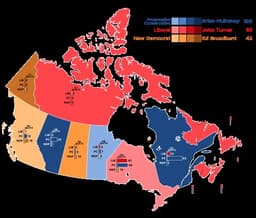
Ed Broadbent
Politician · Modern
56.5Total

Napoleon Bonaparte
General · Modern
70.9Total
Basic Information
Born
1936
1769
Died
—
1821
Era
Modern
Modern
Nationality
Canada
France
Occupation
Politician
General
Civilization
Western
Western
Score Comparison
Military (10%)
50.0
94.0
Political (20%)
60.0
72.0
Influence (20%)
59.0
40.0
Legacy (20%)
47.5
80.0
Leadership (15%)
78.0
78.0
Strategy (15%)
42.0
90.0
TOTAL
56.5
70.9
Ed Broadbent — Complete Timeline
1975 AD
Elected Leader of the New Democratic PartyPolitical Action◆ Major
Ed Broadbent was elected federal leader of the NDP at the party's convention in Winnipeg. He succeeded David Lewis and led the party through a period of growth, becoming a prominent voice for social democracy in Canada.
NDPLeadershipCanadian Politics
Impact: nationalconstructive
1988 AD
NDP Achieves Best Electoral Result Under BroadbentPolitical Action◆ Major
In the 1988 federal election, the NDP under Broadbent won 43 seats and 20.4% of the popular vote, its highest share at that time. The election was dominated by the free trade debate with the United States, and the NDP opposed the Canada-U.S. Free Trade Agreement.
ElectionNDPFree Trade
Impact: nationalconstructive
1989 AD
Resigned as NDP LeaderPolitical Action◆ Major
Broadbent resigned as NDP leader after 14 years, citing a desire to step down while the party was in a strong position. He was succeeded by Audrey McLaughlin, the first woman to lead a major federal party in Canada.
ResignationNDPLeadership
Impact: national
2001 AD
Appointed to the Order of CanadaCultural
Broadbent was appointed as a Companion of the Order of Canada, the country's highest civilian honor, in recognition of his contributions to Canadian politics and social justice. He continued to advocate for democratic reform and human rights.
HonorOrder of Canada
Impact: nationalconstructive
Napoleon Bonaparte — Complete Timeline
1799 AD
Coup of 18 BrumaireOther◆ Major
Napoleon Bonaparte, with support from his brother Lucien and key political figures, overthrew the Directory in a bloodless coup. He established the Consulate with himself as First Consul, effectively becoming the ruler of France. This event ended the French Revolution's most unstable period.
French RevolutionCoupRise to Power
Impact: regional
1804 AD
Promulgation of the Napoleonic CodeOther◆ Major
Napoleon enacted the Civil Code of the French, known as the Napoleonic Code, a comprehensive set of laws that replaced the fragmented feudal legal systems. The code established legal equality, protected property rights, and secularized law. It became the basis for legal systems in many European and world countries.
Legal ReformNapoleonic CodeCivil Law
Impact: globalconstructive
1805 AD
Battle of AusterlitzWar◆ Major
Napoleon's Grande Arm
Napoleonic WarsBattleDecisive Victory
Impact: global
1812 AD
Invasion of RussiaWar◆ Major
Napoleon led the Grande Arm
Napoleonic WarsInvasionDisaster
Impact: globaldestructive
1815 AD
Battle of WaterlooWar◆ Major
Napoleon's French army was defeated by the combined forces of the Duke of Wellington's Anglo-Allied army and Gebhard Leberecht von Bl
Napoleonic WarsBattleFinal Defeat
Impact: globaldestructive
Expert Analysis
ed-broadbent-vs-napoleon-bonaparte
### The Corsican and the Canadian: Two Paths to Power, Two Worlds Apart
On a June morning in 1815, Napoleon Bonaparte watched his Imperial Guard crumble on the muddy slopes of Waterloo, his dream of European dominion dissolving in gunpowder smoke. A century and a half later, on a crisp autumn evening in 1988, Ed Broadbent stood before a cheering crowd in Ottawa, having just led his party to its greatest electoral triumph—43 seats in the House of Commons. One man conquered continents; the other conquered a parliamentary niche. Both were driven by visions of a better world, yet their arcs could not have been more different. What explains the chasm between the emperor and the social democrat? The answer lies not in their ambitions, which were equally fierce, but in the worlds that shaped them.
### Origins
Napoleon was born in 1769 on the rocky island of Corsica, a land recently annexed by France. His family was minor nobility, poor and resentful of French rule. As a boy, he spoke Italian-accented French and was mocked by his classmates at military school. This outsider status forged a restless hunger for recognition. The French Revolution, which erupted when he was twenty, shattered the old order and opened a path for talent over birth. It was a world of chaos and opportunity, where a young artillery officer could rise on the smoke of battle.
Ed Broadbent was born in 1936 in Oshawa, Ontario, a gritty industrial town dominated by the General Motors plant. His father was a clerk, his mother a homemaker. The Great Depression was a living memory, and the labor movement was reshaping Canadian politics. Broadbent studied philosophy at the University of Toronto and earned a doctorate in political science from the London School of Economics. He was shaped not by war, but by ideas—by the writings of democratic socialists like R.H. Tawney and the quiet dignity of working-class communities. His era was one of stability, where change came through ballots, not bayonets.
### Rise to Power
Napoleon’s ascent was meteoric and violent. In 1793, at age 24, he drove the British out of Toulon with a brilliant artillery plan. By 1796, he was commanding the French army in Italy, where his lightning campaigns humiliated the Austrians. He crowned himself Emperor in 1804, a mere eleven years after his first command. Each victory was a stepping stone; each defeat, a lesson he rarely repeated. His rise was a product of war, and war remained his medium.
Broadbent’s rise was patient and democratic. He was elected to Parliament in 1968, and in 1975, at the NDP convention in Winnipeg, he was chosen as party leader. He succeeded David Lewis, inheriting a party that was principled but perpetually in third place. Broadbent did not seize power; he earned it through years of organizing, debating, and building trust with unions and grassroots activists. His path was the slow accumulation of influence, not the sudden seizure of glory.
### Leadership & Governance
Napoleon governed with a blend of iron will and enlightened reform. The Napoleonic Code, enacted in 1804, standardized French law, abolished feudal privileges, and enshrined meritocracy—though it also curtailed women’s rights. He built roads, schools, and a centralized bureaucracy. Militarily, his 94.0 score is no accident: he mastered the use of massed artillery, rapid marches, and decisive engagements. Yet his political score of 75.0 reflects a fatal flaw: he could conquer but not consolidate. He placed his brothers on European thrones, alienating local populations and igniting nationalist resistance.
Broadbent, with a political score of 76.6 and a leadership score of 82.6, governed through persuasion. He never held national office, but his influence was profound. He championed universal healthcare, pension reform, and labor rights, pushing Liberal governments leftward. His military score of 37.5 is irrelevant—his battlefield was the House of Commons. His strategy score of 35.3 reflects a different kind of warfare: the long game of shifting public opinion. He understood that social democracy could not be imposed; it had to be argued for, vote by vote.
### Triumph & Tragedy
Napoleon’s greatest moment was Austerlitz in 1805, where he destroyed a larger Russo-Austrian army, securing his empire. His tragedy was the 1812 invasion of Russia, a catastrophic overreach that cost hundreds of thousands of lives and shattered his invincibility. He died in 1821 on Saint Helena, a prisoner, his final years a study in isolated bitterness.
Broadbent’s triumph was the 1988 election, when the NDP won 43 seats and 20.4% of the vote—its highest share ever. It was a vindication of his belief that Canadians wanted a more just society. His tragedy was that this peak was fleeting. He resigned in 1989, citing a desire to step down while the party was strong, but the NDP never again reached those heights. He lived to see his influence wane, but he died—or rather, he did not die in exile. He was appointed to the Order of Canada in 2001, a quiet honor for a quiet revolutionary.
### Character & Destiny
Napoleon was driven by an insatiable ego. “I am the state,” he once said, and he meant it. His brilliance was inseparable from his arrogance; his ambition, from his blindness. He could not share power, and so he lost it all. Broadbent was driven by conviction. “Politics is about improving the lives of ordinary people,” he often said. His modesty was his strength; he built movements, not thrones. Napoleon’s destiny was shaped by the chaos of revolution; Broadbent’s, by the stability of democracy.
### Legacy
Napoleon’s legacy is a paradox. He spread the ideals of the French Revolution—equality before the law, secular governance—but did so through conquest. His 78.0 legacy score reflects a man who shaped modern Europe, for better and worse. Broadbent’s 65.3 legacy score is lower by the numbers, but his impact on Canada is indelible. The social safety net he championed still protects millions. One is remembered in statues and battlefields; the other, in the quiet dignity of a public hospital.
### Conclusion
Standing at Waterloo, Napoleon saw only defeat. Standing in Ottawa in 1988, Broadbent saw only possibility. The difference between them is not a matter of greatness, but of worlds. Napoleon’s world demanded conquest; Broadbent’s demanded patience. One built an empire that crumbled; the other built a movement that endures. In the end, perhaps the most telling contrast is this: Napoleon died alone, on a rock in the Atlantic. Ed Broadbent died at home, in the country he helped shape, surrounded by the people he served.
Rankings
🥇
Napoleon BonaparteLeader
Mil: 94.0Pol: 72.0Inf: 40.0
70.9
🥈
Ed Broadbent
Mil: 50.0Pol: 60.0Inf: 59.0
56.5
+14.4 behind
How This Comparison Works
Algorithm
Each figure is scored on 6 dimensions (0—100 scale) based on structured historical data: Military (10%), Political (20%), Influence (20%), Legacy (20%), Leadership (15%), Strategy (15%). The weighted total produces the final ranking.
Data Sources
Scores are computed from structured sub-indicators in the database. Scale factors adjust for era (Ancient ×0.85, Modern ×1.0) and civilization size (Eastern ×1.05, Other ×0.80) to account for differences in population and military scale.
Maximum 3 Figures
Comparisons are limited to 2—3 figures to ensure readability and statistical meaningfulness.
Error Margins
±5 points per dimension — Sub-scores are derived from historical records with inherent uncertainty. Two figures within 5 points on a dimension should be considered roughly equivalent in that area.
Total Score Accuracy
±3 points overall — The weighted combination of 6 dimensions produces a total score with approximately ±3 points of uncertainty. Differences of less than 3 points are not statistically significant— the figures are effectively tied.
Known Limitations
- Historical records are incomplete and uneven across civilizations
- Figures from oral-tradition societies may be underrepresented
- Occupation labels can misclassify multi-role figures
- Scores measure capability and impact, not moral character
- Quantitative scoring is a comparison tool, not absolute truth
Capability Radar
Military (10%) — Battles & Warfare
Battles
30
95
Win Rate
31
90
Expansion
32
95
Political (20%) — Governance & Reform
Reform
60
95
Diplomacy
55
80
Economy
50
85
Influence (20%) — Cultural & Global Reach
Cultural
45
85
Global
40
90
Legacy (20%) — Historical Impact
Historical
45
95
Longevity
40
90
Leadership (15%) — Power & Stability
Tenure
65
85
Stability
55
70
Strategy (15%) — Tactics & Innovation
Strategy
39
95
Tactics
39
98
Reform
43
92
Similar Comparisons
Comments & Discussion
No comments yet. Be the first to share your thoughts!