Loading...
Duke Mu of Qin vs Tiridates I of Armenia
Duke Mu of Qin leads by 0.1 pts · 2 figures compared
…
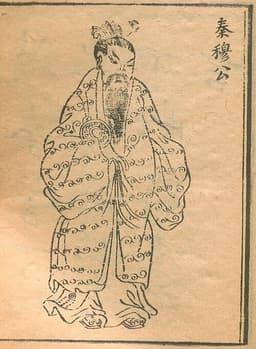
Duke Mu of Qin
Emperor · Ancient
52.9Total

Tiridates I of Armenia
Emperor · Ancient
52.8Total
Basic Information
Born
-683
24
Died
-621
88
Era
Ancient
Ancient
Nationality
China
Armenia
Occupation
Emperor
Emperor
Civilization
Eastern
Middle Eastern
Score Comparison
Military (10%)
52.5
35.0
Political (20%)
48.0
54.7
Influence (20%)
49.4
53.3
Legacy (20%)
44.2
46.7
Leadership (15%)
74.0
74.0
Strategy (15%)
60.0
50.0
TOTAL
52.9
52.8
Duke Mu of Qin — Complete Timeline
650 BC
Expanded Qin into Western TerritoriesWar◆ Major
Duke Mu of Qin led campaigns against the Rong and Di barbarian tribes to the west, conquering twelve minor states and opening up 1,000 li of territory. This expansion strengthened Qin and secured its western flank.
ExpansionBarbariansQin
Impact: regionalconstructive
645 BC
Allied with Jin StatePolitical Action◆ Major
Duke Mu formed an alliance with the state of Jin, marrying his daughter to Duke Hui of Jin. However, when Jin reneged on promises, Duke Mu attacked and defeated Jin at the Battle of Han, capturing Duke Hui.
AllianceJinBattle of Han
Impact: regional
636 BC
Aided Chong'er to Become Duke Wen of JinPolitical Action◆ Major
Duke Mu supported the exiled prince Chong'er, sending troops to help him return to Jin and become Duke Wen. This act created a powerful ally but also a future rival who would challenge Qin's dominance.
SupportJinDuke Wen
Impact: regionalconstructive
627 BC
Failed to Expand EastwardWar◆ Major
Duke Mu's attempt to expand eastward was thwarted by Jin at the Battle of Yao. Qin forces were ambushed and destroyed in a narrow pass, forcing Duke Mu to abandon eastern ambitions and focus on the west.
DefeatJinBattle of Yao
Impact: regionaldestructive
Tiridates I of Armenia — Complete Timeline
63 AD
Treaty of RhandeiaPolitical Action◆ Major
Tiridates I accepted the Treaty of Rhandeia, which ended the Roman-Parthian war over Armenia. Under the treaty, Tiridates was recognized as King of Armenia but agreed to receive his crown from the Roman emperor, making Armenia a client kingdom.
TreatyRoman-Parthian WarArmenia
Impact: regionalconstructive
66 AD
Coronation by Nero in RomePolitical Action◆ Major
Tiridates I traveled to Rome and was formally crowned King of Armenia by Emperor Nero in a public ceremony. This event established the Arsacid dynasty in Armenia under nominal Roman suzerainty, ending the Roman-Parthian war over Armenia.
CoronationRoman-Parthian RelationsArsacid Dynasty
Impact: regionalconstructive
Foundation of the Arsacid Dynasty of ArmeniaPolitical Action
Tiridates I became the first Arsacid king of Armenia, founding a dynasty that would rule Armenia for nearly four centuries. This established a Parthian royal line in Armenia, blending Parthian and Armenian cultures.
Dynasty FoundationArsacid DynastyArmenia
Impact: regionalconstructive
Expert Analysis
Origins
Duke Mu of Qin (r. 659–621 BCE) was born into the House of Ying, rulers of the semi-barbarian state of Qin in western China. His father, Duke Cheng, left him a small, peripheral state often dismissed by central plains kingdoms. Duke Mu received a traditional education in statecraft and military arts, but his early exposure to the Rong and Di tribes shaped his pragmatic worldview. Tiridates I (fl. 1st century CE) was a Parthian prince of the Arsacid dynasty, brother of King Vologases I. He was raised in the Parthian court, steeped in Zoroastrian tradition and Hellenistic influences. His early life involved military training and diplomatic exposure, preparing him for the contested throne of Armenia.
Rise to Power
Duke Mu ascended to the Qin throne in 659 BCE at age 20, inheriting a state ranked low among the Zhou feudal lords. His first major move was to secure an alliance with the powerful state of Jin through marriage, marrying his daughter to Duke Hui of Jin. However, when Jin reneged on territorial promises, Duke Mu launched punitive campaigns, defeating Jin at the Battle of Han (645 BCE). He later supported the exiled prince Chong'er, helping him become Duke Wen of Jin (636 BCE), which created a powerful ally but also a rival. Tiridates I rose during the Roman-Parthian struggle for Armenia. In 54 CE, the Roman emperor Claudius appointed a Roman client king, provoking Parthian intervention. Tiridates, backed by his brother Vologases I, invaded Armenia in 58 CE. After initial Roman successes, the war stalemated, leading to the Treaty of Rhandeia (63 CE), where Tiridates agreed to receive his crown from Nero, thus ending hostilities and founding the Arsacid dynasty of Armenia.
Leadership & Governance
Duke Mu governed Qin with a focus on territorial expansion and agricultural development. He implemented policies to integrate conquered Rong and Di peoples, granting them land and positions. His governance score of 48.0 reflects moderate political acumen; he relied on personal alliances rather than institutional reforms. Tiridates I, with a political score of 54.7, skillfully balanced Parthian and Roman interests. He accepted Roman suzerainty while maintaining Parthian cultural ties, establishing a stable dual monarchy. He minted coins with both Greek and Parthian legends, symbolizing his hybrid rule. Unlike Duke Mu's aggressive expansion, Tiridates focused on consolidation and diplomacy.
Triumph & Tragedy
Duke Mu's greatest triumph was his western expansion: he conquered twelve Rong and Di states, opening 1,000 li of territory and securing Qin's rear. This laid the foundation for future Qin dominance. His tragedy came at the Battle of Yao (627 BCE), where his attempt to expand eastward was crushed by Jin forces in a narrow pass, with Qin troops annihilated. This failure forced Qin to abandon eastern ambitions for generations. Tiridates I's triumph was founding the Arsacid dynasty, which ruled Armenia for nearly four centuries. He secured Roman recognition without sacrificing Parthian allegiance. His tragedy was the inherent fragility of his position: his coronation by Nero (66 CE) was a public spectacle that underscored Armenia's status as a buffer state. After Nero's fall, Tiridates faced renewed Roman pressure, though he retained his throne until his death around 88 CE.
Character & Destiny
Duke Mu was pragmatic and ambitious, but his character scores (Leadership 74.0, Strategy 60.0) reveal a cautious risk-taker. He allied with Jin even after betrayal, showing patience. His fatal mistake at Yao stemmed from overconfidence after years of success. Tiridates I, with identical Leadership 74.0 but lower Strategy 50.0, was more diplomatic than military. He accepted the Treaty of Rhandeia, which required him to travel to Rome and kneel before Nero—a humiliation that secured his dynasty. His destiny was to be a symbol of Armenian autonomy within imperial spheres.
Legacy
Duke Mu's legacy is foundational for Qin's eventual unification of China. His western expansion provided resources and security, while his failures taught future rulers the limits of power. He scored 49.4 in Influence and 44.2 in Legacy, reflecting his role as a stepping stone rather than a unifier. Tiridates I's legacy is more enduring: the Arsacid dynasty he founded ruled Armenia until 428 CE, shaping Armenian identity and culture. His coronation established a tradition of Roman-Parthian power-sharing. He scores 53.3 in Influence and 46.7 in Legacy, higher than Duke Mu in political and influence metrics.
Conclusion
While Duke Mu of Qin and Tiridates I have nearly identical total scores (52.9 vs 52.8), their impacts differ in scope. Duke Mu's conquests were necessary for Qin's rise but his failure at Yao limited his immediate effect. Tiridates I founded a dynasty that endured four centuries, defining Armenian kingship. Tiridates I had greater lasting influence: his political and influence scores (54.7 and 53.3) exceed Duke Mu's (48.0 and 49.4). Duke Mu's military score (52.5) is higher, but his strategic errors reduced his overall effectiveness. Therefore, Tiridates I emerges as the more impactful figure due to the longevity of his dynasty and his successful navigation of imperial politics.
Rankings
🥇
Duke Mu of QinLeader
Mil: 52.5Pol: 48.0Inf: 49.4
52.9
🥈
Tiridates I of Armenia
Mil: 35.0Pol: 54.7Inf: 53.3
52.8
+0.1 behind
How This Comparison Works
Algorithm
Each figure is scored on 6 dimensions (0—100 scale) based on structured historical data: Military (10%), Political (20%), Influence (20%), Legacy (20%), Leadership (15%), Strategy (15%). The weighted total produces the final ranking.
Data Sources
Scores are computed from structured sub-indicators in the database. Scale factors adjust for era (Ancient ×0.85, Modern ×1.0) and civilization size (Eastern ×1.05, Other ×0.80) to account for differences in population and military scale.
Maximum 3 Figures
Comparisons are limited to 2—3 figures to ensure readability and statistical meaningfulness.
Error Margins
±5 points per dimension — Sub-scores are derived from historical records with inherent uncertainty. Two figures within 5 points on a dimension should be considered roughly equivalent in that area.
Total Score Accuracy
±3 points overall — The weighted combination of 6 dimensions produces a total score with approximately ±3 points of uncertainty. Differences of less than 3 points are not statistically significant— the figures are effectively tied.
Known Limitations
- Historical records are incomplete and uneven across civilizations
- Figures from oral-tradition societies may be underrepresented
- Occupation labels can misclassify multi-role figures
- Scores measure capability and impact, not moral character
- Quantitative scoring is a comparison tool, not absolute truth
Capability Radar
Military (10%) — Battles & Warfare
Battles
45
20
Win Rate
50
25
Expansion
60
25
Political (20%) — Governance & Reform
Reform
40
30
Diplomacy
50
70
Economy
45
40
Influence (20%) — Cultural & Global Reach
Cultural
30
40
Global
25
40
Legacy (20%) — Historical Impact
Historical
45
55
Longevity
40
45
Leadership (15%) — Power & Stability
Tenure
55
60
Stability
50
50
Strategy (15%) — Tactics & Innovation
Strategy
55
30
Tactics
40
30
Reform
35
10
Similar Comparisons
Comments & Discussion
No comments yet. Be the first to share your thoughts!