Loading...
Douglas MacArthur vs Yang Su
Douglas MacArthur leads by 8.5 pts · 2 figures compared
…
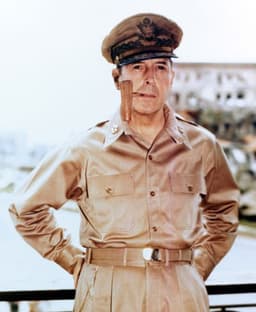
Douglas MacArthur
General · Modern
65.7Total

Yang Su
General · Medieval
57.2Total
Basic Information
Born
1880
544
Died
1964
606
Era
Modern
Medieval
Nationality
United States
China
Occupation
General
General
Civilization
Western
Eastern
Score Comparison
Military (10%)
85.0
80.0
Political (20%)
78.0
45.0
Influence (20%)
68.0
51.8
Legacy (20%)
40.0
45.0
Leadership (15%)
78.0
68.0
Strategy (15%)
68.0
80.5
TOTAL
65.7
57.2
Douglas MacArthur — Complete Timeline
1942 AD
Battle of Bataan and CorregidorWar◆ Major
MacArthur commanded US and Filipino forces defending the Bataan Peninsula and Corregidor Island against Japanese invasion. After months of resistance, he was ordered to evacuate to Australia, leaving his troops who later surrendered and endured the Bataan Death March.
World War IIPacific TheaterDefeat
Impact: regionaltragic
1944 AD
Return to the PhilippinesWar◆ Major
MacArthur led the Allied invasion of Leyte Gulf, fulfilling his promise 'I shall return.' The campaign liberated the Philippines from Japanese occupation, a major strategic victory in the Pacific War.
World War IIPacific TheaterVictory
Impact: regionalconstructive
1945 AD
Surrender of JapanWar
MacArthur, as Supreme Commander for the Allied Powers, accepted Japan's formal surrender aboard USS Missouri in Tokyo Bay. This ended World War II and began the Allied occupation of Japan under his leadership.
World War IIJapanOccupation
Impact: globalconstructive
Occupation of Japan ReformsReform◆ Major
MacArthur oversaw the Allied occupation of Japan, implementing sweeping reforms including a new constitution, land redistribution, women's suffrage, and demilitarization. These changes transformed Japan into a democratic and pacifist state.
JapanPost-WarDemocratization
Impact: globalprogressive
1950 AD
Inchon LandingWar◆ Major
MacArthur planned and executed a bold amphibious assault at Inchon, South Korea, behind North Korean lines. The operation cut North Korean supply lines and recaptured Seoul, turning the tide of the Korean War.
Korean WarAmphibious AssaultVictory
Impact: regionalconstructive
1951 AD
Dismissal by President TrumanPolitical Action◆ Major
President Harry S. Truman relieved MacArthur of command for insubordination after MacArthur publicly advocated for expanding the Korean War into China. The dismissal sparked a political controversy in the US and ended MacArthur's military career.
Korean WarCivil-Military RelationsDismissal
Impact: nationaldestructive
Yang Su — Complete Timeline
599 AD
Led Campaigns against the Tujue (Göktürks)War◆ Major
Yang Su commanded Sui forces in campaigns against the Eastern Tujue (G
Tujue CampaignsMilitary InnovationNorthern Frontier
Impact: regional
604 AD
Suppressed the Rebellion of Yang LiangWar◆ Major
After Emperor Yang of Sui ascended the throne, his brother Yang Liang rebelled in Bingzhou. Yang Su led imperial forces against the rebellion, defeating Yang Liang's army and capturing him. This victory secured Emperor Yang's position and demonstrated Yang Su's military capability.
Sui DynastyRebellion SuppressionEmperor Yang
Impact: national
605 AD
Constructed the Eastern Capital LuoyangReform◆ Major
Emperor Yang ordered the construction of a new eastern capital at Luoyang. Yang Su was appointed as one of the supervisors of the massive project. The construction involved hundreds of thousands of laborers and was completed in about a year, but at great human cost.
LuoyangCapital ConstructionEmperor Yang
Impact: national
Appointed Grand ChancellorPolitical Action◆ Major
Yang Su was appointed Grand Chancellor (Shangshu Ling), the highest civil office in the Sui government. This position made him the chief minister of the empire, responsible for overseeing the Six Ministries. He held this office until his death in 606.
Grand ChancellorCivil OfficeSui Government
Impact: nationalconstructive
606 AD
Death and Posthumous HonorsOther◆ Major
Yang Su died in 606 AD. Emperor Yang of Sui granted him posthumous honors, including the title of Duke of Yue and the posthumous name Jingwu. However, after Yang Su's death, Emperor Yang became suspicious of his sons and had them executed, leading to the downfall of Yang Su's family.
DeathPosthumous HonorsFamily Downfall
Impact: nationaltragic
Expert Analysis
Douglas MacArthur vs Yang Su
# The General and the Chancellor: Two Paths to Power
On a September morning in 1950, Douglas MacArthur stood on the deck of a command ship off the coast of Korea, watching columns of American Marines swarm ashore at Inchon. It was a gamble of breathtaking audacity—a landing at a port with treacherous tides and narrow approaches, far behind enemy lines. Half a world away and fourteen centuries earlier, another general, Yang Su, led a small cavalry force into the vast steppes of Central Asia, facing the dreaded Göktürks. Where his predecessors had relied on defensive formations, Yang Su ordered his men to advance in open order, abandoning the wagon fort for the charge. Both men defied convention. Both achieved stunning victories. But their fates diverged as sharply as the civilizations that produced them—one ending in public disgrace, the other in quiet, if uneasy, triumph.
Origins
Douglas MacArthur was born into the American military aristocracy. His father, Arthur MacArthur, had won the Medal of Honor at Missionary Ridge during the Civil War. Young Douglas grew up on frontier army posts, absorbing the rituals of command and the cult of duty. He entered West Point in 1899, graduating first in his class. The America of his youth was a rising empire, confident and expansionist, and MacArthur embodied that spirit utterly.
Yang Su came from a different world entirely. Born in 544 AD, he grew up in the chaos of the Northern and Southern Dynasties, when China was fractured and warlords ruled. His father, a general under the Northern Zhou, was killed in battle when Yang Su was young. He inherited not privilege but a blood debt. When the future Emperor Wen of Sui came to power, Yang Su threw in his lot with the new dynasty—a pragmatic choice that would define his career. Where MacArthur was born to command, Yang Su had to earn his place through cunning and ruthlessness.
Rise to Power
MacArthur’s ascent was steady and spectacular. He served as aide to President Theodore Roosevelt, helped suppress the Bonus Army protests in 1932, and became Army Chief of Staff in 1930. But his true moment came with World War II. After the fall of Bataan and Corregidor in 1942, MacArthur escaped to Australia, vowing "I shall return." That promise became a personal crusade, a bond between the general and the Filipino people that transcended military strategy.
Yang Su rose through the ranks of the Sui dynasty by delivering results. When Emperor Wen needed someone to pacify the turbulent south, Yang Su led campaigns that crushed resistance with brutal efficiency. He did not make promises to the people; he made calculations for the throne. His greatest political asset was his ability to read the emperor’s mind. When Emperor Yang succeeded his father in 604, Yang Su quickly crushed the rebellion of the new emperor’s brother, Yang Liang, cementing his position as the regime’s indispensable enforcer.
Leadership & Governance
MacArthur governed Japan from 1945 to 1951 as a proconsul with near-absolute authority. He imposed a new constitution, broke up the zaibatsu conglomerates, redistributed land to peasants, and granted women the vote. He saw himself as a democratizing force, a modernizer bringing enlightenment to a defeated enemy. His rule was benevolent but autocratic—he consulted no Japanese parliament, answered to no local assembly. He was the law.
Yang Su governed as Grand Chancellor from 605 AD, the highest civil office in the Sui state. But he never sought to transform society. His job was to keep the empire running while Emperor Yang launched grandiose projects—the Grand Canal, the reconstruction of Luoyang, and disastrous campaigns against Korea. Yang Su supervised the construction of the new eastern capital, driving thousands of laborers to complete it on schedule. He was efficient, ruthless, and utterly loyal to the throne. Unlike MacArthur, he never imagined himself a reformer. He was a servant of power, not its source.
Triumph & Tragedy
MacArthur’s greatest triumph was the Inchon landing in September 1950. It was a masterpiece of strategic imagination—a 90-degree turn that caught the North Koreans completely off guard. Within weeks, his forces had recaptured Seoul and driven the enemy back to the Yalu River. But triumph turned to tragedy when China intervened. MacArthur’s insistence on expanding the war, his public threats to bomb Manchuria, and his open defiance of President Truman led to his dismissal in April 1951. The hero of the Pacific returned home to parades and a speech to Congress, but his career was over.
Yang Su’s tragedy was subtler. He died of illness in 606 AD, honored with posthumous titles and a magnificent funeral. But his legacy was poisoned by association. Emperor Yang’s megalomania would destroy the Sui dynasty within a decade of Yang Su’s death. The general’s son, Yang Xuangan, led a rebellion against the emperor, confirming every suspicion that the Yang family had grown too powerful. The man who had saved the dynasty twice could not save his own blood from its wrath.
Character & Destiny
MacArthur was a man of grand gestures and wounded pride. He believed in destiny—his own and America’s. He once told Congress, "Old soldiers never die; they just fade away." But he could not fade gracefully. His dismissal was a clash of two constitutional principles: civilian control of the military versus a general’s sense of mission. He chose mission over obedience, and paid the price.
Yang Su was a man of cold calculation. He understood that in imperial China, a general who won too many battles became a threat to the throne. He deliberately cultivated an image of corruption and indulgence, accepting bribes and building lavish mansions, to appear harmless. His strategy worked—he died in bed, not on the execution ground. But the price was obscurity. While MacArthur’s name is carved into the American memory, Yang Su is known only to scholars of Chinese history.
Legacy
MacArthur’s legacy is a paradox. His occupation of Japan laid the foundations for a democratic, prosperous ally that endures to this day. His military innovations—especially amphibious warfare—changed how wars are fought. But his insubordination in Korea remains a cautionary tale about the limits of military power in a democracy. He is remembered as both liberator and cautionary figure.
Yang Su’s legacy is more ambiguous. He helped unify China and consolidate Sui rule, but his methods were brutal and his loyalty absolute. He left no political philosophy, no lasting institution. The Sui dynasty collapsed, and his name faded. In Chinese historical memory, he is a footnote—a capable but amoral instrument of a tyrannical regime.
Conclusion
The differences between MacArthur and Yang Su are not merely personal but civilizational. MacArthur operated in a system where a general could become a public figure, accountable to the people and the press. Yang Su operated in a system where a general was a servant of the emperor, whose survival depended on obscurity. One sought glory and found disgrace. One sought survival and found oblivion. Their stories remind us that the same qualities—ambition, brilliance, ruthlessness—produce different outcomes depending on the stage on which they are performed. The general who defies his president and the general who outlives his emperor are both, in the end, prisoners of their times.
Rankings
🥇
Douglas MacArthurLeader
Mil: 85.0Pol: 78.0Inf: 68.0
65.7
🥈
Yang Su
Mil: 80.0Pol: 45.0Inf: 51.8
57.2
+8.5 behind
How This Comparison Works
Algorithm
Each figure is scored on 6 dimensions (0—100 scale) based on structured historical data: Military (10%), Political (20%), Influence (20%), Legacy (20%), Leadership (15%), Strategy (15%). The weighted total produces the final ranking.
Data Sources
Scores are computed from structured sub-indicators in the database. Scale factors adjust for era (Ancient ×0.85, Modern ×1.0) and civilization size (Eastern ×1.05, Other ×0.80) to account for differences in population and military scale.
Maximum 3 Figures
Comparisons are limited to 2—3 figures to ensure readability and statistical meaningfulness.
Error Margins
±5 points per dimension — Sub-scores are derived from historical records with inherent uncertainty. Two figures within 5 points on a dimension should be considered roughly equivalent in that area.
Total Score Accuracy
±3 points overall — The weighted combination of 6 dimensions produces a total score with approximately ±3 points of uncertainty. Differences of less than 3 points are not statistically significant— the figures are effectively tied.
Known Limitations
- Historical records are incomplete and uneven across civilizations
- Figures from oral-tradition societies may be underrepresented
- Occupation labels can misclassify multi-role figures
- Scores measure capability and impact, not moral character
- Quantitative scoring is a comparison tool, not absolute truth
Capability Radar
Military (10%) — Battles & Warfare
Battles
85
85
Win Rate
75
90
Expansion
85
80
Political (20%) — Governance & Reform
Reform
85
65
Diplomacy
75
60
Economy
70
55
Influence (20%) — Cultural & Global Reach
Cultural
70
45
Global
80
35
Legacy (20%) — Historical Impact
Historical
85
60
Longevity
70
40
Leadership (15%) — Power & Stability
Tenure
80
70
Stability
65
50
Strategy (15%) — Tactics & Innovation
Strategy
90
85
Tactics
80
88
Reform
70
75
Similar Comparisons
Comments & Discussion
MACARTHUR FANBOY6/16/2026
Inchon was a masterstroke of strategic audacity, but let's not pretend MacArthur was some tactical genius—he inherited America's industrial might and naval supremacy. Yang Su faced a harsher reality: outnumbered on the steppe with inferior logistics. MacArthur had the luxury of overwhelming firepower; Yang Su had to innovate with open-order cavalry tactics against the Göktürks. That's real generalship against the odds, not a beach landing with total air cover. Give me the Sui dynasty maverick ov
数据侦探6/16/2026
这对比根本不对等。麦克阿瑟在仁川有260艘军舰和500架飞机掩护,伤亡仅200人;杨素对付突厥时骑的是蒙古马,靠的是“破阵法”这种冷兵器创新。说“相似”纯属数据谎言,核心变量差了几个量级。拿20世纪海空一体化战役比6世纪草原突袭,就像用F-35比投石机—逻辑崩坏。
CLASSICS SCHOLAR6/16/2026
Both men understood *fortuna* but wielded it differently. MacArthur saw himself as a Roman proconsul—staging his own *triumphus* at Inchon, defying the Senate in Washington. Yang Su, however, mastered the Chinese art of *quanbian*—strategic flexibility within a rigid bureaucracy. When Sui Emperor Wen suspected him, Yang Su pivoted to palace administration, surviving while MacArthur got sacked for insubordination. One read Livy; the other, Sunzi. Their fates reflect their philosophical roots: hub
历史修正派6/16/2026
少给杨素贴金了,他那套“破阵法”本质是靠叛徒带路和血腥镇压游牧部落换来的胜利。史书说他“驭下严酷,士卒多死”,打仗时用囚犯当敢死队—这叫创新?分明是军阀式的消耗战。麦克阿瑟至少守住了战后秩序,杨素死后被炀帝清算抄家,说明他根本不懂政治博弈的长期成本。两个都是时代的独裁者,别浪漫化了。