Loading...
Douglas MacArthur vs Soeharto
Douglas MacArthur leads by 3.7 pts · 2 figures compared
…
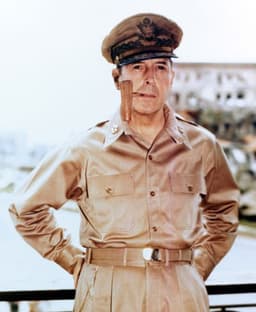
Douglas MacArthur
General · Modern
65.7Total
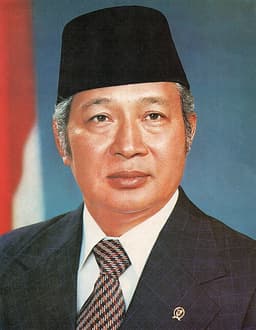
Soeharto
General · Modern
62.0Total
Basic Information
Born
1880
1921
Died
1964
—
Era
Modern
Modern
Nationality
United States
Indonesia
Occupation
General
General
Civilization
Western
Eastern
Score Comparison
Military (10%)
85.0
55.0
Political (20%)
78.0
70.0
Influence (20%)
68.0
55.0
Legacy (20%)
40.0
58.0
Leadership (15%)
78.0
78.0
Strategy (15%)
68.0
60.0
TOTAL
65.7
62.0
Douglas MacArthur — Complete Timeline
1942 AD
Battle of Bataan and CorregidorWar◆ Major
MacArthur commanded US and Filipino forces defending the Bataan Peninsula and Corregidor Island against Japanese invasion. After months of resistance, he was ordered to evacuate to Australia, leaving his troops who later surrendered and endured the Bataan Death March.
World War IIPacific TheaterDefeat
Impact: regionaltragic
1944 AD
Return to the PhilippinesWar◆ Major
MacArthur led the Allied invasion of Leyte Gulf, fulfilling his promise 'I shall return.' The campaign liberated the Philippines from Japanese occupation, a major strategic victory in the Pacific War.
World War IIPacific TheaterVictory
Impact: regionalconstructive
1945 AD
Surrender of JapanWar
MacArthur, as Supreme Commander for the Allied Powers, accepted Japan's formal surrender aboard USS Missouri in Tokyo Bay. This ended World War II and began the Allied occupation of Japan under his leadership.
World War IIJapanOccupation
Impact: globalconstructive
Occupation of Japan ReformsReform◆ Major
MacArthur oversaw the Allied occupation of Japan, implementing sweeping reforms including a new constitution, land redistribution, women's suffrage, and demilitarization. These changes transformed Japan into a democratic and pacifist state.
JapanPost-WarDemocratization
Impact: globalprogressive
1950 AD
Inchon LandingWar◆ Major
MacArthur planned and executed a bold amphibious assault at Inchon, South Korea, behind North Korean lines. The operation cut North Korean supply lines and recaptured Seoul, turning the tide of the Korean War.
Korean WarAmphibious AssaultVictory
Impact: regionalconstructive
1951 AD
Dismissal by President TrumanPolitical Action◆ Major
President Harry S. Truman relieved MacArthur of command for insubordination after MacArthur publicly advocated for expanding the Korean War into China. The dismissal sparked a political controversy in the US and ended MacArthur's military career.
Korean WarCivil-Military RelationsDismissal
Impact: nationaldestructive
Soeharto — Complete Timeline
1966 AD
Assumed Power via SupersemarPolitical Action
Soeharto received the Supersemar order from President Sukarno, granting him authority to restore order after the 30 September Movement. This marked the beginning of his rise to power.
Power TransitionSupersemarIndonesia
Impact: national
1967 AD
Inaugurated as Acting PresidentPolitical Action◆ Major
Soeharto was inaugurated as acting president, replacing Sukarno. He formally became president in 1968, beginning the New Order regime that lasted 32 years.
PresidencyNew OrderIndonesia
Impact: national
1975 AD
Invasion of East TimorWar◆ Major
Soeharto ordered the invasion of East Timor following its declaration of independence. The occupation resulted in widespread human rights abuses and an estimated 100,000-200,000 deaths.
InvasionEast TimorHuman Rights
Impact: regionaldestructive
1998 AD
Resignation Amidst Economic CrisisPolitical Action
Soeharto resigned as president after massive protests triggered by the Asian Financial Crisis. His resignation ended the New Order regime and led to democratic reforms.
ResignationCrisisReformasi
Impact: nationaltragic
Expert Analysis
Douglas MacArthur vs Soeharto
### The General and the Strongman
In the summer of 1945, Douglas MacArthur stood on the deck of the USS *Missouri* in Tokyo Bay, the master of a defeated empire. He was the face of American victory, a man who seemed to stride across history. Four decades later, in the spring of 1998, another general, Soeharto of Indonesia, sat alone in a Jakarta palace, his 32-year rule crumbling under the weight of economic collapse and street protests. One was dismissed by his own president for being too ambitious; the other was forced out by his own people for staying too long. They were both generals, both wielded immense power, and both shaped the post-war destiny of Asia. Yet their paths, their characters, and their legacies could not have been more different. What drove one to a tragic, glorious downfall, and the other to a long, corroding twilight?
### Origins
Douglas MacArthur was born into the American military aristocracy. His father, Arthur MacArthur, was a Civil War hero and a governor-general of the Philippines. Douglas grew up on army posts, breathing the air of duty and destiny. He graduated first in his class at West Point, a man groomed for command from childhood. His world was one of clear enemies, clear victories, and a manifest American purpose.
Soeharto was born into the Javanese peasantry, the son of a minor irrigation official. He grew up in a world of spirits, village hierarchies, and quiet endurance. He never finished high school. He joined the Dutch colonial army, then the Japanese-sponsored militia during World War II, learning the arts of survival and patience. His world was one of indirect power, shadowy networks, and the slow accumulation of influence. One man was forged in the bright light of a military academy; the other was shaped in the humid darkness of a rice paddy.
### Rise to Power
MacArthur’s rise was a story of audacity and fame. He became the youngest superintendent of West Point, then the Army Chief of Staff. But his legend was sealed in the Pacific War. After the fall of Bataan in 1942, he escaped to Australia, vowing, “I shall return.” In 1944, he did, wading ashore at Leyte Gulf in a carefully staged moment of triumph. He accepted Japan’s surrender in 1945, becoming the virtual emperor of a shattered nation.
Soeharto’s rise was a story of crisis and cunning. In 1965, Indonesia was torn apart by a failed coup and anti-communist massacres. General Soeharto, a relatively obscure commander, seized the moment. In 1966, he received the “Supersemar” order from President Sukarno, a vaguely worded decree that gave him authority to restore order. He used it to dismantle the old regime, purge the left, and install himself as acting president in 1967. Where MacArthur rode the wave of a world war, Soeharto navigated the murky currents of a civil conflict.
### Leadership & Governance
MacArthur governed Japan from 1945 to 1951 with a mixture of arrogance and idealism. He imposed a new constitution, granted women the vote, broke up the zaibatsu monopolies, and distributed land to peasants. He saw himself as a proconsul, a Roman governor bringing civilization to the barbarians. His reforms were sweeping, but they were also imperial. He did not ask the Japanese what they wanted; he told them.
Soeharto governed Indonesia with a different kind of paternalism. His “New Order” was about stability, not transformation. He crushed dissent, imprisoned opponents, and built a network of crony capitalism. He also presided over rapid economic growth, lifting millions out of poverty. But his rule was a bargain: prosperity for obedience. He did not reform Indonesia; he managed it.
In war, MacArthur was a master of the bold stroke. His Inchon Landing in 1950 was a tactical masterpiece, a gamble that broke the North Korean army. In peace, Soeharto was a master of the slow squeeze. His invasion of East Timor in 1975 was a brutal, grinding occupation that killed tens of thousands. One general fought wars to win them; the other fought wars to silence them.
### Triumph & Tragedy
MacArthur’s greatest triumph was the occupation of Japan. He turned an enemy into an ally, a dictatorship into a democracy. His greatest tragedy was Korea. He pushed the war too far, provoking Chinese intervention, and then defied his commander-in-chief, President Truman. His dismissal in 1951 was a national drama. He returned home to a hero’s welcome, but his career was over. He had become a victim of his own legend.
Soeharto’s greatest triumph was economic development. Indonesia, the “sick man of Asia,” became a tiger. His greatest tragedy was the Asian Financial Crisis of 1997-98. The crony empire collapsed. The rupiah plunged. Students filled the streets. In May 1998, he resigned, a bitter end to a 32-year reign. He had become a victim of his own system.
### Character & Destiny
MacArthur was a man of grand gestures and fatal pride. He believed he was chosen by destiny. He once said, “Old soldiers never die; they just fade away.” But he did not fade. He burned out in a blaze of insubordination. His character drove him to greatness and to ruin.
Soeharto was a man of silence and calculation. He believed in *nrimo*, the Javanese concept of acceptance. He did not seek glory; he sought control. His character kept him in power for three decades, but it also made him blind to the fragility of his regime. One man could not stop fighting; the other could not stop holding on.
### Legacy
MacArthur is remembered as a flawed giant. His military genius is undeniable, but his political judgment is suspect. He is a symbol of American power at its most confident and its most reckless. His statue stands in West Point, a reminder of what ambition can achieve and what it can destroy.
Soeharto is remembered as a development dictator. He is credited with modernizing Indonesia, but also blamed for corruption and human rights abuses. His legacy is deeply contested. Some Indonesians remember the rice and the roads; others remember the disappeared. He is a symbol of the bargain between order and freedom.
### Conclusion
Standing on the deck of the *Missouri*, MacArthur could see the horizon. He thought he was the architect of a new Asia. Sitting in his palace, Soeharto could only see the walls. He thought he was the guardian of an old one. In the end, both men were swept away by forces they could not control—MacArthur by the limits of American democracy, Soeharto by the tides of a global economy. They remind us that generals are not masters of history. They are its servants, and sometimes its victims.
Rankings
🥇
Douglas MacArthurLeader
Mil: 85.0Pol: 78.0Inf: 68.0
65.7
🥈
Soeharto
Mil: 55.0Pol: 70.0Inf: 55.0
62.0
+3.7 behind
How This Comparison Works
Algorithm
Each figure is scored on 6 dimensions (0—100 scale) based on structured historical data: Military (10%), Political (20%), Influence (20%), Legacy (20%), Leadership (15%), Strategy (15%). The weighted total produces the final ranking.
Data Sources
Scores are computed from structured sub-indicators in the database. Scale factors adjust for era (Ancient ×0.85, Modern ×1.0) and civilization size (Eastern ×1.05, Other ×0.80) to account for differences in population and military scale.
Maximum 3 Figures
Comparisons are limited to 2—3 figures to ensure readability and statistical meaningfulness.
Error Margins
±5 points per dimension — Sub-scores are derived from historical records with inherent uncertainty. Two figures within 5 points on a dimension should be considered roughly equivalent in that area.
Total Score Accuracy
±3 points overall — The weighted combination of 6 dimensions produces a total score with approximately ±3 points of uncertainty. Differences of less than 3 points are not statistically significant— the figures are effectively tied.
Known Limitations
- Historical records are incomplete and uneven across civilizations
- Figures from oral-tradition societies may be underrepresented
- Occupation labels can misclassify multi-role figures
- Scores measure capability and impact, not moral character
- Quantitative scoring is a comparison tool, not absolute truth
Capability Radar
Military (10%) — Battles & Warfare
Battles
85
35
Win Rate
75
40
Expansion
85
20
Political (20%) — Governance & Reform
Reform
85
55
Diplomacy
75
65
Economy
70
70
Influence (20%) — Cultural & Global Reach
Cultural
70
50
Global
80
55
Legacy (20%) — Historical Impact
Historical
85
60
Longevity
70
55
Leadership (15%) — Power & Stability
Tenure
80
85
Stability
65
75
Strategy (15%) — Tactics & Innovation
Strategy
90
45
Tactics
80
30
Reform
70
60
Similar Comparisons
Comments & Discussion
Patton's Ghost6/16/2026
Let me settle the "too ambitious vs staying too long" nonsense. MacArthur wasn't dismissed for ambition—he was dismissed for trying to expand the Korean War into China and nearly triggering World War III. Truman had every right to fire him. Soeharto stayed for 32 years because he crushed his opposition with the military, not because the people wanted him. One was a glory-hound who couldn't follow orders; the other was a dictator who followed only his own survival instinct.|血手将军|zh|别拿麦克阿瑟的"悲剧堕落"糊