Loading...
Doris Leuthard vs Napoleon Bonaparte
Napoleon Bonaparte leads by 15.7 pts · 2 figures compared
…
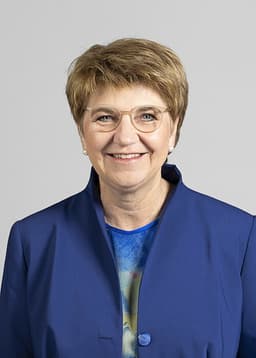
Doris Leuthard
Politician · Modern
55.2Total

Napoleon Bonaparte
General · Modern
70.9Total
Basic Information
Born
1963
1769
Died
—
1821
Era
Modern
Modern
Nationality
Switzerland
France
Occupation
Politician
General
Civilization
Western
Western
Score Comparison
Military (10%)
50.0
94.0
Political (20%)
61.0
72.0
Influence (20%)
54.9
40.0
Legacy (20%)
44.2
80.0
Leadership (15%)
80.0
78.0
Strategy (15%)
42.3
90.0
TOTAL
55.2
70.9
Doris Leuthard — Complete Timeline
2010 AD
Elected President of the Swiss ConfederationPolitical Action◆ Major
Leuthard was elected President of the Swiss Confederation for 2010, focusing on energy policy and sustainable development. She was the second woman to hold the office, following Micheline Calmy-Rey.
PresidencyEnergy PolicyGender Equality
Impact: nationalprogressive
Led the Federal Department of Environment, Transport, Energy and CommunicationsPolitical Action◆ Major
Leuthard was elected to the Federal Council and headed the Federal Department of Environment, Transport, Energy and Communications from 2010 to 2018. She oversaw policies on climate change, infrastructure, and digitalization.
Federal CouncilEnvironmentTransport
Impact: nationalconstructive
2011 AD
Championed the Energy Strategy 2050Reform
Leuthard spearheaded the Energy Strategy 2050, a comprehensive plan to transition Switzerland away from nuclear power and fossil fuels toward renewable energy. The strategy included measures to increase energy efficiency and promote solar, wind, and hydroelectric power.
Energy TransitionRenewable EnergyNuclear Phase-out
Impact: nationalprogressive
2016 AD
Advocated for Digitalization and InnovationReform
Leuthard promoted digitalization in Switzerland, including the development of e-government services and support for digital startups. She emphasized the importance of innovation for Switzerland's economic competitiveness.
DigitalizationInnovationE-Government
Impact: nationalconstructive
2017 AD
Re-elected President of the Swiss ConfederationPolitical Action
Leuthard was re-elected as President of the Swiss Confederation for 2017, a rare second term. She continued her work on energy transition and digitalization, advocating for a sustainable and innovative Switzerland.
PresidencyRe-electionSustainability
Impact: nationalconstructive
2018 AD
Resigned from the Federal CouncilPolitical Action
Leuthard announced her resignation from the Federal Council, effective at the end of 2018. She cited a desire to step down after eight years in office. Her legacy includes the Energy Strategy 2050 and digitalization efforts.
ResignationFederal CouncilLegacy
Impact: national
Napoleon Bonaparte — Complete Timeline
1799 AD
Coup of 18 BrumaireOther◆ Major
Napoleon Bonaparte, with support from his brother Lucien and key political figures, overthrew the Directory in a bloodless coup. He established the Consulate with himself as First Consul, effectively becoming the ruler of France. This event ended the French Revolution's most unstable period.
French RevolutionCoupRise to Power
Impact: regional
1804 AD
Promulgation of the Napoleonic CodeOther◆ Major
Napoleon enacted the Civil Code of the French, known as the Napoleonic Code, a comprehensive set of laws that replaced the fragmented feudal legal systems. The code established legal equality, protected property rights, and secularized law. It became the basis for legal systems in many European and world countries.
Legal ReformNapoleonic CodeCivil Law
Impact: globalconstructive
1805 AD
Battle of AusterlitzWar◆ Major
Napoleon's Grande Arm
Napoleonic WarsBattleDecisive Victory
Impact: global
1812 AD
Invasion of RussiaWar◆ Major
Napoleon led the Grande Arm
Napoleonic WarsInvasionDisaster
Impact: globaldestructive
1815 AD
Battle of WaterlooWar◆ Major
Napoleon's French army was defeated by the combined forces of the Duke of Wellington's Anglo-Allied army and Gebhard Leberecht von Bl
Napoleonic WarsBattleFinal Defeat
Impact: globaldestructive
Expert Analysis
doris-leuthard-vs-napoleon-bonaparte
# The Emperor and the Engineer: Napoleon Bonaparte and Doris Leuthard
On a June morning in 1815, Napoleon Bonaparte surveyed a muddy field near Waterloo, his Grande Armée arrayed for what would be his final gamble. Two centuries later, on a crisp January day in Bern, Doris Leuthard took the oath of office as President of the Swiss Confederation, her domain not a battlefield but a conference room. Between these two figures lies a chasm so vast it seems to defy comparison—and yet, in that very gulf, we find the most revealing story of how power, ambition, and circumstance shape the human journey through history.
Origins
Napoleon was born in 1769 on the rugged island of Corsica, a place that had only recently become French. His family were minor nobles, proud and impoverished, and the young Napoleon grew up speaking Italian-accented French, an outsider in a nation he would one day rule. The French Revolution erupted when he was twenty, a cataclysm that shattered the old order and opened paths unimaginable under the Bourbon monarchy. For a boy with a military education and a hunger for glory, the timing was perfect.
Doris Leuthard was born in 1963 in Merenschwand, a small Swiss village where cows outnumber people. Switzerland in the 1960s was a placid, prosperous republic, untouched by the wars that had ravaged its neighbors. Her father ran a farm; her mother taught school. There were no revolutions, no collapsing empires—only the steady hum of consensus and compromise that defines Swiss democracy. Leuthard studied law, entered politics through the Christian Democratic People's Party, and climbed a ladder built not for conquerors but for conciliators.
Rise to Power
Napoleon’s ascent was a masterpiece of audacity. At twenty-four, he crushed a royalist uprising in Paris with a "whiff of grapeshot," earning the gratitude of the revolutionary government. By twenty-six, he was commanding the Army of Italy, winning battles that seemed impossible. In 1799, he staged a coup d'état and made himself First Consul. Five years later, he crowned himself Emperor in Notre-Dame Cathedral, taking the crown from the Pope’s hands and placing it on his own head. Each step was a gamble, each victory a springboard.
Leuthard’s rise was methodical, almost invisible by comparison. She served in the cantonal government of Aargau, then won election to the National Council in 1999. In 2006, she was elected to the Federal Council, Switzerland’s seven-member executive body. Her presidency came in 2010, a rotating position that changes every year. Where Napoleon seized power, Leuthard was given it—and only temporarily. The contrast is not merely personal; it is structural. Revolutionary France rewarded ambition; consensual Switzerland rewarded patience.
Leadership & Governance
Napoleon governed as he conquered: with energy, genius, and an iron will. His Napoleonic Code, enacted in 1804, standardized French law across his empire, abolishing feudal privileges and establishing legal equality. He reformed education, built roads, and centralized the state. But his greatest achievement was also his greatest flaw: he could not stop. The same drive that carried him from Corsica to Moscow pushed him beyond all reasonable limits. "Power is my mistress," he once said. "I have worked too hard at her conquest to allow anyone to take her from me."
Leuthard’s governance was the antithesis of Napoleonic ambition. As head of the Federal Department of Environment, Transport, Energy and Communications, she championed the Energy Strategy 2050, a plan to phase out nuclear power and transition to renewable energy. She promoted digitalization, e-government, and sustainable development. Her methods were not decrees but consultations, not commands but referendums. In 2017, she was re-elected president—a rare honor in a system that prizes rotation—because her colleagues trusted her ability to build consensus, not to impose her will.
Triumph & Tragedy
Napoleon’s triumphs were breathtaking: Austerlitz in 1805, where he destroyed the combined armies of Russia and Austria; Jena in 1806, where he crushed Prussia; the creation of a continental empire that stretched from Spain to Poland. His tragedy was equally vast: the disastrous invasion of Russia in 1812, where he lost half a million men; the defeat at Leipzig in 1813; exile to Elba; the final, crushing blow at Waterloo in 1815. He died in 1821 on the remote island of Saint Helena, a prisoner of the British, his empire reduced to memory.
Leuthard’s triumphs were quieter but more durable. The Energy Strategy 2050, approved by Swiss voters in a 2017 referendum, set the nation on a course toward carbon neutrality. She helped steer Switzerland through the digital revolution, modernizing a government that had changed little since the nineteenth century. Her tragedy, if it can be called that, was the opposite of Napoleon’s: she succeeded so thoroughly that her work became invisible. When she resigned in 2018, citing a desire to step down, she left behind no dramatic collapse—only a country that continued to function smoothly, as it always had.
Character & Destiny
Napoleon’s character was forged in fire. He was restless, brilliant, and incapable of contentment. "Glory is fleeting," he said, "but obscurity is forever." That belief drove him to conquer, to reform, to dare everything. It also destroyed him. His personality was a force of nature, but nature does not negotiate—it overwhelms. At his peak, he commanded the loyalty of millions; in his fall, he left Europe littered with corpses and exhausted by war.
Leuthard’s character was shaped by consensus. She was pragmatic, patient, and skilled at the art of the possible. She did not seek glory; she sought results. In a system where power is shared and decisions are slow, her temperament was an asset. Where Napoleon’s personality bent history to his will, Leuthard’s personality allowed history to flow through her. One was a storm; the other, a channel.
Legacy
Napoleon’s legacy is written in stone and blood. His legal code underpins the civil law systems of much of Europe. His military tactics are still studied in war colleges. His name evokes both admiration and horror, a symbol of ambition unleashed. He is remembered as a titan, flawed but magnificent, a man who remade the world in his image and was broken by the attempt.
Doris Leuthard’s legacy is written in policy and practice. Switzerland’s energy transition is her monument, though few tourists visit it. She is remembered as competent, steady, and effective—a leader who did her job and then stepped aside. In a world that celebrates Napoleonic drama, her legacy is almost invisible. But perhaps that is the point. Not every leader needs to conquer; some need only to govern.
Conclusion
Standing at the grave of Napoleon on Saint Helena, one feels the weight of a life lived at full throttle—a life of glory and ruin, of ambition and despair. Standing in the quiet streets of Bern, one feels something different: the hum of a well-ordered society, the product of countless small decisions made by people who valued stability over spectacle. The difference between Napoleon Bonaparte and Doris Leuthard is not merely a difference of personality or era. It is a difference of worlds—one built for heroes, the other for citizens. And in that difference lies the deepest question of all: what kind of world do we want to build?
Rankings
🥇
Napoleon BonaparteLeader
Mil: 94.0Pol: 72.0Inf: 40.0
70.9
🥈
Doris Leuthard
Mil: 50.0Pol: 61.0Inf: 54.9
55.2
+15.7 behind
How This Comparison Works
Algorithm
Each figure is scored on 6 dimensions (0—100 scale) based on structured historical data: Military (10%), Political (20%), Influence (20%), Legacy (20%), Leadership (15%), Strategy (15%). The weighted total produces the final ranking.
Data Sources
Scores are computed from structured sub-indicators in the database. Scale factors adjust for era (Ancient ×0.85, Modern ×1.0) and civilization size (Eastern ×1.05, Other ×0.80) to account for differences in population and military scale.
Maximum 3 Figures
Comparisons are limited to 2—3 figures to ensure readability and statistical meaningfulness.
Error Margins
±5 points per dimension — Sub-scores are derived from historical records with inherent uncertainty. Two figures within 5 points on a dimension should be considered roughly equivalent in that area.
Total Score Accuracy
±3 points overall — The weighted combination of 6 dimensions produces a total score with approximately ±3 points of uncertainty. Differences of less than 3 points are not statistically significant— the figures are effectively tied.
Known Limitations
- Historical records are incomplete and uneven across civilizations
- Figures from oral-tradition societies may be underrepresented
- Occupation labels can misclassify multi-role figures
- Scores measure capability and impact, not moral character
- Quantitative scoring is a comparison tool, not absolute truth
Capability Radar
Military (10%) — Battles & Warfare
Battles
26
95
Win Rate
31
90
Expansion
38
95
Political (20%) — Governance & Reform
Reform
70
95
Diplomacy
68
80
Economy
65
85
Influence (20%) — Cultural & Global Reach
Cultural
30
85
Global
40
90
Legacy (20%) — Historical Impact
Historical
35
95
Longevity
30
90
Leadership (15%) — Power & Stability
Tenure
65
85
Stability
70
70
Strategy (15%) — Tactics & Innovation
Strategy
37
95
Tactics
38
98
Reform
46
92
Similar Comparisons
Comments & Discussion
No comments yet. Be the first to share your thoughts!