Loading...
Dinh Tien Hoang vs Rurik
Dinh Tien Hoang leads by 0.8 pts · 2 figures compared
…
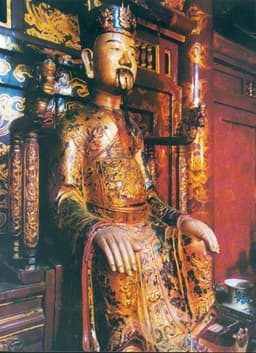
Dinh Tien Hoang
Emperor · Medieval
60.4Total
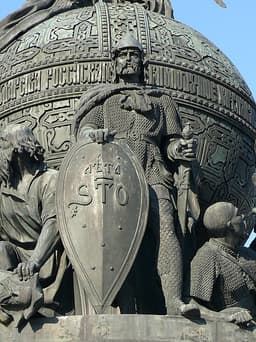
Rurik
Emperor · Medieval
59.6Total
Basic Information
Born
924
830
Died
979
879
Era
Medieval
Medieval
Nationality
Vietnam
Kievan Rus
Occupation
Emperor
Emperor
Civilization
Eastern
Western
Score Comparison
Military (10%)
60.0
50.0
Political (20%)
72.0
35.1
Influence (20%)
65.0
82.0
Legacy (20%)
40.0
68.0
Leadership (15%)
77.2
55.3
Strategy (15%)
58.0
35.7
TOTAL
60.4
59.6
Dinh Tien Hoang — Complete Timeline
968 AD
Defeat of the Twelve WarlordsWar
Dinh Bo Linh, later known as Dinh Tien Hoang, unified Vietnam by defeating the Twelve Warlords who had divided the country after the collapse of Chinese rule. He established the Dinh dynasty and became the first emperor of an independent Vietnam.
UnificationDinh DynastyVietnamese Independence
Impact: nationalconstructive
Establishment of the Dinh DynastyPolitical Action◆ Major
Dinh Tien Hoang founded the Dinh dynasty and declared himself Emperor. He moved the capital to Hoa Lu and implemented administrative reforms to consolidate power. This marked the beginning of a new era of Vietnamese independence after centuries of Chinese domination.
Dynasty FoundingCapital MoveAdministrative Reform
Impact: nationalconstructive
979 AD
Assassination of Dinh Tien HoangPolitical Action◆ Major
Dinh Tien Hoang and his crown prince were assassinated by a court official while sleeping. The murder plunged the Dinh dynasty into chaos, leading to a succession crisis and eventual takeover by Le Hoan. The assassination ended the short-lived Dinh dynasty.
AssassinationSuccession CrisisEnd of Dinh Dynasty
Impact: nationaltragic
Rurik — Complete Timeline
860 AD
Sent Askold and Dir to ConstantinopleWar
According to tradition, Rurik sent his lieutenants Askold and Dir to raid Constantinople. While the historicity is uncertain, this event is associated with the first Rus' attack on the Byzantine Empire, highlighting early Rus' expansion.
RaidByzantine EmpireExpansion
Impact: regional
862 AD
Founded the Rurik dynastyPolitical Action
According to the Primary Chronicle, Rurik, a Varangian chieftain, was invited by Slavic and Finnic tribes to rule over them. He established his capital at Novgorod, founding the Rurik dynasty that would rule Kievan Rus' and later the Tsardom of Russia until 1598.
FoundationVarangianKievan Rus'
Impact: global
864 AD
Consolidated control over NovgorodPolitical Action◆ Major
Rurik consolidated his rule over Novgorod and the surrounding territories, suppressing a rebellion led by Vadim the Bold. He established a centralized authority that became the basis for the early Russian state.
ConsolidationNovgorodRebellion
Impact: regional
Expert Analysis
Dinh Tien Hoang vs Rurik
# The Chieftain and the Emperor: Two Foundations of Empire
On a spring night in 979, the first emperor of a newly independent Vietnam lay sleeping in his palace at Hoa Lu when a court official crept into his chamber. Dinh Tien Hoang, the man who had united a fractured land and declared himself sovereign, never woke. A century earlier and thousands of miles to the north, a Varangian chieftain named Rurik supposedly sat in Novgorod, watching his lieutenants sail south toward Constantinople, their oars cutting through waters that would eventually carry his dynasty to rule for seven centuries. One died violently at the height of his power; the other vanished into legend, leaving behind a name that would outlast any single life. What drove these two founders to such different fates?
Origins
Dinh Bo Linh, later known as Dinh Tien Hoang, was born in 924 in what is now Ninh Binh Province, Vietnam. He grew up in the shadow of Chinese domination, a child of a land that had been under foreign rule for nearly a thousand years. When the Tang Dynasty collapsed, local warlords seized the opportunity to carve out their own domains, and Vietnam splintered into twelve rival factions. Dinh was a boy of the frontier, raised among warriors who remembered independence as a distant dream. He learned to fight before he learned to read, and by his teens, he had already gathered a band of followers.
Rurik’s origins are murkier, shrouded in the mist of the Baltic Sea. He was born around 830, likely in Scandinavia, a Varangian—a Norse trader and raider who moved along the river routes between the Baltic and the Black Sea. The Primary Chronicle, written centuries later, claims he was a chieftain of the Rus, a people whose name would eventually give Russia its identity. Where Dinh emerged from a specific, documented struggle against Chinese rule, Rurik steps out of legend, a figure whose historicity scholars still debate. One is the product of a conquered civilization fighting to be reborn; the other, the creation of a chronicler’s pen, a symbol of origins that may never be fully known.
Rise to Power
Dinh’s path was forged in blood and battle. In 968, after years of campaigning, he defeated the last of the Twelve Warlords, unifying Vietnam under a single sword. He did not negotiate his way to power; he conquered it, village by village, stronghold by stronghold. The turning point came when he crushed the forces of the warlord known as Kieu Cong Han, a victory that left no rival standing. Dinh then declared himself Emperor, took the reign name Dinh Tien Hoang, and established his capital at Hoa Lu, a natural fortress of limestone mountains and rivers.
Rurik’s rise was different. According to the Primary Chronicle, in 862, Slavic and Finnic tribes, weary of internal strife, invited the Varangian chieftain to rule over them. "Our land is great and abundant, but there is no order in it," they supposedly said. Rurik came not as a conqueror but as a hired arbitrator, a foreign strongman brought in to impose peace. He settled in Novgorod, consolidated his control by 864 by crushing a rebellion led by Vadim the Bold, and then dispatched his lieutenants Askold and Dir to raid Constantinople in 860. Where Dinh seized power through personal military genius, Rurik’s authority rested on invitation and alliance—a foundation of consent rather than conquest.
Leadership & Governance
Dinh Tien Hoang ruled with an iron hand. He moved the capital to Hoa Lu, a strategic choice that reflected his military mindset: the city was a natural citadel, surrounded by mountains and rivers that made it nearly impregnable. He implemented administrative reforms, centralizing authority and breaking the power of local lords. His leadership was direct, personal, and ruthless. He did not tolerate dissent, and he rewarded loyalty with land and titles. His military score of 62 reflects a commander who was effective but not brilliant; his political score of 90 reveals a ruler who understood that unification required more than battles—it required institutions.
Rurik, by contrast, governed as a chieftain among chieftains. His leadership score of 79 suggests a figure who commanded respect through presence and negotiation rather than terror. He did not build a bureaucracy or reform a legal system; he ruled through personal relationships and the loyalty of his Varangian warriors. His political score of 51 is low because he left behind no written laws, no administrative structure, no capital that would outlast his reign. He was a founder not of a state but of a dynasty—a name that would be passed down through generations, even as the institutions of Kievan Rus took shape under his successors.
Triumph & Tragedy
Dinh’s greatest triumph was the unification of Vietnam in 968, a feat that ended a century of chaos and laid the foundation for an independent nation. His tragedy came eleven years later, in 979, when he and his crown prince were assassinated in their sleep by a court official named Do Thich. The murder was a personal betrayal, a knife in the dark that shattered the dynasty he had built. The Dinh dynasty collapsed within years, and Vietnam plunged into another succession crisis. Dinh’s triumph was immediate, his tragedy sudden and absolute.
Rurik’s triumph is harder to pin down. His founding of the Rurik dynasty in 862 set in motion a lineage that would rule Kievan Rus and later Russia for over 700 years, until the death of Tsar Feodor I in 1598. But his tragedy is the tragedy of legend: we do not know if he truly existed. The Primary Chronicle’s account may be a myth, a story invented to legitimize later rulers. Rurik’s triumph is the triumph of a name; his tragedy is the silence of history, the absence of a real man behind the story.
Character & Destiny
Dinh Tien Hoang was a man of action, driven by ambition and a vision of a unified Vietnam. His personality was forged in war, and his decisions reflected a warrior’s impatience. He trusted his sword more than his court, and that trust proved fatal. His assassination was not a political accident but a personal failure—a failure to secure the loyalty of those around him. His destiny was to be the first, but not the lasting, founder of his nation.
Rurik’s character is a blank page. The chronicles tell us nothing of his personality, his fears, or his loves. He is a cipher, a figure onto whom later generations projected their own ideals of leadership. His destiny was to become a symbol, a founding father whose very ambiguity allowed his dynasty to claim legitimacy for centuries. Where Dinh’s personality led to his downfall, Rurik’s absence of personality ensured his endurance.
Legacy
Dinh Tien Hoang is remembered as the first emperor of an independent Vietnam, a national hero who broke the chains of Chinese domination. His legacy score of 70 reflects a figure who is honored but not revered, a founder whose dynasty fell too quickly to become a golden age. Statues of him stand in Ninh Binh, and his name appears in textbooks, but he is overshadowed by later Vietnamese emperors like Ly Thai To and Tran Hung Dao.
Rurik’s legacy is immense. His dynasty shaped the political geography of Eastern Europe for centuries, and his name became synonymous with Russian rule. His legacy score of 68 is deceptively low, for it measures the man, not the myth. As a historical figure, he is obscure; as a symbol, he is immortal. The Rurik dynasty gave Russia its first princes, its first laws, and its first identity.
Conclusion
One died in his bed, stabbed by a traitor; the other died in the pages of a chronicle, a ghost whose reality may never be confirmed. Dinh Tien Hoang and Rurik represent two ways of founding an empire: through blood and conquest, or through invitation and legend. Dinh’s Vietnam rose from the ashes of Chinese rule, a nation forged in battle and extinguished by betrayal. Rurik’s Russia emerged from the mists of the Baltic, a dynasty built on a story. In the end, both men succeeded, and both men failed. Dinh created a nation that would endure, though his dynasty did not. Rurik created a dynasty that would endure, though his nation would change beyond recognition. They remind us that history is not made by facts alone, but by the stories we tell about them—and that the most powerful legacies are often the ones we can never fully verify.
Rankings
🥇
Dinh Tien HoangLeader
Mil: 60.0Pol: 72.0Inf: 65.0
60.4
🥈
Rurik
Mil: 50.0Pol: 35.1Inf: 82.0
59.6
+0.8 behind
How This Comparison Works
Algorithm
Each figure is scored on 6 dimensions (0—100 scale) based on structured historical data: Military (10%), Political (20%), Influence (20%), Legacy (20%), Leadership (15%), Strategy (15%). The weighted total produces the final ranking.
Data Sources
Scores are computed from structured sub-indicators in the database. Scale factors adjust for era (Ancient ×0.85, Modern ×1.0) and civilization size (Eastern ×1.05, Other ×0.80) to account for differences in population and military scale.
Maximum 3 Figures
Comparisons are limited to 2—3 figures to ensure readability and statistical meaningfulness.
Error Margins
±5 points per dimension — Sub-scores are derived from historical records with inherent uncertainty. Two figures within 5 points on a dimension should be considered roughly equivalent in that area.
Total Score Accuracy
±3 points overall — The weighted combination of 6 dimensions produces a total score with approximately ±3 points of uncertainty. Differences of less than 3 points are not statistically significant— the figures are effectively tied.
Known Limitations
- Historical records are incomplete and uneven across civilizations
- Figures from oral-tradition societies may be underrepresented
- Occupation labels can misclassify multi-role figures
- Scores measure capability and impact, not moral character
- Quantitative scoring is a comparison tool, not absolute truth
Capability Radar
Military (10%) — Battles & Warfare
Battles
70
15
Win Rate
75
20
Expansion
65
30
Political (20%) — Governance & Reform
Reform
70
30
Diplomacy
65
35
Economy
60
25
Influence (20%) — Cultural & Global Reach
Cultural
65
50
Global
55
60
Legacy (20%) — Historical Impact
Historical
75
70
Longevity
70
80
Leadership (15%) — Power & Stability
Tenure
60
40
Stability
55
30
Strategy (15%) — Tactics & Innovation
Strategy
70
20
Tactics
65
15
Reform
60
10
Similar Comparisons
Comments & Discussion
The Axe of Hoa Lu6/16/2026
Let’s be real: Dinh Tien Hoang actually *earned* his crown by uniting a fractured Vietnam with iron discipline, even executing his own son for treason. Rurik? He’s a Viking ghost story, a half-mythical Varangian cribbed from a single chronicle by a monk. One man murdered for power; the other invented for propaganda. No contest.
Legendary Navigator6/16/2026
北欧吹嘘的留里克不过是东斯拉夫部落请来的雇佣兵头子罢了——要是真有本事,怎么连自己出生地都说不清?丁先皇可是实打实从十二使君之乱里杀出来的铁血帝王,他那套严酷军法连亲儿子都不放过,这才是真正的建国硬核。留里克?更像是维京人编给自己脸上贴金的漂流传说。
数据屠宰者6/16/2026
比什么比?一个死于宫廷暗杀的酗酒暴君,一个在《往年纪事》里活不过三页的海盗头子——历史地位全凭后人瞎吹。丁先皇978年的领土统计就三州之地,留里克的诺夫哥罗德考古证据少得可怜。两位都是早期封建军阀的典型失败品,最后全便宜了下一代王朝收割胜利果实。
Varangian Apologist6/16/2026
You dismiss Rurik’s legend, but his bloodline ruled Rus’ for 700 years — try outpacing that, Dinh. Sure, Dinh Tien Hoang unified Vietnam against Chinese rule, but his dynasty folded within decades, swallowed by the Le. Rurik’s legacy? It’s the DNA of modern Russia, Ukraine, and Belarus. That’s not myth — that’s geopolitical staying power.
Revolutionary Pragmatist6/16/2026
说说丁先皇最大的能耐——他不光打赢仗,还设计出新的货币“太平兴宝”,用铜钱和铁钱强制统一市场,打破地方割据的经济壁垒。留里克呢?按《往年纪事》记载,他跟两个兄弟分领三城后基本就躺了,连基辅都打不过去。前者用铜板铸国本,后者用传说糊弄后代,高下立判。