Loading...
Dinh Tien Hoang vs King Taejo of Goryeo
King Taejo of Goryeo leads by 9.7 pts · 2 figures compared
…
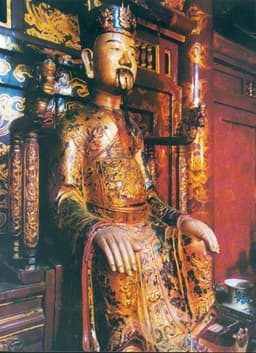
Dinh Tien Hoang
Emperor · Medieval
60.4Total
King Taejo of Goryeo
Emperor · Medieval
70.1Total
Basic Information
Born
924
877
Died
979
943
Era
Medieval
Medieval
Nationality
Vietnam
Korea
Occupation
Emperor
Emperor
Civilization
Eastern
Eastern
Score Comparison
Military (10%)
60.0
78.0
Political (20%)
72.0
72.0
Influence (20%)
65.0
65.0
Legacy (20%)
40.0
65.0
Leadership (15%)
77.2
82.0
Strategy (15%)
58.0
67.2
TOTAL
60.4
70.1
Dinh Tien Hoang — Complete Timeline
968 AD
Defeat of the Twelve WarlordsWar
Dinh Bo Linh, later known as Dinh Tien Hoang, unified Vietnam by defeating the Twelve Warlords who had divided the country after the collapse of Chinese rule. He established the Dinh dynasty and became the first emperor of an independent Vietnam.
UnificationDinh DynastyVietnamese Independence
Impact: nationalconstructive
Establishment of the Dinh DynastyPolitical Action◆ Major
Dinh Tien Hoang founded the Dinh dynasty and declared himself Emperor. He moved the capital to Hoa Lu and implemented administrative reforms to consolidate power. This marked the beginning of a new era of Vietnamese independence after centuries of Chinese domination.
Dynasty FoundingCapital MoveAdministrative Reform
Impact: nationalconstructive
979 AD
Assassination of Dinh Tien HoangPolitical Action◆ Major
Dinh Tien Hoang and his crown prince were assassinated by a court official while sleeping. The murder plunged the Dinh dynasty into chaos, leading to a succession crisis and eventual takeover by Le Hoan. The assassination ended the short-lived Dinh dynasty.
AssassinationSuccession CrisisEnd of Dinh Dynasty
Impact: nationaltragic
King Taejo of Goryeo — Complete Timeline
918 AD
Founded the Goryeo DynastyPolitical Action
Wang Geon (Taejo) overthrew the Later Goguryeo state and established the Goryeo dynasty, with its capital at Songak (Kaesong). This marked the beginning of a new era in Korean history.
Dynasty FoundingGoryeoKorea
Impact: regionalconstructive
920 AD
Adopted a Policy of Marrying Local ElitesPolitical Action◆ Major
Taejo married women from powerful local clans to secure their loyalty and integrate regional powers into the Goryeo state. This policy helped stabilize the new dynasty.
Marriage PolicyGoryeoUnification
Impact: regionalconstructive
936 AD
Unified the Later Three KingdomsWar
Taejo completed the unification of the Later Three Kingdoms (Later Goguryeo, Later Baekje, and Silla) under Goryeo rule. This ended the period of division and established a unified Korean state.
UnificationLater Three KingdomsGoryeo
Impact: regionalconstructive
943 AD
Implemented Ten InjunctionsPolitical Action◆ Major
Taejo issued the Ten Injunctions, a set of political guidelines for his successors. These stressed the importance of Buddhism, diplomacy with China, and avoiding internal conflict.
GovernanceGoryeoPolicy
Impact: regionalconstructive
Expert Analysis
Dinh Tien Hoang vs King Taejo of Goryeo
# The Founders: Two Paths to Unity in Medieval East Asia
On a spring night in 979, Emperor Dinh Tien Hoang of Vietnam lay sleeping in his palace at Hoa Lu, unaware that death was creeping toward him through the darkness. A court official named Do Thich, driven by a grudge or perhaps a dream of power, slipped into the imperial bedchamber and murdered both the emperor and his crown prince. In a single stroke, the Dinh dynasty—the first to rule a truly independent Vietnam—was extinguished. Half a century earlier and a thousand miles to the north, another founder had died peacefully in his bed, surrounded by his sons and ministers, leaving behind a dynasty that would endure for nearly five centuries. Why did one founder’s work crumble so quickly, while the other’s became the bedrock of a nation?
Origins
Dinh Bo Linh was born in 924 in the village of Dam Dien, in what is now Ninh Binh province, into a Vietnam still reeling from the collapse of Chinese Tang rule. His father was a local official under the Khuc family, who had briefly asserted Vietnamese autonomy, but the boy grew up in a land fractured by warlords. From childhood, he showed a fierce independence—legend says he once killed a neighbor’s ox for a game and faced down the angry owner without flinching. The era demanded ruthlessness; the Later Le dynasty had fallen, and a dozen petty lords carved up the Red River Delta.
Wang Geon, later King Taejo of Goryeo, was born in 877 in Songak (modern Kaesong), into a powerful maritime trading family that controlled the region around the Han River. His father, Wang Ryung, was a local lord under the state of Later Goguryeo, and the young Wang Geon grew up not in a village of oxen and rice paddies but in a world of ships, merchants, and diplomacy. Korea was also divided—the Later Three Kingdoms of Silla, Later Baekje, and Later Goguryeo—but Wang Geon’s upbringing was one of strategic calculation rather than bare-knuckled survival.
Rise to Power
Dinh Bo Linh’s ascent was forged in blood and iron. In 968, after years of campaigning, he defeated the last of the Twelve Warlords who had torn Vietnam apart. He did not negotiate; he conquered. He executed rivals, absorbed their armies, and forced submission through sheer military might. When he declared himself Emperor Dinh Tien Hoang, he moved the capital to Hoa Lu, a natural fortress of limestone mountains and rivers, and imposed a harsh administrative system that centralized power in his own hands. His was a rule built on fear and force.
Wang Geon’s path was subtler. In 918, he overthrew Gung Ye, the tyrannical ruler of Later Goguryeo, but he did so not as a warlord but as a general who had won the loyalty of the court and army. He founded the Goryeo dynasty not by annihilating his enemies but by absorbing them. Over the next eighteen years, he methodically unified the Later Three Kingdoms, culminating in the peaceful surrender of Silla in 935 and the defeat of Later Baekje in 936. Where Dinh conquered, Wang co-opted.
Leadership & Governance
The contrast in their ruling styles is stark. Dinh Tien Hoang governed like a warrior-king: he centralized authority, suppressed dissent with executions, and relied on his personal reputation to hold the realm together. His reforms were practical—standardizing taxes, building roads, fortifying Hoa Lu—but they lacked a vision beyond his own lifetime. He had no plan for succession, no network of alliances to outlast him. The Dinh dynasty was a one-man show.
Taejo of Goryeo thought in centuries. He married his daughters to the sons of powerful local clans, binding the aristocracy to the throne through blood rather than fear. When he unified the Later Three Kingdoms, he accepted Silla’s surrender with honor, allowing its last king to live and its nobles to retain their lands. In 943, as death approached, he issued the Ten Injunctions—a political testament that urged his successors to uphold Buddhism, avoid excessive centralization, and trust the local elites he had so carefully cultivated. These were not the words of a conqueror but of a statesman building an institution.
Triumph & Tragedy
Dinh Tien Hoang’s greatest triumph was also his only one: the unification of Vietnam. In 968, he achieved what no Vietnamese ruler had done for centuries—a single, independent kingdom. But his tragedy was that he could not secure it. His assassination in 979, at the hands of a court official, plunged the Dinh dynasty into chaos. Within a year, the child emperor was dead, and a new dynasty, the Early Le, had to be founded by a general to fend off Chinese invasion. Dinh’s work was undone almost as soon as he died.
Taejo’s triumph was not a single battle but a lifetime of strategic marriage and diplomacy. His unification of the Later Three Kingdoms in 936 was the culmination of a process, not a climax. His tragedy was that he could not fully control the aristocratic families he had empowered—the Ten Injunctions were as much a warning as a guide, acknowledging that the clans might one day tear Goryeo apart. Yet even this fear proved prescient: the Injunctions became the foundation of Goryeo’s political culture, guiding kings for centuries.
Character & Destiny
Dinh Tien Hoang was a man of action, not reflection. His military score of 62.0 and strategy of 60.0 suggest a commander who relied on brute force rather than cunning—and indeed, he crushed the Twelve Warlords through relentless campaigning, not subtle maneuvering. His political score of 90.2, however, reveals a ruler who understood the mechanics of power: he knew how to seize it, but not how to preserve it. His personality—proud, direct, ruthless—shaped a destiny of swift rise and swifter fall.
Taejo’s political score of 80.0 and leadership of 80.1 reflect a different temperament. He was patient, diplomatic, and long-sighted, willing to share power to secure it. His military score of 74.6 and strategy of 70.5 show a capable commander, but not a great one; he won not by out-fighting his enemies but by outlasting them. His personality—calculating, generous, visionary—created a dynasty that outlived him by 474 years.
Legacy
Dinh Tien Hoang is remembered today as the father of Vietnamese independence, a heroic figure who broke the chains of Chinese rule. His legacy is symbolic: he proved that Vietnam could stand alone. But his dynasty was a footnote, a brief experiment that collapsed into chaos. His name lives on in temples and textbooks, but his political achievements were ephemeral.
Taejo of Goryeo left something more tangible: a dynasty that gave its name to modern Korea. The word “Korea” itself derives from Goryeo, and Taejo’s policies of integration and Buddhism shaped Korean culture for centuries. His legacy is institutional—a system of governance that balanced central power with local autonomy, a model that later dynasties would refine. He is remembered not as a conqueror but as a founder.
Conclusion
The difference between these two founders lies not in their ambition but in their imagination. Dinh Tien Hoang saw power as a prize to be seized; Taejo saw it as a garden to be cultivated. One built a fortress; the other built a lineage. One died by a knife in the dark; the other died in bed, surrounded by sons. In the end, the question is not who was braver or stronger—Dinh may well have been both—but who understood that a kingdom, like a tree, must be rooted in more than one man’s will. Taejo’s Ten Injunctions, written in the shadow of death, whisper the answer: a dynasty endures not by the sword but by the bonds it weaves.
Rankings
🥇
King Taejo of GoryeoLeader
Mil: 78.0Pol: 72.0Inf: 65.0
70.1
🥈
Dinh Tien Hoang
Mil: 60.0Pol: 72.0Inf: 65.0
60.4
+9.7 behind
How This Comparison Works
Algorithm
Each figure is scored on 6 dimensions (0—100 scale) based on structured historical data: Military (10%), Political (20%), Influence (20%), Legacy (20%), Leadership (15%), Strategy (15%). The weighted total produces the final ranking.
Data Sources
Scores are computed from structured sub-indicators in the database. Scale factors adjust for era (Ancient ×0.85, Modern ×1.0) and civilization size (Eastern ×1.05, Other ×0.80) to account for differences in population and military scale.
Maximum 3 Figures
Comparisons are limited to 2—3 figures to ensure readability and statistical meaningfulness.
Error Margins
±5 points per dimension — Sub-scores are derived from historical records with inherent uncertainty. Two figures within 5 points on a dimension should be considered roughly equivalent in that area.
Total Score Accuracy
±3 points overall — The weighted combination of 6 dimensions produces a total score with approximately ±3 points of uncertainty. Differences of less than 3 points are not statistically significant— the figures are effectively tied.
Known Limitations
- Historical records are incomplete and uneven across civilizations
- Figures from oral-tradition societies may be underrepresented
- Occupation labels can misclassify multi-role figures
- Scores measure capability and impact, not moral character
- Quantitative scoring is a comparison tool, not absolute truth
Capability Radar
Military (10%) — Battles & Warfare
Battles
70
75
Win Rate
75
80
Expansion
65
80
Political (20%) — Governance & Reform
Reform
70
80
Diplomacy
65
75
Economy
60
70
Influence (20%) — Cultural & Global Reach
Cultural
65
70
Global
55
60
Legacy (20%) — Historical Impact
Historical
75
80
Longevity
70
75
Leadership (15%) — Power & Stability
Tenure
60
85
Stability
55
75
Strategy (15%) — Tactics & Innovation
Strategy
70
85
Tactics
65
70
Reform
60
65
Similar Comparisons
Comments & Discussion
No comments yet. Be the first to share your thoughts!