Loading...
This comparison has not been analyzed yet.
One-time AI generation (~1 minute). Scores and timeline are already available below.
Deria Hassan vs Frederick VII of Denmark
Frederick VII of Denmark leads by 8.4 pts · 2 figures compared
…

Deria Hassan
Emperor · Modern
47.0Total
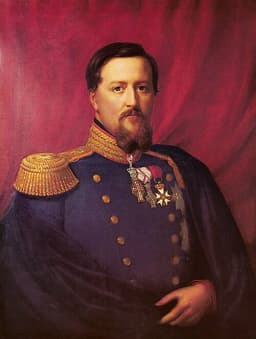
Frederick VII of Denmark
Emperor · Modern
55.4Total
Basic Information
Born
1830
1808
Died
1884
1863
Era
Modern
Modern
Nationality
Somalia
Denmark
Occupation
Emperor
Emperor
Civilization
Other
Western
Score Comparison
Military (10%)
50.0
25.0
Political (20%)
37.9
72.0
Influence (20%)
52.5
51.8
Legacy (20%)
43.3
48.3
Leadership (15%)
65.7
74.0
Strategy (15%)
25.0
60.0
TOTAL
47.0
55.4
Deria Hassan — Complete Timeline
1880 AD
Resistance to British ExpansionWar
Deria Hassan led military resistance against British colonial encroachment into Isaaq territory, engaging in skirmishes and diplomatic efforts to preserve the sultanate's independence before ultimately accepting protectorate status.
ResistanceColonial ConflictIsaaq
1884 AD
Signing of the British Protectorate TreatyPolitical Action◆ Major
Deria Hassan, as the last sultan of the Isaaq Sultanate, signed a treaty with the British Empire establishing a protectorate over the region. This ended Isaaq sovereignty and integrated the territory into British Somaliland.
ColonialismTreatyBritish Somaliland
Impact: regionaltragic
Frederick VII of Denmark — Complete Timeline
1848 AD
First Schleswig WarWar◆ Major
Frederick VII faced a rebellion in the duchies of Schleswig and Holstein, supported by Prussia. The war ended in 1851 with the London Protocol, which confirmed Danish sovereignty over Schleswig-Holstein but required Denmark not to integrate Schleswig into the kingdom.
Schleswig-HolsteinWarNationalism
Impact: regional
1849 AD
Granted the Constitution of DenmarkPolitical Action
Frederick VII signed the Danish Constitution on June 5, 1849, transforming Denmark from an absolute monarchy into a constitutional monarchy. The constitution established a bicameral parliament (Rigsdag) and granted civil rights to citizens, ending royal absolutism.
ConstitutionConstitutional MonarchyReform
Impact: nationalprogressive
1857 AD
Abolition of the Øresund TollReform◆ Major
Frederick VII agreed to the abolition of the
TradeBaltic SeaReform
Impact: regionalconstructive
1863 AD
Promulgation of the November ConstitutionPolitical Action◆ Major
Frederick VII signed the November Constitution, which incorporated Schleswig into Denmark in violation of the London Protocol. This act provoked the Second Schleswig War with Prussia and Austria, leading to Danish defeat and loss of the duchies.
ConstitutionSchleswig-HolsteinWar
Impact: regionaldestructive
This comparison has not been analyzed yet.
One-time AI generation (~1 minute). Scores and timeline are already available below.
Rankings
🥇
Frederick VII of DenmarkLeader
Mil: 25.0Pol: 72.0Inf: 51.8
55.4
🥈
Deria Hassan
Mil: 50.0Pol: 37.9Inf: 52.5
47.0
+8.4 behind
How This Comparison Works
Algorithm
Each figure is scored on 6 dimensions (0—100 scale) based on structured historical data: Military (10%), Political (20%), Influence (20%), Legacy (20%), Leadership (15%), Strategy (15%). The weighted total produces the final ranking.
Data Sources
Scores are computed from structured sub-indicators in the database. Scale factors adjust for era (Ancient ×0.85, Modern ×1.0) and civilization size (Eastern ×1.05, Other ×0.80) to account for differences in population and military scale.
Maximum 3 Figures
Comparisons are limited to 2—3 figures to ensure readability and statistical meaningfulness.
Error Margins
±5 points per dimension — Sub-scores are derived from historical records with inherent uncertainty. Two figures within 5 points on a dimension should be considered roughly equivalent in that area.
Total Score Accuracy
±3 points overall — The weighted combination of 6 dimensions produces a total score with approximately ±3 points of uncertainty. Differences of less than 3 points are not statistically significant— the figures are effectively tied.
Known Limitations
- Historical records are incomplete and uneven across civilizations
- Figures from oral-tradition societies may be underrepresented
- Occupation labels can misclassify multi-role figures
- Scores measure capability and impact, not moral character
- Quantitative scoring is a comparison tool, not absolute truth
Capability Radar
Military (10%) — Battles & Warfare
Battles
20
37
Win Rate
25
38
Expansion
15
40
Political (20%) — Governance & Reform
Reform
20
75
Diplomacy
30
50
Economy
20
30
Influence (20%) — Cultural & Global Reach
Cultural
30
30
Global
15
20
Legacy (20%) — Historical Impact
Historical
35
50
Longevity
25
40
Leadership (15%) — Power & Stability
Tenure
40
25
Stability
25
40
Strategy (15%) — Tactics & Innovation
Strategy
20
48
Tactics
20
47
Reform
10
50
Similar Comparisons
Comments & Discussion
No comments yet. Be the first to share your thoughts!