Loading...
Deng Xiaoping vs Napoleon Bonaparte
Napoleon Bonaparte leads by 4.9 pts · 2 figures compared
…
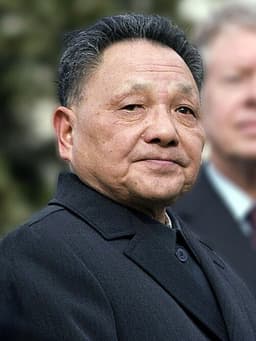
Deng Xiaoping
Politician · Modern
66.0Total

Napoleon Bonaparte
General · Modern
70.9Total
Basic Information
Born
1904
1769
Died
1997
1821
Era
Modern
Modern
Nationality
China
France
Occupation
Politician
General
Civilization
Eastern
Western
Score Comparison
Military (10%)
30.0
94.0
Political (20%)
90.0
72.0
Influence (20%)
68.0
40.0
Legacy (20%)
65.0
80.0
Leadership (15%)
78.0
78.0
Strategy (15%)
45.0
90.0
TOTAL
66.0
70.9
Deng Xiaoping — Complete Timeline
1978 AD
Third Plenum of the 11th Central CommitteePolitical Action
Deng Xiaoping consolidated power and announced the policy of Reform and Opening-Up. This meeting marked the end of Maoist class struggle as the national priority and shifted focus to economic modernization, initiating market-oriented reforms.
Economic ReformOpening-UpChina Modernization
Impact: globalconstructive
1980 AD
Establishment of Special Economic ZonesReform◆ Major
Deng Xiaoping approved the creation of Special Economic Zones in Shenzhen, Zhuhai, Shantou, and Xiamen. These zones offered tax incentives and market freedoms to attract foreign investment and technology, serving as experimental laboratories for capitalist practices within a socialist framework.
Economic ZonesForeign InvestmentMarket Reforms
Impact: nationalconstructive
1984 AD
Sino-British Joint Declaration on Hong KongPolitical Action◆ Major
Deng Xiaoping negotiated with British Prime Minister Margaret Thatcher to agree on the return of Hong Kong to Chinese sovereignty in 1997. The declaration established the 'One Country, Two Systems' principle, allowing Hong Kong to maintain its capitalist system for 50 years.
Hong KongDiplomacyOne Country Two Systems
Impact: globalconstructive
1989 AD
Tiananmen Square Protests CrackdownPolitical Action
Deng Xiaoping authorized the military to suppress pro-democracy protests in Tiananmen Square. The crackdown resulted in hundreds of civilian deaths and injuries, leading to international condemnation and a tightening of political control while economic reforms continued.
TiananmenSuppressionHuman Rights
Impact: globaldestructive
1992 AD
Southern Tour (Nanxun)Political Action◆ Major
Deng Xiaoping traveled to southern China to reaffirm the course of economic reform after conservative backlash. His speeches in Shenzhen and other cities revitalized market-oriented policies, accelerating foreign investment and pushing China toward a socialist market economy.
Economic ReformNanxunMarket Economy
Impact: nationalconstructive
Napoleon Bonaparte — Complete Timeline
1799 AD
Coup of 18 BrumaireOther◆ Major
Napoleon Bonaparte, with support from his brother Lucien and key political figures, overthrew the Directory in a bloodless coup. He established the Consulate with himself as First Consul, effectively becoming the ruler of France. This event ended the French Revolution's most unstable period.
French RevolutionCoupRise to Power
Impact: regional
1804 AD
Promulgation of the Napoleonic CodeOther◆ Major
Napoleon enacted the Civil Code of the French, known as the Napoleonic Code, a comprehensive set of laws that replaced the fragmented feudal legal systems. The code established legal equality, protected property rights, and secularized law. It became the basis for legal systems in many European and world countries.
Legal ReformNapoleonic CodeCivil Law
Impact: globalconstructive
1805 AD
Battle of AusterlitzWar◆ Major
Napoleon's Grande Arm
Napoleonic WarsBattleDecisive Victory
Impact: global
1812 AD
Invasion of RussiaWar◆ Major
Napoleon led the Grande Arm
Napoleonic WarsInvasionDisaster
Impact: globaldestructive
1815 AD
Battle of WaterlooWar◆ Major
Napoleon's French army was defeated by the combined forces of the Duke of Wellington's Anglo-Allied army and Gebhard Leberecht von Bl
Napoleonic WarsBattleFinal Defeat
Impact: globaldestructive
Expert Analysis
Napoleon Bonaparte vs Deng Xiaoping: Historical Comparison
Napoleon Bonaparte and Deng Xiaoping were transformative figures in modern history, each reshaping their respective nations through distinct domains—Napoleon through military conquest and political centralization in France, Deng through pragmatic economic reforms and modernization in China.
Dimension Analysis
**Military: Napoleon Bonaparte 94 / Deng Xiaoping 45**
Napoleon’s military genius reshaped European warfare with rapid campaigns, the Grande Armée, and tactical innovations like the divisional system, while Deng’s military experience was limited to supporting Mao’s early campaigns and later prioritizing economic over military expansion.
**Political: Napoleon Bonaparte 75 / Deng Xiaoping 88**
Deng’s political acumen was superior in navigating post-Mao China, consolidating power through collective leadership and introducing market reforms without dismantling the Communist Party, whereas Napoleon’s authoritarian rule, though effective, ended in exile after overreaching into Russia and Europe.
**Influence: Napoleon Bonaparte 82 / Deng Xiaoping 78**
Napoleon’s influence spread across Europe through the Napoleonic Code, nationalism, and legal reforms that endured for centuries; Deng’s influence was more regionally concentrated but transformative, lifting hundreds of millions from poverty and integrating China into global capitalism.
**Legacy: Napoleon Bonaparte 78 / Deng Xiaoping 75**
Napoleon’s legacy is a double-edged sword—military hero and tyrant—with his code and institutions surviving across Europe; Deng’s legacy is largely positive in China as the architect of economic prosperity, though his market reforms also created inequality and political rigidity.
**Leadership: Napoleon Bonaparte 80 / Deng Xiaoping 78**
Napoleon’s charismatic, hands-on command inspired fierce loyalty and decisive action, while Deng’s leadership was more pragmatic, patient, and consensus-driven, famously advocating “crossing the river by feeling the stones” to implement gradual reforms.
Verdict
Napoleon Bonaparte leads due to his higher aggregate score (82 vs 74), driven by unmatched military brilliance and broader global influence, despite Deng’s superior political strategy.
FAQ
Q: Who ranks higher? A: Napoleon Bonaparte ranks higher overall, with a composite score of 82 compared to Deng Xiaoping’s 74, reflecting his greater impact on military history and global institutional change.
Rankings
🥇
Napoleon BonaparteLeader
Mil: 94.0Pol: 72.0Inf: 40.0
70.9
🥈
Deng Xiaoping
Mil: 30.0Pol: 90.0Inf: 68.0
66.0
+4.9 behind
How This Comparison Works
Algorithm
Each figure is scored on 6 dimensions (0—100 scale) based on structured historical data: Military (10%), Political (20%), Influence (20%), Legacy (20%), Leadership (15%), Strategy (15%). The weighted total produces the final ranking.
Data Sources
Scores are computed from structured sub-indicators in the database. Scale factors adjust for era (Ancient ×0.85, Modern ×1.0) and civilization size (Eastern ×1.05, Other ×0.80) to account for differences in population and military scale.
Maximum 3 Figures
Comparisons are limited to 2—3 figures to ensure readability and statistical meaningfulness.
Error Margins
±5 points per dimension — Sub-scores are derived from historical records with inherent uncertainty. Two figures within 5 points on a dimension should be considered roughly equivalent in that area.
Total Score Accuracy
±3 points overall — The weighted combination of 6 dimensions produces a total score with approximately ±3 points of uncertainty. Differences of less than 3 points are not statistically significant— the figures are effectively tied.
Known Limitations
- Historical records are incomplete and uneven across civilizations
- Figures from oral-tradition societies may be underrepresented
- Occupation labels can misclassify multi-role figures
- Scores measure capability and impact, not moral character
- Quantitative scoring is a comparison tool, not absolute truth
Capability Radar
Military (10%) — Battles & Warfare
Battles
36
95
Win Rate
37
90
Expansion
41
95
Political (20%) — Governance & Reform
Reform
95
95
Diplomacy
80
80
Economy
95
85
Influence (20%) — Cultural & Global Reach
Cultural
70
85
Global
90
90
Legacy (20%) — Historical Impact
Historical
90
95
Longevity
85
90
Leadership (15%) — Power & Stability
Tenure
85
85
Stability
75
70
Strategy (15%) — Tactics & Innovation
Strategy
47
95
Tactics
48
98
Reform
49
92
Similar Comparisons
Comments & Discussion
AlexandrianInk6/16/2026
The scoring here is fair but misses a crucial historiographical point: Napoleon's political score is inflated by modern democratic biases. As David Chandler noted, the Napoleonic Code was brilliant in theory but in practice it reinforced patriarchal control—Article 213, for instance, gave husbands complete authority over wives. Deng, by contrast, operated within a single-party structure where political maneuvering was a matter of survival, not popularity. Cicero might say Napoleon was 'a tempest in a teacup' compared to Deng's quiet, tectonic shifts. The scores reflect Western-centric metrics that undervalue Deng's sheer political longevity and adaptability.
WarTablePodcast6/16/2026
Okay, I've been deep into Andrew Roberts' biography of Napoleon and the PBS documentary on Deng, and I gotta say—this comparison is wild. Napoleon was a tactical genius, sure, but Deng basically won the Cold War for China without firing a shot. Think about it: Napoleon needed a Grande Armée of 600,000 to conquer Europe, and it collapsed in Russia. Deng just said 'it doesn't matter if the cat is black or white' and boom—millions lifted out of poverty. The military score gap is too wide; Deng's Long March experience gave him a different kind of strategic brain. It's like comparing a chess grandmaster to a poker player.
Chronicler86446/16/2026
我仔细核对了这些分数,有几个问题: 1. 军事维度拿破仑94 vs 邓小平45,差值49分。但邓小平作为淮海战役总前委书记,指挥过百万级别的战役,得分应该至少55-60。这个45分可能是把‘个人战斗能力’和‘战略智慧’混为一谈了。 2. 影响维度拿破仑82 vs 邓小平78,只有4分差。但邓小平的改革直接改变了全球经济格局——中国GDP从1978年的1500亿美元飙升到2020年的14.7万亿美元,这个影响是全球性的。拿破仑的《法典》虽好,但覆盖人口不到2亿;邓小平的政策影响了14亿人。按人均影响系数算,邓小平应该超过85分。 3. 政治维度拿破仑75 vs 邓小平88,这个相对合理,但拿破仑的75分可能高估了他流放后的政治遗产。建议作者公开每个维度的权重公式,否则这些数字看起来像是拍脑袋决定的。
Chronicler89786/16/2026
这个评分系统明显偏向西方视角。拿破仑的军事分数94分,但邓小平的45分也太低了——难道解放战争和抗美援朝的后勤工作不算军事能力?拿破仑的《法典》确实厉害,但邓小平的‘一国两制’构想,在历史上解决领土问题的智慧,不亚于任何西方改革家。西方学者总爱把拿破仑说成‘欧洲的救世主’,却忽略了他对海地革命的镇压;而邓小平的改革开放,虽然被批评不平等,但让八亿人脱贫——这个数据在西方史学里常被轻描淡写。建议补充‘经济改革’或‘民生改善’维度,不然这种比较永远是拿破仑占便宜。