Loading...
This comparison has not been analyzed yet.
One-time AI generation (~1 minute). Scores and timeline are already available below.
Decius vs Intef II
Intef II leads by 1.9 pts · 2 figures compared
…
Decius
Emperor · Ancient
43.1Total
Intef II
Emperor · Ancient
45.0Total
Basic Information
Born
201
-2100
Died
251
-2050
Era
Ancient
Ancient
Nationality
Roman Empire
Middle Kingdom Egypt
Occupation
Emperor
Emperor
Civilization
Western
Middle Eastern
Score Comparison
Military (10%)
38.3
25.0
Political (20%)
37.9
36.5
Influence (20%)
46.3
46.3
Legacy (20%)
39.2
40.8
Leadership (15%)
41.5
74.0
Strategy (15%)
60.0
41.7
TOTAL
43.1
45.0
Decius — Complete Timeline
249 AD
Proclamation as Emperor and Defeat of Philip the ArabPolitical Action◆ Major
Decius, a Roman senator and general, was proclaimed emperor by the Danubian legions. He marched into Italy and defeated Philip the Arab at the Battle of Verona, where Philip was killed, securing Decius's position as sole emperor.
Imperial AccessionCivil WarBattle of Verona
Impact: global
250 AD
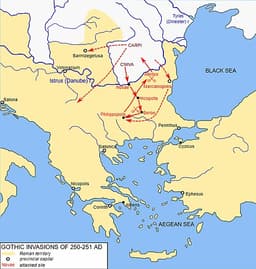
Campaign against the GothsWar
Decius led a military campaign against the Goths who had invaded the Danubian provinces. He initially achieved some successes, driving the Goths back, but the campaign was hampered by logistical issues and the plague.
Gothic WarDanube FrontierCampaign
Impact: regional
Edict of Decius (Decian Persecution)Political Action◆ Major
Decius issued an edict requiring all Roman citizens to perform a sacrifice to the Roman gods and obtain a certificate (libellus) proving compliance. This triggered the first empire-wide persecution of Christians, who refused to sacrifice, leading to widespread arrests, torture, and executions.
Christian PersecutionEdictReligious Policy
Impact: globaldestructive
251 AD
Death at the Battle of AbritusWar◆ Major
Decius and his son Herennius Etruscus were killed in battle against the Goths at Abritus (modern Bulgaria). They were ambushed in a swamp by the Gothic king Cniva, making Decius the first Roman emperor to die in battle against a foreign enemy.
Battle of AbritusGothic WarImperial Death
Impact: globaltragic
Intef II — Complete Timeline
2100 BC
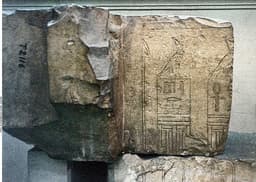
Accession as Theban pharaohPolitical Action◆ Major
Intef II became ruler of Thebes, succeeding Intef I. His reign of approximately 50 years was the longest of the 11th Dynasty and marked a period of sustained expansion and consolidation of Theban power.
AccessionTheban DynastyLong Reign
Impact: regional
2080 BC
Conquest of the Thinite nomeWar◆ Major
Intef II captured the Thinite nome (Abydos region) from the Heracleopolitan kingdom. This victory gave Thebes control of a key religious and strategic area, strengthening their position in the ongoing civil war.
ConquestAbydosCivil War
Impact: regionalconstructive
2070 BC
Establishment of the 'Intef' tomb at ThebesCultural
Intef II built a large saff-tomb at El-Tarif in Thebes, a new type of royal burial. This tomb, with its long causeway and courtyard, reflected the growing wealth and power of the 11th Dynasty and set a precedent for later Theban burials.
TombArchitectureThebes
2060 BC
Expansion of Theban control to the 14th nomeWar◆ Major
Intef II extended Theban rule northward to the 14th nome of Lower Egypt, near the Faiyum. This expansion brought the Theban kingdom to the borders of the Heracleopolitan domain, setting the stage for eventual reunification.
ExpansionTerritorialReunification
Impact: regionalconstructive
This comparison has not been analyzed yet.
One-time AI generation (~1 minute). Scores and timeline are already available below.
Rankings
🥇
Intef IILeader
Mil: 25.0Pol: 36.5Inf: 46.3
45.0
🥈
Decius
Mil: 38.3Pol: 37.9Inf: 46.3
43.1
+1.9 behind
How This Comparison Works
Algorithm
Each figure is scored on 6 dimensions (0—100 scale) based on structured historical data: Military (10%), Political (20%), Influence (20%), Legacy (20%), Leadership (15%), Strategy (15%). The weighted total produces the final ranking.
Data Sources
Scores are computed from structured sub-indicators in the database. Scale factors adjust for era (Ancient ×0.85, Modern ×1.0) and civilization size (Eastern ×1.05, Other ×0.80) to account for differences in population and military scale.
Maximum 3 Figures
Comparisons are limited to 2—3 figures to ensure readability and statistical meaningfulness.
Error Margins
±5 points per dimension — Sub-scores are derived from historical records with inherent uncertainty. Two figures within 5 points on a dimension should be considered roughly equivalent in that area.
Total Score Accuracy
±3 points overall — The weighted combination of 6 dimensions produces a total score with approximately ±3 points of uncertainty. Differences of less than 3 points are not statistically significant— the figures are effectively tied.
Known Limitations
- Historical records are incomplete and uneven across civilizations
- Figures from oral-tradition societies may be underrepresented
- Occupation labels can misclassify multi-role figures
- Scores measure capability and impact, not moral character
- Quantitative scoring is a comparison tool, not absolute truth
Capability Radar
Military (10%) — Battles & Warfare
Battles
40
30
Win Rate
30
35
Expansion
20
40
Political (20%) — Governance & Reform
Reform
45
30
Diplomacy
30
35
Economy
25
30
Influence (20%) — Cultural & Global Reach
Cultural
20
20
Global
15
15
Legacy (20%) — Historical Impact
Historical
35
30
Longevity
20
25
Leadership (15%) — Power & Stability
Tenure
30
70
Stability
20
40
Strategy (15%) — Tactics & Innovation
Strategy
40
30
Tactics
35
25
Reform
50
20
Similar Comparisons
Comments & Discussion
No comments yet. Be the first to share your thoughts!