Loading...
Decius vs Julius Caesar
Julius Caesar leads by 39.7 pts · 2 figures compared
…
Decius
Emperor · Ancient
43.1Total

Julius Caesar
General · Ancient
82.8Total
Basic Information
Born
201
-100
Died
251
-44
Era
Ancient
Ancient
Nationality
Roman Empire
Roman Republic
Occupation
Emperor
General
Civilization
Western
Western
Score Comparison
Military (10%)
38.3
88.0
Political (20%)
37.9
78.0
Influence (20%)
46.3
85.0
Legacy (20%)
39.2
82.0
Leadership (15%)
41.5
80.0
Strategy (15%)
60.0
85.0
TOTAL
43.1
82.8
Decius — Complete Timeline
249 AD
Proclamation as Emperor and Defeat of Philip the ArabPolitical Action◆ Major
Decius, a Roman senator and general, was proclaimed emperor by the Danubian legions. He marched into Italy and defeated Philip the Arab at the Battle of Verona, where Philip was killed, securing Decius's position as sole emperor.
Imperial AccessionCivil WarBattle of Verona
Impact: global
250 AD
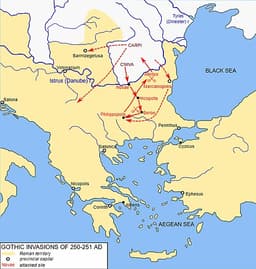
Campaign against the GothsWar
Decius led a military campaign against the Goths who had invaded the Danubian provinces. He initially achieved some successes, driving the Goths back, but the campaign was hampered by logistical issues and the plague.
Gothic WarDanube FrontierCampaign
Impact: regional
Edict of Decius (Decian Persecution)Political Action◆ Major
Decius issued an edict requiring all Roman citizens to perform a sacrifice to the Roman gods and obtain a certificate (libellus) proving compliance. This triggered the first empire-wide persecution of Christians, who refused to sacrifice, leading to widespread arrests, torture, and executions.
Christian PersecutionEdictReligious Policy
Impact: globaldestructive
251 AD
Death at the Battle of AbritusWar◆ Major
Decius and his son Herennius Etruscus were killed in battle against the Goths at Abritus (modern Bulgaria). They were ambushed in a swamp by the Gothic king Cniva, making Decius the first Roman emperor to die in battle against a foreign enemy.
Battle of AbritusGothic WarImperial Death
Impact: globaltragic
Julius Caesar — Complete Timeline
58 BC
Gallic WarsWar◆ Major
Caesar, as proconsul of Gaul, launched a series of campaigns that conquered all of Gaul (modern France, Belgium, and parts of Switzerland). He fought numerous battles, including against the Helvetii, the Belgae, and the Gallic chieftain Vercingetorix. The wars brought immense wealth and a loyal army to Caesar.
Gallic WarsConquestRoman Expansion
Impact: regional
49 BC
Crossing the RubiconPolitical Action◆ Major
Caesar led Legio XIII across the Rubicon River into Italy, defying the Roman Senate's order to disband his army. This act triggered a civil war against Pompey and the Optimates, ultimately leading to Caesar's dictatorship and the end of the Roman Republic.
Roman Civil WarEnd of RepublicPower Struggle
Impact: global
48 BC
Battle of PharsalusWar◆ Major
Caesar's outnumbered army defeated the larger forces of Pompey the Great at Pharsalus in Greece. Caesar's tactical use of a reserve line to counter Pompey's cavalry charge proved decisive. Pompey fled to Egypt, where he was assassinated, leaving Caesar as the undisputed master of the Roman world.
Roman Civil WarBattleDecisive Victory
Impact: regional
44 BC
Appointment as Dictator for LifePolitical Action◆ Major
The Roman Senate appointed Caesar dictator perpetuo (dictator for life), granting him unprecedented personal power. This move concentrated military, legislative, and judicial authority in one person, effectively ending the Roman Republic's traditional system of checks and balances and alarming many senators.
DictatorshipEnd of RepublicPower Consolidation
Impact: regionaldestructive
Assassination on the Ides of MarchPolitical Action◆ Major
A group of Roman senators, led by Marcus Junius Brutus and Gaius Cassius Longinus, stabbed Caesar to death at a meeting of the Senate in the Theatre of Pompey. The assassination was intended to restore the Republic, but instead triggered another civil war that led to the rise of the Roman Empire.
AssassinationRoman PoliticsEnd of Republic
Impact: globaldestructive
Expert Analysis
decius-vs-julius-caesar
# The Ides and the Abyss: Caesar and Decius, Two Roman Fates
On March 15, 44 BCE, Julius Caesar fell beneath twenty-three dagger strokes in the Senate chamber, his blood pooling on the marble floor as his assassins cried liberty. Two hundred and ninety-five years later, on a swampy battlefield in modern Bulgaria, Emperor Decius slipped into a bog and vanished—swallowed by Gothic spears, his body never recovered. Both men were Roman rulers. Both died violently. But between them lies a chasm not merely of centuries, but of destiny. Why did one become the founding myth of an empire, the other a forgotten footnote? The answer is not in their stars, but in themselves.
Origins
Caesar was born into the patrician Julian clan, an ancient but impoverished family in a Republic where noble birth meant little without gold. He grew up in the shadow of civil wars and the dictatorship of Sulla, learning early that survival required charm, debt, and audacity. His Rome was a restless republic, tearing itself apart with ambition.
Decius, by contrast, emerged from the Illyrian provinces—a soldier of modest birth in an empire that had already become a military monarchy. His Rome was a sprawling, weary colossus, lurching from crisis to crisis. Where Caesar’s world was one of opportunity, Decius’s was one of desperation. The Republic Caesar inherited still believed in its own greatness. The Empire Decius inherited was already praying for deliverance.
Rise to Power
Caesar’s ascent was a masterpiece of calculated risk. He climbed the *cursus honorum*—quaestor, aedile, praetor—spending borrowed fortunes on games and bribes. His appointment as governor of Gaul at age forty gave him an army; his conquest of that vast land gave him glory. When the Senate ordered him to disband his legions, he crossed the Rubicon River in 49 BCE, gambling everything on civil war. He won.
Decius’s rise was simpler and sadder. In 249 CE, the Danubian legions proclaimed him emperor, not out of love but out of panic: the Goths were pouring across the Danube, and the existing emperor, Philip the Arab, seemed powerless. Decius marched south, defeated Philip in battle, and took the throne. There was no Rubicon, no grand gamble—only the grim logic of a crumbling frontier.
Leadership & Governance
Caesar governed as a revolutionary reformer. He recalibrated the calendar, extended citizenship to Gauls, reformed debt laws, and centralized power in his own hands—all while maintaining the fiction of republican tradition. His military genius was tactical and strategic: at Alesia, he besieged the besiegers; at Pharsalus, he defeated a larger army with veteran discipline. He was ruthless when necessary, merciful when useful.
Decius governed as a desperate traditionalist. Facing barbarian invasions, economic collapse, and a plague that would soon ravage the empire, he turned to the old gods. In 250 CE, he issued the Edict of Decius, ordering every Roman to sacrifice to the state deities and obtain a certificate—a *libellus*—proving compliance. Christians who refused were executed. It was not cruelty for its own sake, but a panicked attempt to restore divine favor. Unlike Caesar’s reforms, Decius’s policy solved nothing. It created martyrs and deepened divisions.
Triumph & Tragedy
Caesar’s greatest triumph was Gaul—the conquest of a million people, the opening of a new world for Rome. His greatest tragedy was his own success: dictatorship made him a target, and the Ides of March ended his life just as he planned a campaign against Parthia. He died at the height of his power, and his death triggered another civil war.
Decius’s triumph was bitter: he drove the Goths back temporarily in 250 CE, winning a few skirmishes. His tragedy was absolute. In 251 CE, he pursued the Gothic king Cniva into the marshes of Abrittus. His army was ambushed. His son Herennius Etruscus died beside him. Decius himself fell in the mud, the first Roman emperor ever killed by a foreign enemy. His body was stripped and left to rot. The Gothic victory shattered the myth of Roman invincibility.
Character & Destiny
Caesar was audacity incarnate. He pardoned enemies, seduced allies, and trusted his luck. “The die is cast,” he said at the Rubicon—but he had loaded the dice. His personality—arrogant, generous, calculating, impulsive—drove every decision. He believed he could control the forces he unleashed. He was wrong, but his miscalculation was magnificent.
Decius was duty personified. He was not ambitious in the Caesarian sense; he accepted the throne because someone had to. His persecution of Christians was not personal malice but administrative panic. He died leading from the front because that was what a Roman emperor was supposed to do. His tragedy was that duty, without genius, is not enough. The crisis of the third century required a Caesar. It got a conscientious soldier.
Legacy
Caesar’s legacy is the Roman Empire itself. His name became a title—*Kaiser*, *Tsar*—and his writings, his calendar, his reforms outlasted the Republic he destroyed. He is remembered as a demigod, a tyrant, a visionary. His story is told and retold because it is the story of how one man can change the world.
Decius’s legacy is a warning. His persecution made Christianity stronger; his death made the empire weaker. He is remembered, if at all, as a symbol of failed reaction—a man who tried to restore the past and was crushed by the future. His *libelli* survive on papyrus, mute testimony to a bureaucracy of fear.
Conclusion
Caesar and Decius both died for Rome. But Caesar died because he had become too powerful; Decius because he was not powerful enough. One shaped history through will; the other was shaped by history through necessity. In the end, the difference between them is the difference between the man who seizes fate and the man who merely endures it. The Ides of March gave us a martyr. The marshes of Abrittus gave us a lesson.
Rankings
🥇
Julius CaesarLeader
Mil: 88.0Pol: 78.0Inf: 85.0
82.8
🥈
Decius
Mil: 38.3Pol: 37.9Inf: 46.3
43.1
+39.7 behind
How This Comparison Works
Algorithm
Each figure is scored on 6 dimensions (0—100 scale) based on structured historical data: Military (10%), Political (20%), Influence (20%), Legacy (20%), Leadership (15%), Strategy (15%). The weighted total produces the final ranking.
Data Sources
Scores are computed from structured sub-indicators in the database. Scale factors adjust for era (Ancient ×0.85, Modern ×1.0) and civilization size (Eastern ×1.05, Other ×0.80) to account for differences in population and military scale.
Maximum 3 Figures
Comparisons are limited to 2—3 figures to ensure readability and statistical meaningfulness.
Error Margins
±5 points per dimension — Sub-scores are derived from historical records with inherent uncertainty. Two figures within 5 points on a dimension should be considered roughly equivalent in that area.
Total Score Accuracy
±3 points overall — The weighted combination of 6 dimensions produces a total score with approximately ±3 points of uncertainty. Differences of less than 3 points are not statistically significant— the figures are effectively tied.
Known Limitations
- Historical records are incomplete and uneven across civilizations
- Figures from oral-tradition societies may be underrepresented
- Occupation labels can misclassify multi-role figures
- Scores measure capability and impact, not moral character
- Quantitative scoring is a comparison tool, not absolute truth
Capability Radar
Military (10%) — Battles & Warfare
Battles
40
95
Win Rate
30
92
Expansion
20
97
Political (20%) — Governance & Reform
Reform
45
90
Diplomacy
30
85
Economy
25
82
Influence (20%) — Cultural & Global Reach
Cultural
20
88
Global
15
94
Legacy (20%) — Historical Impact
Historical
35
95
Longevity
20
96
Leadership (15%) — Power & Stability
Tenure
30
75
Stability
20
60
Strategy (15%) — Tactics & Innovation
Strategy
40
94
Tactics
35
96
Reform
50
88
Similar Comparisons
Comments & Discussion
BOG-BORN BUREAUCRAT6/17/2026
Let's be real: Decius was a bean-counter in armor. A competent administrator who stumbled into a purple he didn't know how to wear. Meanwhile, Caesar turned Gaul into a personal ATM and crossed the Rubicon because he *knew* he was the main character. Decius died face-down in a marsh trying to be a hero. Caesar died face-up, betrayed by friends, but knowing history would remember his name. One was a temporary placeholder, the other was an epoch.
黄河将军6/17/2026
得基乌斯就是个运气不好的保安队长,上来就接了个烂摊子。哥特人像蝗虫一样,军团士气散得跟沙子似的,他倒好,追着敌人自己掉沼泽里喂了鱼。凯撒好歹是死在元老院里,死得像个人物。得基乌斯?尸体都找不着,鸟都不鸟他。罗马要的是传奇,不是这种淹死的笑话。
THE PERSECUTION PUNK6/17/2026
Everyone ignores the elephant in the temple: Decius was the first emperor to systematically persecute Christians empire-wide. Caesar didn't give a damn about obscure cults. But Decius's edict demanding everyone sacrifice to the gods? That backfired monumentally. It created martyrs, unified the Church, and arguably made Christianity stronger. Caesar's assassination cemented the Republic's death; Decius's death cemented Christianity's rise. Both changed history, just not how they intended.
文史扫描器6/17/2026
一个有趣的数据点:凯撒遇刺时,罗马直接控制的地中海世界人口约5000万;得基乌斯死时,帝国人口因瘟疫和战争已骤降至约3000万。凯撒在繁荣中倒塌,得基乌斯在萎缩中沉没。凯撒之死是暴发户贵族的最后一刀,得基乌斯之死是体制衰竭的溺亡。两人死于不同尺度的危机,注定了迥异的遗产规模。
SENATE SAUSAGE MAKER6/17/2026
Here's the dirty secret: Decius died fighting Goths—a real, existential threat to Rome's borders. Caesar died because a bunch of disgruntled Senators had hurt feelings about their lost privileges. One death was strategically meaningful, the other was political theater. Decius at least went down trying to save the Empire. Caesar? He was busy turning the Republic into a monarchy and got shanked by his buddies. Give me the bog warrior over the backstabbed narcissist any day.