Loading...
Decius vs Napoleon Bonaparte
Napoleon Bonaparte leads by 27.8 pts · 2 figures compared
…
Decius
Emperor · Ancient
43.1Total

Napoleon Bonaparte
General · Modern
70.9Total
Basic Information
Born
201
1769
Died
251
1821
Era
Ancient
Modern
Nationality
Roman Empire
France
Occupation
Emperor
General
Civilization
Western
Western
Score Comparison
Military (10%)
38.3
94.0
Political (20%)
37.9
72.0
Influence (20%)
46.3
40.0
Legacy (20%)
39.2
80.0
Leadership (15%)
41.5
78.0
Strategy (15%)
60.0
90.0
TOTAL
43.1
70.9
Decius — Complete Timeline
249 AD
Proclamation as Emperor and Defeat of Philip the ArabPolitical Action◆ Major
Decius, a Roman senator and general, was proclaimed emperor by the Danubian legions. He marched into Italy and defeated Philip the Arab at the Battle of Verona, where Philip was killed, securing Decius's position as sole emperor.
Imperial AccessionCivil WarBattle of Verona
Impact: global
250 AD
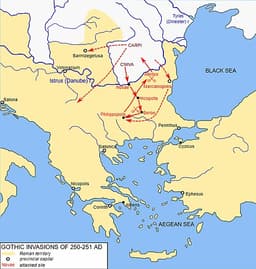
Campaign against the GothsWar
Decius led a military campaign against the Goths who had invaded the Danubian provinces. He initially achieved some successes, driving the Goths back, but the campaign was hampered by logistical issues and the plague.
Gothic WarDanube FrontierCampaign
Impact: regional
Edict of Decius (Decian Persecution)Political Action◆ Major
Decius issued an edict requiring all Roman citizens to perform a sacrifice to the Roman gods and obtain a certificate (libellus) proving compliance. This triggered the first empire-wide persecution of Christians, who refused to sacrifice, leading to widespread arrests, torture, and executions.
Christian PersecutionEdictReligious Policy
Impact: globaldestructive
251 AD
Death at the Battle of AbritusWar◆ Major
Decius and his son Herennius Etruscus were killed in battle against the Goths at Abritus (modern Bulgaria). They were ambushed in a swamp by the Gothic king Cniva, making Decius the first Roman emperor to die in battle against a foreign enemy.
Battle of AbritusGothic WarImperial Death
Impact: globaltragic
Napoleon Bonaparte — Complete Timeline
1799 AD
Coup of 18 BrumaireOther◆ Major
Napoleon Bonaparte, with support from his brother Lucien and key political figures, overthrew the Directory in a bloodless coup. He established the Consulate with himself as First Consul, effectively becoming the ruler of France. This event ended the French Revolution's most unstable period.
French RevolutionCoupRise to Power
Impact: regional
1804 AD
Promulgation of the Napoleonic CodeOther◆ Major
Napoleon enacted the Civil Code of the French, known as the Napoleonic Code, a comprehensive set of laws that replaced the fragmented feudal legal systems. The code established legal equality, protected property rights, and secularized law. It became the basis for legal systems in many European and world countries.
Legal ReformNapoleonic CodeCivil Law
Impact: globalconstructive
1805 AD
Battle of AusterlitzWar◆ Major
Napoleon's Grande Arm
Napoleonic WarsBattleDecisive Victory
Impact: global
1812 AD
Invasion of RussiaWar◆ Major
Napoleon led the Grande Arm
Napoleonic WarsInvasionDisaster
Impact: globaldestructive
1815 AD
Battle of WaterlooWar◆ Major
Napoleon's French army was defeated by the combined forces of the Duke of Wellington's Anglo-Allied army and Gebhard Leberecht von Bl
Napoleonic WarsBattleFinal Defeat
Impact: globaldestructive
Expert Analysis
decius-vs-napoleon-bonaparte
# The Emperor and the General: Two Paths to Ruin
On a June morning in 1815, the fields of Waterloo ran red with the blood of an empire. Napoleon Bonaparte, master of Europe for a decade, watched his Grande Armée shatter against the Duke of Wellington’s squares. Sixteen centuries earlier, in the swamps of Abrittus, another emperor faced his end—Decius, trapped by Gothic horsemen, his body lost to the marsh. Both men died in battle, both saw their life’s work undone. But where Napoleon’s fall became legend, Decius’s became a footnote. Why? The answer lies not in their defeats, but in what they built before them.
Origins
Napoleon Bonaparte was born in 1769 on Corsica, an island of fierce independence recently annexed by France. His family was minor nobility, poor enough to hunger for status, proud enough to resent their conquerors. This dual identity—outsider yet ambitious insider—shaped everything. He studied at French military schools, where his accent marked him as foreign, his brilliance as dangerous. The French Revolution, erupting when he was twenty, offered a ladder. In a world where birth once determined fate, now talent could reign.
Decius came from a different world entirely. Born in 201 near Sirmium (modern Serbia), he was a Roman senator of the old school—loyal, conservative, steeped in the belief that Rome’s greatness came from its gods and traditions. The Roman Empire of the third century was a machine creaking under its own weight: barbarians at the borders, plagues within, emperors rising and falling like wheat before the scythe. Decius believed in order, in the old ways. He was not a revolutionary; he was a restorer.
Rise to Power
Napoleon’s ascent was meteoric. At twenty-four, he drove the British out of Toulon; at twenty-six, he crushed a royalist uprising in Paris with a “whiff of grapeshot.” The Directory, a corrupt and flailing government, saw in him a sword. They sent him to Italy, where he turned a starving, ragged army into a conquering force. In 1799, he staged a coup, making himself First Consul. By 1804, he crowned himself Emperor—not by blood, but by will.
Decius rose differently. He was a senator, a governor, a man of the system. In 249, the Danubian legions—restless, loyal to their commander—proclaimed him emperor. He marched on Rome, defeated the reigning emperor Philip the Arab in battle, and took the throne. It was a coup, but a conservative one. Decius did not seek to remake Rome; he sought to save it.
Leadership & Governance
Napoleon governed with a genius for organization. He reformed French law into the Napoleonic Code, a system of civil rights, property protections, and merit-based advancement that would influence Europe for centuries. He centralized the state, built roads, founded banks, and opened schools. His military strategy was revolutionary: rapid marches, massed artillery, and the exploitation of interior lines. At Austerlitz in 1805, he destroyed a combined Russian and Austrian army with a trap so perfect it became a textbook case. His political score of 75 reflects a ruler who could build empires but not sustain them—his reforms were brilliant, but his ambition overreached.
Decius governed in crisis. His Edict of 250 required all Romans to sacrifice to the gods and obtain a certificate—a loyalty test in a time of plague and invasion. This was not mere persecution; it was an attempt to restore religious unity, to propitiate the gods who seemed to have abandoned Rome. But the edict backfired. Christians refused, were martyred, and the empire gained new enemies within. His military score of 40.5 and leadership of 41.4 tell a story of competence, not brilliance. He fought the Goths with courage but without Napoleon’s strategic depth. He was a good general in an impossible war.
Triumph & Tragedy
Napoleon’s greatest moment was Austerlitz—the sun of glory shining on his army. His worst was the Russian campaign of 1812, where he marched 600,000 men into snow and starvation, losing over 90%. He was exiled to Elba, escaped, and raised another army—only to fall at Waterloo. His tragedy was hubris: he could not stop, could not compromise.
Decius’s triumph was his rise—a senator who became emperor. His tragedy was Abrittus in 251. He and his son Herennius Etruscus died together, the first Roman emperor killed by a foreign enemy. His body was never recovered. The empire he tried to save spiraled deeper into chaos.
Character & Destiny
Napoleon was a creature of will. “Impossible is a word to be found only in the dictionary of fools,” he said. He believed he could shape history with sheer force of personality. And for a time, he did. But that same will made him blind to limits. He could not share power, could not accept defeat.
Decius was a creature of duty. He believed in Rome, in its gods, in its traditions. His persecution was not cruelty for its own sake but a desperate act of preservation. He died because he led from the front, a general among his soldiers. His character was noble but rigid—he could not adapt, could not see that the world had changed.
Legacy
Napoleon’s legacy is immense. The Napoleonic Code governs much of Europe. His military tactics are still studied. He reshaped national borders, inspired nationalism, and left a shadow that stretches to the present. His total score of 82.4 reflects a figure who changed the world, for better and worse.
Decius’s legacy is narrower. He is remembered for the persecution, for being the first emperor killed by barbarians, for a brief reign that could not stop the fall. His score of 52.2 is a mark of mediocrity—a man who tried but failed. Yet he matters as a symbol: the last gasp of old Rome, the moment when the empire realized it could die.
Conclusion
Napoleon and Decius both died in battle, both saw their empires crumble. But Napoleon’s fall was a tragedy—a great man undone by his own greatness. Decius’s fall was an epitaph—a good man overwhelmed by forces he could not control. One reshaped history; the other was crushed by it. In their difference lies a lesson: ambition can build worlds, but duty alone cannot save them. And sometimes, the most powerful thing a leader can do is know when to stop.
Rankings
🥇
Napoleon BonaparteLeader
Mil: 94.0Pol: 72.0Inf: 40.0
70.9
🥈
Decius
Mil: 38.3Pol: 37.9Inf: 46.3
43.1
+27.8 behind
How This Comparison Works
Algorithm
Each figure is scored on 6 dimensions (0—100 scale) based on structured historical data: Military (10%), Political (20%), Influence (20%), Legacy (20%), Leadership (15%), Strategy (15%). The weighted total produces the final ranking.
Data Sources
Scores are computed from structured sub-indicators in the database. Scale factors adjust for era (Ancient ×0.85, Modern ×1.0) and civilization size (Eastern ×1.05, Other ×0.80) to account for differences in population and military scale.
Maximum 3 Figures
Comparisons are limited to 2—3 figures to ensure readability and statistical meaningfulness.
Error Margins
±5 points per dimension — Sub-scores are derived from historical records with inherent uncertainty. Two figures within 5 points on a dimension should be considered roughly equivalent in that area.
Total Score Accuracy
±3 points overall — The weighted combination of 6 dimensions produces a total score with approximately ±3 points of uncertainty. Differences of less than 3 points are not statistically significant— the figures are effectively tied.
Known Limitations
- Historical records are incomplete and uneven across civilizations
- Figures from oral-tradition societies may be underrepresented
- Occupation labels can misclassify multi-role figures
- Scores measure capability and impact, not moral character
- Quantitative scoring is a comparison tool, not absolute truth
Capability Radar
Military (10%) — Battles & Warfare
Battles
40
95
Win Rate
30
90
Expansion
20
95
Political (20%) — Governance & Reform
Reform
45
95
Diplomacy
30
80
Economy
25
85
Influence (20%) — Cultural & Global Reach
Cultural
20
85
Global
15
90
Legacy (20%) — Historical Impact
Historical
35
95
Longevity
20
90
Leadership (15%) — Power & Stability
Tenure
30
85
Stability
20
70
Strategy (15%) — Tactics & Innovation
Strategy
40
95
Tactics
35
98
Reform
50
92
Similar Comparisons
Comments & Discussion
LegionnaireStoic6/17/2026
Decius was a relic trying to rebuild a temple that was already crumbling. His anti-Christian purge wasn’t just cruel—it was strategically stupid, alienating the very urban populations that held the empire together. Napoleon, for all his megalomania, knew how to read a room. Decius read an oracle and got it wrong. His death at Abrittus was inevitable; the Goths were just the ones to collect the tab.
暗夜铁骑6/17/2026
拿战拿破仑是大众情人般的悲剧英雄,但德西乌斯才是真正的“帝国之墓”。看看公元251年的阿拉伯世界,哥特人第一次骑上战马冲锋欧陆,德西乌斯是唯一死在蛮族骑兵手里的罗马皇帝。拿破仑在滑铁卢还能喊“近卫军不退”,德西乌斯连尸体都被沼泽吞了。谁更惨?谁更真实?
DataSkeptic_426/17/2026
Let’s talk numbers. Napoleon commanded over 200,000 men at Waterloo’s peak—Decius had maybe half that at Abrittus. But here’s the kicker: Napoleon lost 25,000 at Waterloo; Decius lost his entire army estimated at 70% casualties. Ratio-wise, Decius’s defeat was statistically more catastrophic. Yet we glorify Napoleon’s “near-miss” while Decius is a trivia answer. Popularity isn’t merit—it’s marketing.
明镜本空6/17/2026
德西乌斯可是个被自我神话害死的皇帝。他颁布迫害基督徒的敕令时,自以为是在效忠罗马祖制为天下表率,哪知这正是帝国解体的加速剂。拿破仑至少知道自己是个机会主义者,虚伪得坦诚;德西乌斯却真诚地愚昧,直到哥特的马蹄踩碎他的勋章还在念旧诗。在惨烈上,他俩平手;在智识上,德西乌斯输得底裤都没了。
MarchOfTheFool6/17/2026
Both men died for a delusion, but at least Napoleon’s was grand: a European order under his boot. Decius died for a ghost—a Rome that never really existed. His persecution of Christians wasn’t about faith; it was about nostalgia. He wanted to freeze time, and time swallowed him. Waterloo made Napoleon a myth; Abrittus made Decius a warning. The real difference? Napoleon’s failure felt like a tragedy. Decius’s felt like a ledger being balanced.
荒野判官6/17/2026
别吹德西乌斯多惨了,他最大的错是没学会放手。看看拿破仑,他在莱比锡兵败后还能回岛养精蓄锐准备第二次,德西乌斯却在一场伏击战里赌上整个帝国。哥特人根本没想杀皇帝——他们只是乱箭射杀