Loading...
This comparison has not been analyzed yet.
One-time AI generation (~1 minute). Scores and timeline are already available below.
Daulat Rao Sindhia vs Maximilian II
Maximilian II leads by 0.4 pts · 2 figures compared
…

Daulat Rao Sindhia
Emperor · Modern
51.2Total
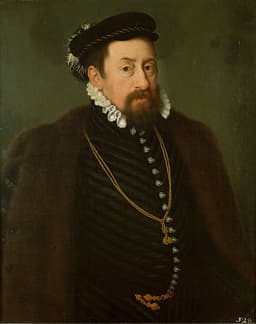
Maximilian II
Emperor · Modern
51.6Total
Basic Information
Born
1779
1527
Died
1827
1576
Era
Modern
Modern
Nationality
India
Holy Roman Empire
Occupation
Emperor
Emperor
Civilization
Indian
Western
Score Comparison
Military (10%)
40.0
50.0
Political (20%)
48.0
72.0
Influence (20%)
51.8
54.1
Legacy (20%)
43.3
42.5
Leadership (15%)
74.0
53.2
Strategy (15%)
51.7
36.8
TOTAL
51.2
51.6
Daulat Rao Sindhia — Complete Timeline
1803 AD
Battle of AssayeWar◆ Major
Daulat Rao Sindhia's forces fought the British East India Company under Arthur Wellesley at Assaye during the Second Anglo-Maratha War. The Maratha army was decisively defeated, leading to the loss of territories and weakening Sindhia's power.
Second Anglo-Maratha WarBattle
Impact: regionaltragic
Treaty of Surji-AnjangaonPolitical Action
Daulat Rao Sindhia signed the Treaty of Surji-Anjangaon with the British after his defeat at Assaye. He ceded territories including Delhi, Agra, and parts of Bundelkhand, and accepted British suzerainty, reducing Gwalior to a subsidiary state.
Second Anglo-Maratha WarTreaty
Impact: regionaltragic
1810 AD
Restoration of Gwalior FortCultural
Daulat Rao Sindhia undertook the restoration and fortification of Gwalior Fort, strengthening its defenses and adding structures. This project reinforced Gwalior's strategic importance and preserved its architectural heritage.
GwaliorArchitecture
constructive
Maximilian II — Complete Timeline
1564 AD
Coronation as Holy Roman EmperorPolitical Action◆ Major
Maximilian II was crowned Holy Roman Emperor in Frankfurt, succeeding his father Ferdinand I. His coronation was marked by a conciliatory tone towards Protestants, reflecting his personal beliefs. Maximilian's reign was characterized by an attempt to maintain peace between the Catholic and Protestant factions in the Empire.
CoronationImperial AuthorityReligious Peace
Impact: globalconstructive
1566 AD
Conflict with the Ottoman EmpireWar◆ Major
Maximilian II led a campaign against the Ottoman Empire in Hungary, culminating in the Siege of Szigetv
Ottoman WarsSiege of SzigetvárHungary
Impact: regional
1568 AD
Religious Toleration PolicyReform◆ Major
Maximilian II issued a decree of religious toleration for the Protestant nobility in Austria, allowing them to practice their faith freely. This policy was influenced by his own Protestant sympathies and aimed to reduce religious tensions. However, it was opposed by the Catholic Church and his Spanish relatives.
Religious TolerationProtestantismAustria
Impact: regionalprogressive
1570 AD
Patronage of the Arts and SciencesCultural
Maximilian II was a patron of the arts and sciences, supporting scholars, musicians, and artists at his court in Vienna. He employed the botanist Carolus Clusius and the historian Johannes Sambucus. His court became a center of humanist learning and cultural exchange, though his patronage was less extravagant than that of his son Rudolf II.
PatronageHumanismCultural Center
Impact: regionalconstructive
This comparison has not been analyzed yet.
One-time AI generation (~1 minute). Scores and timeline are already available below.
Rankings
🥇
Maximilian IILeader
Mil: 50.0Pol: 72.0Inf: 54.1
51.6
🥈
Daulat Rao Sindhia
Mil: 40.0Pol: 48.0Inf: 51.8
51.2
+0.4 behind
How This Comparison Works
Algorithm
Each figure is scored on 6 dimensions (0—100 scale) based on structured historical data: Military (10%), Political (20%), Influence (20%), Legacy (20%), Leadership (15%), Strategy (15%). The weighted total produces the final ranking.
Data Sources
Scores are computed from structured sub-indicators in the database. Scale factors adjust for era (Ancient ×0.85, Modern ×1.0) and civilization size (Eastern ×1.05, Other ×0.80) to account for differences in population and military scale.
Maximum 3 Figures
Comparisons are limited to 2—3 figures to ensure readability and statistical meaningfulness.
Error Margins
±5 points per dimension — Sub-scores are derived from historical records with inherent uncertainty. Two figures within 5 points on a dimension should be considered roughly equivalent in that area.
Total Score Accuracy
±3 points overall — The weighted combination of 6 dimensions produces a total score with approximately ±3 points of uncertainty. Differences of less than 3 points are not statistically significant— the figures are effectively tied.
Known Limitations
- Historical records are incomplete and uneven across civilizations
- Figures from oral-tradition societies may be underrepresented
- Occupation labels can misclassify multi-role figures
- Scores measure capability and impact, not moral character
- Quantitative scoring is a comparison tool, not absolute truth
Capability Radar
Military (10%) — Battles & Warfare
Battles
55
15
Win Rate
40
20
Expansion
50
10
Political (20%) — Governance & Reform
Reform
35
60
Diplomacy
45
65
Economy
40
50
Influence (20%) — Cultural & Global Reach
Cultural
30
40
Global
20
25
Legacy (20%) — Historical Impact
Historical
35
35
Longevity
25
30
Leadership (15%) — Power & Stability
Tenure
60
55
Stability
30
45
Strategy (15%) — Tactics & Innovation
Strategy
45
15
Tactics
50
10
Reform
30
20
Similar Comparisons
Comments & Discussion
No comments yet. Be the first to share your thoughts!