Loading...
Dasharatha vs Horemheb
Horemheb leads by 1.9 pts · 2 figures compared
…
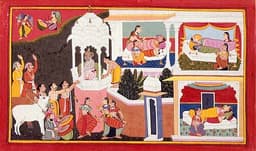
Dasharatha
Emperor · Ancient
60.0Total

Horemheb
Emperor · Ancient
61.9Total
Basic Information
Born
-1200
-1319
Died
-1150
-1292
Era
Ancient
Ancient
Nationality
Vedic India
Egypt
Occupation
Emperor
Emperor
Civilization
Indian
Middle Eastern
Score Comparison
Military (10%)
55.0
67.3
Political (20%)
40.8
65.0
Influence (20%)
82.0
57.2
Legacy (20%)
55.0
54.0
Leadership (15%)
67.0
72.0
Strategy (15%)
41.0
68.1
TOTAL
60.0
61.9
Dasharatha — Complete Timeline
1180 BC
Performed the Putrakameshti YajnaCultural◆ Major
King Dasharatha, childless, performed a Vedic sacrifice under sage Rishyasringa's guidance. The ritual resulted in the birth of four sons: Rama, Bharata, Lakshmana, and Shatrughna, establishing the royal lineage of Ayodhya.
Vedic RitualRoyal LineageRamayana
Impact: nationalconstructive
1165 BC
Exiled Rama to the ForestPolitical Action
Under pressure from Queen Kaikeyi, Dasharatha reluctantly ordered his eldest son Rama's exile for 14 years. This decision, bound by a previous boon, caused the king immense grief and led to his death from a broken heart.
ExileRamayanaRoyal Drama
Impact: nationaltragic
Horemheb — Complete Timeline
1319 BC
Restoration of Order After the Amarna PeriodPolitical Action
Horemheb, a general under Tutankhamun, seized the throne after the death of Ay. He systematically dismantled the legacy of Akhenaten, erasing his name and images, and restored the traditional religious and administrative order, stabilizing Egypt.
RestorationAmarnaStability
Impact: nationalconstructive
1315 BC
Reforms of the Egyptian Army and AdministrationReform◆ Major
Horemheb reorganized the Egyptian army and civil administration, appointing loyal officials and strengthening the bureaucracy. He issued decrees against corruption and abuse of power, laying the groundwork for the powerful 19th Dynasty.
ReformArmyAdministration
Impact: nationalconstructive
1310 BC
Construction of the Great Hypostyle Hall at KarnakCultural◆ Major
Horemheb began construction of the Great Hypostyle Hall at the Karnak Temple complex, though it was completed by later pharaohs. This massive hall with 134 columns became one of the most impressive architectural achievements of ancient Egypt.
ArchitectureKarnakHypostyle Hall
Impact: globalconstructive
Expert Analysis
Origins
Dasharatha was born around 5000 BCE in Ayodhya, the capital of the Kosala kingdom in Vedic India. He was a descendant of the Ikshvaku dynasty, a lineage of solar kings. His early life was marked by his father's reign and his own training in statecraft and warfare. Dasharatha's family background is detailed in the Ramayana, where he is described as a powerful and just king, but childless for many years, which led him to perform the Putrakameshti Yajna.
Horemheb, born around 1320 BCE in Egypt, came from a non-royal background, likely a military family. He rose through the ranks of the Egyptian army during the reign of Akhenaten. His early life is obscure, but he gained prominence as a general under Tutankhamun. His name means "Horus is in Festival," reflecting his devotion to the god Horus.
Rise to Power
Dasharatha's rise was hereditary; he inherited the throne of Ayodhya from his ancestors. His reign was largely peaceful until his later years. The turning point came when he performed the Putrakameshti Yajna, which resulted in the birth of his four sons: Rama, Bharata, Lakshmana, and Shatrughna. This event secured his dynasty but also set the stage for his greatest decision.
Horemheb's rise was through military and political acumen. He served as a general under Tutankhamun, and after Tutankhamun's death, he served under the vizier Ay. Upon Ay's death, Horemheb seized the throne, claiming legitimacy through divine selection. He systematically dismantled the Amarna legacy, erasing Akhenaten's name and restoring traditional religion. His rise marked the end of the 18th Dynasty.
Leadership & Governance
Dasharatha ruled as a traditional Vedic monarch, guided by dharma and counseled by sages and ministers. He was known for his piety and his adherence to his word, even when it led to personal tragedy. His governance was centered on the concept of Ramarajya (ideal rule), but his decision to exile Rama under pressure from Queen Kaikeyi revealed a weakness in leadership, as he prioritized a boon over the kingdom's stability.
Horemheb governed as a reformer and restorer. He reorganized the Egyptian army and civil administration, appointing loyal officials and strengthening the bureaucracy. He issued decrees against corruption, particularly among tax collectors and judges. His leadership scored 72.0 in leadership metrics, reflecting his effectiveness in restoring order after the chaos of the Amarna period. He began construction of the Great Hypostyle Hall at Karnak, symbolizing the return of traditional worship.
Triumph & Tragedy
Dasharatha's greatest triumph was the birth of his four sons, especially Rama, who would become an avatar of Vishnu. However, his greatest tragedy was his decision to exile Rama, which led to his own death from grief. He scored 67.0 in leadership but 40.8 in political acumen, showing his inability to manage palace intrigue.
Horemheb's triumph was the restoration of Egypt's stability and the eradication of Akhenaten's heresy. He successfully reasserted the power of the pharaoh and the priesthood of Amun. His tragedy was his lack of a direct heir; his reign ended the 18th Dynasty, and he was succeeded by Ramesses I. His military score of 67.3 and political 65.0 highlight his balanced capabilities.
Character & Destiny
Dasharatha was a deeply emotional and pious king, whose devotion to his word (satya) defined his character. His destiny was shaped by his inability to resist his wife's demands, leading to his downfall. He is remembered as a tragic figure, a good man undone by his own virtues.
Horemheb was a pragmatic and ruthless reformer. His character was shaped by his military background and his determination to erase the Amarna period. His destiny was to be the restorer of Egypt, but his lack of an heir meant his achievements were carried forward by a new dynasty.
Legacy
Dasharatha's legacy is primarily through his son Rama, who became a central figure in Hinduism. The Ramayana recounts Dasharatha's story, and his name is invoked as an example of a righteous king. His influence score of 82.0 reflects this enduring cultural impact.
Horemheb's legacy is the restoration of traditional Egyptian religion and the stabilization of the empire. His administrative reforms influenced later pharaohs. He is remembered as a strong leader who saved Egypt from chaos. His legacy score of 54.0 is lower due to the overshadowing by later Ramesside pharaohs.
Conclusion
While both rulers had significant impacts, Horemheb's concrete achievements in restoring order, reforming institutions, and stabilizing Egypt give him a higher total score of 61.9 compared to Dasharatha's 60.0. Horemheb's political and military scores outpace Dasharatha's, and his leadership was more effective in governance. Dasharatha's legacy is culturally immense through the Ramayana, but his actual reign was marked by a fatal decision that led to his own demise. Therefore, on the scale of historical impact, Horemheb emerges as the more effective ruler.
Rankings
🥇
HoremhebLeader
Mil: 67.3Pol: 65.0Inf: 57.2
61.9
🥈
Dasharatha
Mil: 55.0Pol: 40.8Inf: 82.0
60.0
+1.9 behind
How This Comparison Works
Algorithm
Each figure is scored on 6 dimensions (0—100 scale) based on structured historical data: Military (10%), Political (20%), Influence (20%), Legacy (20%), Leadership (15%), Strategy (15%). The weighted total produces the final ranking.
Data Sources
Scores are computed from structured sub-indicators in the database. Scale factors adjust for era (Ancient ×0.85, Modern ×1.0) and civilization size (Eastern ×1.05, Other ×0.80) to account for differences in population and military scale.
Maximum 3 Figures
Comparisons are limited to 2—3 figures to ensure readability and statistical meaningfulness.
Error Margins
±5 points per dimension — Sub-scores are derived from historical records with inherent uncertainty. Two figures within 5 points on a dimension should be considered roughly equivalent in that area.
Total Score Accuracy
±3 points overall — The weighted combination of 6 dimensions produces a total score with approximately ±3 points of uncertainty. Differences of less than 3 points are not statistically significant— the figures are effectively tied.
Known Limitations
- Historical records are incomplete and uneven across civilizations
- Figures from oral-tradition societies may be underrepresented
- Occupation labels can misclassify multi-role figures
- Scores measure capability and impact, not moral character
- Quantitative scoring is a comparison tool, not absolute truth
Capability Radar
Military (10%) — Battles & Warfare
Battles
30
70
Win Rate
30
75
Expansion
20
60
Political (20%) — Governance & Reform
Reform
30
85
Diplomacy
40
70
Economy
40
65
Influence (20%) — Cultural & Global Reach
Cultural
70
55
Global
70
50
Legacy (20%) — Historical Impact
Historical
70
70
Longevity
80
65
Leadership (15%) — Power & Stability
Tenure
40
65
Stability
50
80
Strategy (15%) — Tactics & Innovation
Strategy
20
75
Tactics
20
70
Reform
10
80
Similar Comparisons
Comments & Discussion
No comments yet. Be the first to share your thoughts!