Loading...
Dasharatha vs Napoleon Bonaparte
Napoleon Bonaparte leads by 10.9 pts · 2 figures compared
…
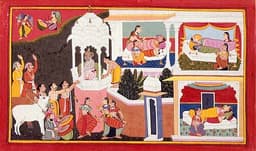
Dasharatha
Emperor · Ancient
60.0Total

Napoleon Bonaparte
General · Modern
70.9Total
Basic Information
Born
-1200
1769
Died
-1150
1821
Era
Ancient
Modern
Nationality
Vedic India
France
Occupation
Emperor
General
Civilization
Indian
Western
Score Comparison
Military (10%)
55.0
94.0
Political (20%)
40.8
72.0
Influence (20%)
82.0
40.0
Legacy (20%)
55.0
80.0
Leadership (15%)
67.0
78.0
Strategy (15%)
41.0
90.0
TOTAL
60.0
70.9
Dasharatha — Complete Timeline
1180 BC
Performed the Putrakameshti YajnaCultural◆ Major
King Dasharatha, childless, performed a Vedic sacrifice under sage Rishyasringa's guidance. The ritual resulted in the birth of four sons: Rama, Bharata, Lakshmana, and Shatrughna, establishing the royal lineage of Ayodhya.
Vedic RitualRoyal LineageRamayana
Impact: nationalconstructive
1165 BC
Exiled Rama to the ForestPolitical Action
Under pressure from Queen Kaikeyi, Dasharatha reluctantly ordered his eldest son Rama's exile for 14 years. This decision, bound by a previous boon, caused the king immense grief and led to his death from a broken heart.
ExileRamayanaRoyal Drama
Impact: nationaltragic
Napoleon Bonaparte — Complete Timeline
1799 AD
Coup of 18 BrumaireOther◆ Major
Napoleon Bonaparte, with support from his brother Lucien and key political figures, overthrew the Directory in a bloodless coup. He established the Consulate with himself as First Consul, effectively becoming the ruler of France. This event ended the French Revolution's most unstable period.
French RevolutionCoupRise to Power
Impact: regional
1804 AD
Promulgation of the Napoleonic CodeOther◆ Major
Napoleon enacted the Civil Code of the French, known as the Napoleonic Code, a comprehensive set of laws that replaced the fragmented feudal legal systems. The code established legal equality, protected property rights, and secularized law. It became the basis for legal systems in many European and world countries.
Legal ReformNapoleonic CodeCivil Law
Impact: globalconstructive
1805 AD
Battle of AusterlitzWar◆ Major
Napoleon's Grande Arm
Napoleonic WarsBattleDecisive Victory
Impact: global
1812 AD
Invasion of RussiaWar◆ Major
Napoleon led the Grande Arm
Napoleonic WarsInvasionDisaster
Impact: globaldestructive
1815 AD
Battle of WaterlooWar◆ Major
Napoleon's French army was defeated by the combined forces of the Duke of Wellington's Anglo-Allied army and Gebhard Leberecht von Bl
Napoleonic WarsBattleFinal Defeat
Impact: globaldestructive
Expert Analysis
dasharatha-vs-napoleon-bonaparte
### The Emperor and the Father: Napoleon Bonaparte and Dasharatha
In the winter of 1812, Napoleon Bonaparte watched his Grand Army burn as it retreated from Moscow, a campaign of hubris that would shatter an empire. Four millennia earlier, in the ancient city of Ayodhya, another ruler, Emperor Dasharatha, faced a different kind of conflagration: the burning grief of a father who had exiled his own beloved son. One man’s tragedy was written in snow and steel, the other in tears and duty. What separates a conqueror who remade a continent from a king remembered only for his heartbreak? The answer lies not in their power, but in the worlds they inhabited and the choices that defined them.
### Origins
Napoleon was born in 1769 on the island of Corsica, a recent French acquisition, into a minor noble family of modest means. His era was one of revolution and upheaval—the old order of kings and aristocrats was crumbling, and a young man with talent and ambition could seize the moment. He was a child of the Enlightenment, fed on Rousseau and the calculus of cannon fire, molded by a France that needed generals, not courtiers. His world was a crucible of change, where the only law was victory.
Dasharatha, by contrast, lived in the twilight of Vedic India, around 1200–1150 BC, in a world governed by dharma—a cosmic order of duty, caste, and ritual. He was an emperor of the Solar Dynasty, born into a role that was as much spiritual as political. His Ayodhya was not a nation-state but a kingdom bound by sacred texts and the wisdom of sages. Where Napoleon’s ambition was propelled by the chaos of modernity, Dasharatha’s fate was sealed by the weight of ancient tradition. One man saw history as something to be conquered; the other saw it as something to be obeyed.
### Rise to Power
Napoleon’s ascent was a lightning strike. He rose through the ranks of the Revolutionary Army, his military genius recognized early. At the Siege of Toulon in 1793, at just 24, he forced the British fleet to retreat. By 1796, he was commanding the Army of Italy, dazzling Europe with campaigns that turned a ragtag force into a legend. His path was forged by cannon smoke and political cunning—he was a master of propaganda, presenting himself as the savior of the Revolution. In 1799, he seized power in a coup, becoming First Consul. By 1804, he crowned himself Emperor. The door was open because the old world had shattered.
Dasharatha’s rise was quiet and inherited. He was born to rule, his authority unquestioned in a society where kings were considered divine. There was no coup, no battlefield glory to claim the throne. His power was a given, a mantle passed through generations. The turning point of his reign came not from conquest, but from a desperate personal plea: he was childless. In 1180 BC, he performed the Putrakameshti Yajna, a Vedic sacrifice guided by the sage Rishyasringa, to beseech the gods for an heir. The ritual succeeded, and his sons—Rama, Bharata, Lakshmana, and Shatrughna—were born. His rise was not a story of ambition, but of ritual and divine favor.
### Leadership & Governance
Napoleon ruled with a blend of iron will and visionary reform. His military genius was unmatched—he revolutionized warfare with speed, decisive battles, and the use of mass conscription. His campaigns from Austerlitz in 1805 to Jena in 1806 redrew the map of Europe. Yet he was also a political architect: the Napoleonic Code, established in 1804, standardized law across his empire, enshrining principles of equality before the law and secular governance. He built schools, roads, and a centralized state. But his governance was autocratic; he silenced dissent, censored the press, and crowned himself with the pope looking on. He was a reformer who crushed freedom in the name of order.
Dasharatha governed by counsel and tradition. He was not a general but a dharma-king, ruling through a council of ministers and sages. His military score of 46.8 reflects a reign of peace, not war. His wisdom lay in listening—to his wife Kausalya, to his ministers, and most tragically, to Queen Kaikeyi. When she demanded that Rama be exiled, he did not wage a political battle. He submitted to his vow, bound by a promise made long ago. His governance was not about conquering others, but about maintaining cosmic harmony. His political score of 52.3 suggests a ruler who was more a steward than a shaper of destiny.
### Triumph & Tragedy
Napoleon’s greatest triumph was the Empire itself. By 1810, he controlled most of Western Europe, his brothers on thrones from Spain to Holland. His legal reforms, the Code, outlasted his empire, influencing civil law across the world. But his tragedy was total: the invasion of Russia in 1812 cost him half a million men. Exiled to Elba in 1814, he returned for a final, desperate gamble—the Hundred Days—only to be crushed at Waterloo in 1815. He died in 1821 on the remote island of Saint Helena, a prisoner of the British, his ambition reduced to bitter memoirs.
Dasharatha’s triumph was his son Rama—the prince who would become the hero of the Ramayana, an avatar of the god Vishnu. But his tragedy was immediate and intimate. In 1165 BC, under pressure from Queen Kaikeyi, he was forced to exile Rama to the forest for 14 years. The king’s heart shattered. He could not bear the loss, and according to tradition, he died of grief shortly after, his final moments filled with the unbearable weight of a father’s broken promise. His tragedy was not a military defeat, but a wound to the soul.
### Character & Destiny
Napoleon’s character was a storm of ambition, intelligence, and insecurity. He was ruthless, calculating, and supremely confident—but also paranoid, demanding absolute loyalty. His decisions were driven by a need to prove himself, to reshape the world in his image. This hubris led him to overreach, to believe that even Moscow could not deny him. His destiny was to fall, because the very forces that lifted him—revolution, nationalism, the hunger for glory—eventually turned against him. He was a man of his era, a product of its chaos, and its ultimate victim.
Dasharatha was a man of duty, bound by dharma and love. His character was tender, indecisive, and profoundly human. He loved Rama more than life itself, yet he exiled him because he could not break a promise. His decisions were not driven by ambition, but by a tragic adherence to a code that demanded sacrifice. His destiny was to be remembered not as a conqueror, but as a father who lost his son. The Ramayana does not celebrate his power; it mourns his pain.
### Legacy
Napoleon’s legacy is written in law, war, and national identity. He is remembered as a military genius, a reformer, and a tyrant. His scores—Military 94, Strategy 93, Influence 82—reflect a titan who changed Europe forever. He is studied in every war college, his name synonymous with ambition and downfall. Yet his empire crumbled; his lasting gift is the idea that a man, not a king, could rise and rule.
Dasharatha’s legacy is quieter but deeper. His score of 74.9 in legacy is built on the Ramayana, an epic that has shaped the moral and spiritual life of billions for over three thousand years. He is not a hero; he is a flawed, grieving father whose story teaches the cost of dharma and the pain of love. He is remembered not for his conquests, but for his sacrifice.
### Conclusion
One man conquered the world and lost himself. Another lost his son and found eternity. Napoleon’s story is a warning about the price of ambition; Dasharatha’s is a meditation on the weight of duty. They are separated by four thousand years, by continents, by every measure of power. Yet both faced the same question: What do you do when the thing you love most must be sacrificed? Napoleon chose to destroy his army for glory. Dasharatha chose to destroy his heart for honor. In the end, history does not measure them by their victories, but by the sorrow they carried.
Rankings
🥇
Napoleon BonaparteLeader
Mil: 94.0Pol: 72.0Inf: 40.0
70.9
🥈
Dasharatha
Mil: 55.0Pol: 40.8Inf: 82.0
60.0
+10.9 behind
How This Comparison Works
Algorithm
Each figure is scored on 6 dimensions (0—100 scale) based on structured historical data: Military (10%), Political (20%), Influence (20%), Legacy (20%), Leadership (15%), Strategy (15%). The weighted total produces the final ranking.
Data Sources
Scores are computed from structured sub-indicators in the database. Scale factors adjust for era (Ancient ×0.85, Modern ×1.0) and civilization size (Eastern ×1.05, Other ×0.80) to account for differences in population and military scale.
Maximum 3 Figures
Comparisons are limited to 2—3 figures to ensure readability and statistical meaningfulness.
Error Margins
±5 points per dimension — Sub-scores are derived from historical records with inherent uncertainty. Two figures within 5 points on a dimension should be considered roughly equivalent in that area.
Total Score Accuracy
±3 points overall — The weighted combination of 6 dimensions produces a total score with approximately ±3 points of uncertainty. Differences of less than 3 points are not statistically significant— the figures are effectively tied.
Known Limitations
- Historical records are incomplete and uneven across civilizations
- Figures from oral-tradition societies may be underrepresented
- Occupation labels can misclassify multi-role figures
- Scores measure capability and impact, not moral character
- Quantitative scoring is a comparison tool, not absolute truth
Capability Radar
Military (10%) — Battles & Warfare
Battles
30
95
Win Rate
30
90
Expansion
20
95
Political (20%) — Governance & Reform
Reform
30
95
Diplomacy
40
80
Economy
40
85
Influence (20%) — Cultural & Global Reach
Cultural
70
85
Global
70
90
Legacy (20%) — Historical Impact
Historical
70
95
Longevity
80
90
Leadership (15%) — Power & Stability
Tenure
40
85
Stability
50
70
Strategy (15%) — Tactics & Innovation
Strategy
20
95
Tactics
20
98
Reform
10
92
Similar Comparisons
Comments & Discussion
No comments yet. Be the first to share your thoughts!