Loading...
Dasharatha vs Julius Caesar
Julius Caesar leads by 22.8 pts · 2 figures compared
…
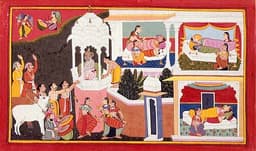
Dasharatha
Emperor · Ancient
60.0Total

Julius Caesar
General · Ancient
82.8Total
Basic Information
Born
-1200
-100
Died
-1150
-44
Era
Ancient
Ancient
Nationality
Vedic India
Roman Republic
Occupation
Emperor
General
Civilization
Indian
Western
Score Comparison
Military (10%)
55.0
88.0
Political (20%)
40.8
78.0
Influence (20%)
82.0
85.0
Legacy (20%)
55.0
82.0
Leadership (15%)
67.0
80.0
Strategy (15%)
41.0
85.0
TOTAL
60.0
82.8
Dasharatha — Complete Timeline
1180 BC
Performed the Putrakameshti YajnaCultural◆ Major
King Dasharatha, childless, performed a Vedic sacrifice under sage Rishyasringa's guidance. The ritual resulted in the birth of four sons: Rama, Bharata, Lakshmana, and Shatrughna, establishing the royal lineage of Ayodhya.
Vedic RitualRoyal LineageRamayana
Impact: nationalconstructive
1165 BC
Exiled Rama to the ForestPolitical Action
Under pressure from Queen Kaikeyi, Dasharatha reluctantly ordered his eldest son Rama's exile for 14 years. This decision, bound by a previous boon, caused the king immense grief and led to his death from a broken heart.
ExileRamayanaRoyal Drama
Impact: nationaltragic
Julius Caesar — Complete Timeline
58 BC
Gallic WarsWar◆ Major
Caesar, as proconsul of Gaul, launched a series of campaigns that conquered all of Gaul (modern France, Belgium, and parts of Switzerland). He fought numerous battles, including against the Helvetii, the Belgae, and the Gallic chieftain Vercingetorix. The wars brought immense wealth and a loyal army to Caesar.
Gallic WarsConquestRoman Expansion
Impact: regional
49 BC
Crossing the RubiconPolitical Action◆ Major
Caesar led Legio XIII across the Rubicon River into Italy, defying the Roman Senate's order to disband his army. This act triggered a civil war against Pompey and the Optimates, ultimately leading to Caesar's dictatorship and the end of the Roman Republic.
Roman Civil WarEnd of RepublicPower Struggle
Impact: global
48 BC
Battle of PharsalusWar◆ Major
Caesar's outnumbered army defeated the larger forces of Pompey the Great at Pharsalus in Greece. Caesar's tactical use of a reserve line to counter Pompey's cavalry charge proved decisive. Pompey fled to Egypt, where he was assassinated, leaving Caesar as the undisputed master of the Roman world.
Roman Civil WarBattleDecisive Victory
Impact: regional
44 BC
Appointment as Dictator for LifePolitical Action◆ Major
The Roman Senate appointed Caesar dictator perpetuo (dictator for life), granting him unprecedented personal power. This move concentrated military, legislative, and judicial authority in one person, effectively ending the Roman Republic's traditional system of checks and balances and alarming many senators.
DictatorshipEnd of RepublicPower Consolidation
Impact: regionaldestructive
Assassination on the Ides of MarchPolitical Action◆ Major
A group of Roman senators, led by Marcus Junius Brutus and Gaius Cassius Longinus, stabbed Caesar to death at a meeting of the Senate in the Theatre of Pompey. The assassination was intended to restore the Republic, but instead triggered another civil war that led to the rise of the Roman Empire.
AssassinationRoman PoliticsEnd of Republic
Impact: globaldestructive
Expert Analysis
dasharatha-vs-julius-caesar
# The Emperor and the General: Dasharatha and Caesar at the Crossroads of History
On a spring morning in 44 BCE, a man in a purple toga fell at the foot of a marble statue in Rome, stabbed twenty-three times by men he had called friends. Two thousand miles east and more than a millennium earlier, an aging king in the sacred city of Ayodhya lay dying of a broken heart, his last breath escaping with the name of the son he had banished. Both men were rulers. Both had shaped the destiny of their civilizations. But one would be remembered as the father of an empire, the other as the father of a god.
Origins
Julius Caesar was born into the chaos of a dying republic. The year was 100 BCE, and Rome was a city of marble and blood, where senators carried daggers beneath their togas and generals commanded armies more loyal to themselves than to the state. Caesar’s family, the Julii, claimed descent from the goddess Venus, but they were not among the ruling elite. His father died when Caesar was sixteen, leaving him to navigate a world of civil wars, proscriptions, and shifting alliances. He learned early that in Rome, survival meant ambition, and ambition meant risk.
Dasharatha came from a world that moved to a different rhythm. In Vedic India around 1200 BCE, power was measured not by legions but by rituals. As emperor of Ayodhya, Dasharatha ruled a kingdom where the Vedas were the ultimate authority and the Brahmins were the keepers of cosmic order. His lineage stretched back to the solar dynasty of Ikshvaku, and his name meant “he who holds the chariot”—a symbol of the warrior-king who protects dharma, the sacred law. But for all his royal blood, Dasharatha faced a crisis that no ritual could solve: he had no heir.
Rise to Power
Caesar’s path to power was a masterclass in calculated audacity. He rose through the ranks of Roman politics with breathtaking speed—quaestor, aedile, praetor, consul—each step funded by borrowed money and secured by alliances with the powerful. In 58 BCE, he secured command of Gaul, a province that would become his launching pad. Over eight years, he conquered hundreds of tribes, crossed the Rhine into Germany, and invaded Britain—all while writing his own propaganda in elegant Latin. When his political enemies in Rome tried to strip him of command, he made his choice: on January 10, 49 BCE, he led a single legion across the Rubicon River, declaring war on the Republic itself. “The die is cast,” he reportedly said, and the world changed.
Dasharatha’s rise was quieter but no less significant. He inherited a stable kingdom and governed with the consent of priests and elders. His great turning point came not on a battlefield but at a sacrificial altar. In 1180 BCE, after years of childlessness, Dasharatha performed the Putrakameshti Yajna, a Vedic fire sacrifice designed to secure offspring. Under the guidance of the sage Rishyasringa, the ritual was completed, and from the flames emerged a divine being bearing a bowl of sacred pudding. Dasharatha divided it among his three queens—and soon, four sons were born. The eldest, Rama, was no ordinary child; he was an incarnation of the god Vishnu.
Leadership & Governance
As dictator of Rome, Caesar governed with the precision of a general and the vision of a reformer. He overhauled the calendar, granting the world the Julian calendar that would serve for sixteen centuries. He extended citizenship to provincials, settled veterans on public lands, and began ambitious building projects. But his rule was a dictatorship, and he made no secret of it. He accepted the title “dictator for life,” placed his image on coins, and allowed statues of himself to be erected in temples. His military genius was undeniable—his siege of Alesia in 52 BCE remains a textbook example of tactical brilliance—but his political wisdom was undermined by his arrogance. He pardoned his enemies, but he never earned their trust.
Dasharatha ruled not through personal power but through dharma. In the Ramayana, he is portrayed not as a conquering hero but as a king who governs with the counsel of sages and the consent of his people. His military scores are modest—46.8 compared to Caesar’s 88.0—reflecting a world where war was ritualized and kingship was about preservation, not expansion. His greatest act of governance was also his greatest failure: when Queen Kaikeyi demanded that Rama be exiled to the forest for fourteen years, Dasharatha honored his earlier vow to her, even though it broke him. In 1165 BCE, he ordered his beloved son to leave Ayodhya, and the kingdom wept.
Triumph & Tragedy
Caesar’s triumph was absolute: he conquered the known world and remade Rome in his image. His tragedy was that he could not see the knife until it was inside him. On the Ides of March—March 15, 44 BCE—a conspiracy of senators, many of whom he had pardoned, surrounded him in the Theatre of Pompey. He fell, according to legend, at the feet of a statue of his old rival Pompey, covering his face with his toga as the blades fell. He died with twenty-three wounds, and Rome descended into another civil war.
Dasharatha’s tragedy was quieter but deeper. After Rama’s exile, the king did not fight, did not scheme, did not march. He retreated to his chambers and died of grief, his heart unable to bear the separation from his son. His triumph was not in conquest but in legacy: his son Rama would return, defeat the demon king Ravana, and establish the ideal kingdom of Ramarajya—a golden age remembered for millennia.
Character & Destiny
Caesar’s character was forged in the crucible of Roman ambition. He was brilliant, charismatic, and ruthless. He could forgive his enemies but not tolerate equals. His famous line—“I came, I saw, I conquered”—captures his essence: action, speed, domination. His destiny was to break the Republic and plant the seeds of empire, but he could not control the forces he unleashed.
Dasharatha’s character was shaped by duty. He was a king who kept his word even when it destroyed him. The Ramayana presents him as a man torn between love and duty, a father who sacrifices his son for the sake of honor. His destiny was not to conquer but to suffer, and through his suffering, to enable the divine plan. Where Caesar’s story is about power, Dasharatha’s is about sacrifice.
Legacy
Caesar’s legacy is written in stone and blood. His name became a title—Kaiser, Tsar—and his reforms shaped Western civilization. But he also left a warning: absolute power, unchecked, destroys even those who wield it. His assassination did not save the Republic; it ended it.
Dasharatha’s legacy is written in scripture and prayer. He is remembered not as a warrior or a reformer but as the father of Rama, the ideal king whose life is celebrated every year in the festival of Diwali. His story teaches that the greatest rulers are those who serve dharma, even at the cost of their own happiness.
Conclusion
Two kings, two worlds, two very different definitions of greatness. Caesar changed history through force of will; Dasharatha changed it through force of sacrifice. One built an empire that crumbled; the other fathered a god who endures. Perhaps the deepest difference lies in what they valued: Caesar sought to be remembered, and he was. Dasharatha sought to be dutiful, and he became eternal. In the end, the general who crossed the Rubicon and the emperor who broke his own heart both shaped civilizations that still live—but only one of them died knowing he had kept his word.
Rankings
🥇
Julius CaesarLeader
Mil: 88.0Pol: 78.0Inf: 85.0
82.8
🥈
Dasharatha
Mil: 55.0Pol: 40.8Inf: 82.0
60.0
+22.8 behind
How This Comparison Works
Algorithm
Each figure is scored on 6 dimensions (0—100 scale) based on structured historical data: Military (10%), Political (20%), Influence (20%), Legacy (20%), Leadership (15%), Strategy (15%). The weighted total produces the final ranking.
Data Sources
Scores are computed from structured sub-indicators in the database. Scale factors adjust for era (Ancient ×0.85, Modern ×1.0) and civilization size (Eastern ×1.05, Other ×0.80) to account for differences in population and military scale.
Maximum 3 Figures
Comparisons are limited to 2—3 figures to ensure readability and statistical meaningfulness.
Error Margins
±5 points per dimension — Sub-scores are derived from historical records with inherent uncertainty. Two figures within 5 points on a dimension should be considered roughly equivalent in that area.
Total Score Accuracy
±3 points overall — The weighted combination of 6 dimensions produces a total score with approximately ±3 points of uncertainty. Differences of less than 3 points are not statistically significant— the figures are effectively tied.
Known Limitations
- Historical records are incomplete and uneven across civilizations
- Figures from oral-tradition societies may be underrepresented
- Occupation labels can misclassify multi-role figures
- Scores measure capability and impact, not moral character
- Quantitative scoring is a comparison tool, not absolute truth
Capability Radar
Military (10%) — Battles & Warfare
Battles
30
95
Win Rate
30
92
Expansion
20
97
Political (20%) — Governance & Reform
Reform
30
90
Diplomacy
40
85
Economy
40
82
Influence (20%) — Cultural & Global Reach
Cultural
70
88
Global
70
94
Legacy (20%) — Historical Impact
Historical
70
95
Longevity
80
96
Leadership (15%) — Power & Stability
Tenure
40
75
Stability
50
60
Strategy (15%) — Tactics & Innovation
Strategy
20
94
Tactics
20
96
Reform
10
88
Similar Comparisons
Comments & Discussion
No comments yet. Be the first to share your thoughts!