Loading...
Daniel OConnell vs Souvanna Phouma
Daniel OConnell leads by 7.5 pts · 2 figures compared
…
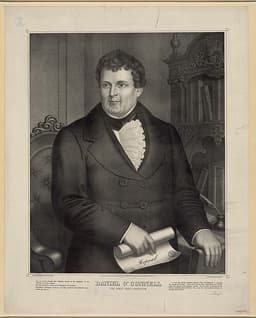
Daniel OConnell
Politician · Modern
57.0Total
Souvanna Phouma
Politician · Modern
49.5Total
Basic Information
Born
1775
1901
Died
1847
1984
Era
Modern
Modern
Nationality
Ireland
Laos
Occupation
Politician
Politician
Civilization
Western
Eastern
Score Comparison
Military (10%)
50.0
11.1
Political (20%)
72.0
68.0
Influence (20%)
55.0
53.3
Legacy (20%)
52.0
45.0
Leadership (15%)
68.0
65.0
Strategy (15%)
42.7
38.9
TOTAL
57.0
49.5
Daniel OConnell — Complete Timeline
1823 AD
Catholic Association FoundedPolitical Action◆ Major
O'Connell founded the Catholic Association to campaign for Catholic emancipation. The organization used mass membership and the 'Catholic Rent' (a penny a month subscription) to mobilize Irish Catholics politically.
Catholic EmancipationPolitical OrganizationMass Mobilization
Impact: nationalprogressive
1828 AD
Election to ParliamentPolitical Action◆ Major
O'Connell won a by-election in County Clare, defeating a Protestant candidate. As a Catholic, he was legally barred from taking his seat, forcing the British government to pass the Catholic Relief Act 1829 to avoid civil unrest.
ElectionCatholic EmancipationPolitical Crisis
Impact: nationalprogressive
1829 AD
Catholic Relief Act 1829Reform
The British Parliament passed the Catholic Relief Act, allowing Catholics to sit in Parliament and hold most public offices. O'Connell's campaign was the primary cause, though the act also raised the property qualification for Irish voters.
Catholic EmancipationLegislationReform
Impact: nationalprogressive
1840 AD
Repeal Association FoundedPolitical Action◆ Major
O'Connell founded the Repeal Association to campaign for the repeal of the Acts of Union 1800 and the restoration of an Irish parliament. The movement used mass meetings, known as 'monster meetings', to demonstrate popular support.
RepealNationalismMass Politics
Impact: nationalprogressive
1843 AD
Monster Meeting at TaraPolitical Action
O'Connell held a massive 'monster meeting' at the Hill of Tara, attracting an estimated 750,000 people. These peaceful demonstrations demonstrated the strength of the Repeal movement but alarmed the British government.
Monster MeetingRepealMass Mobilization
Impact: nationalprogressive
1844 AD
Trial for ConspiracyPolitical Action◆ Major
O'Connell was tried and convicted for conspiracy to incite rebellion, based on his Repeal campaign speeches. He was sentenced to a year in prison but was released after three months by the House of Lords on appeal.
TrialImprisonmentRepeal
Impact: national
Souvanna Phouma — Complete Timeline
1951 AD
First term as Prime MinisterPolitical Action◆ Major
Souvanna Phouma became Prime Minister of Laos for the first time, leading a neutralist government. He sought to maintain Laos's neutrality in the Cold War, balancing between communist Pathet Lao and right-wing factions.
Prime MinisterNeutralityCold War
Impact: nationalconstructive
1962 AD
Geneva Accords of 1962Political Action◆ Major
Souvanna Phouma signed the Geneva Accords, which established Laos as a neutral state and created a coalition government. The agreement was intended to end the Laotian Civil War but ultimately failed to prevent further conflict.
Geneva AccordsNeutralityCoalition
Impact: regionalconstructive
1973 AD
Formation of coalition governmentPolitical Action◆ Major
Souvanna Phouma helped form a new coalition government with the Pathet Lao after the Vientiane Agreement. This government aimed to end the civil war but was short-lived as the Pathet Lao seized full power in 1975.
CoalitionCivil warVientiane Agreement
Impact: nationalconstructive
1975 AD
Resignation after Pathet Lao takeoverPolitical Action◆ Major
Souvanna Phouma resigned as Prime Minister after the Pathet Lao took control of Laos, ending the monarchy. He remained in Laos as an advisor to the new communist government until his death.
ResignationPathet LaoCommunist takeover
Impact: nationaltragic
Expert Analysis
Origins
Daniel O'Connell was born in 1775 near Cahirciveen, County Kerry, Ireland, into a Catholic gentry family. His uncle, Maurice 'Hunting Cap' O'Connell, provided his education. He studied at a Catholic school in France and later at Lincoln's Inn and King's Inns, becoming a barrister. His early exposure to the French Revolution shaped his views on political reform.
Souvanna Phouma was born in 1901 in Luang Prabang, Laos, into the royal family as the son of Prince Bounkhong. He studied in Hanoi and Paris, earning a degree in civil engineering. His education in France exposed him to Western political ideas, but he remained deeply connected to Laotian traditions.
Rise to Power
O'Connell rose to prominence through his legal career and his leadership of the Catholic emancipation movement. In 1823, he founded the Catholic Association, which used mass membership and a penny-a-month subscription called the 'Catholic Rent' to mobilize Irish Catholics. His turning point came in 1828 when he won a by-election in County Clare, defeating a Protestant candidate. Although as a Catholic he could not take his seat, the victory forced the British government to pass the Catholic Relief Act 1829, granting Catholics the right to sit in Parliament.
Souvanna Phouma entered politics after World War II, becoming Prime Minister for the first time in 1951. His rise was marked by his commitment to neutrality during the Laotian Civil War. He gained international recognition through the Geneva Accords of 1962, which established Laos as a neutral state and created a coalition government. However, his power was constantly challenged by the communist Pathet Lao and right-wing factions.
Leadership & Governance
O'Connell's leadership was characterized by mass mobilization and non-violent agitation. He organized 'monster meetings' with hundreds of thousands of people, demonstrating popular support for repeal of the Acts of Union. His governance style was parliamentary and legalistic; he sought to achieve change through British institutions. He scored 68.0 in leadership, reflecting his ability to unite diverse groups.
Souvanna Phouma's leadership was diplomatic and conciliatory. He attempted to balance the Pathet Lao, the royalists, and American interests. His governance focused on coalition-building, but his neutralist stance often left him without strong allies. He scored 65.0 in leadership, similar to O'Connell, but his political environment was more fragmented.
Triumph & Tragedy
O'Connell's greatest triumph was the Catholic Relief Act 1829, which ended decades of penal laws. He also secured the right for Catholics to hold public office. However, his later campaign for repeal of the Acts of Union failed. The Repeal Association lost momentum after the British government banned his monster meetings in 1843. He was tried for conspiracy, sentenced to prison, and his health declined.
Souvanna Phouma's triumph was the Geneva Accords of 1962, which temporarily stabilized Laos. He also succeeded in forming coalition governments. However, his tragedy was the collapse of neutrality. The Pathet Lao eventually took full control in 1975, forcing his resignation and ending the monarchy. He remained as an advisor but saw his vision of a neutral Laos destroyed.
Character & Destiny
O'Connell was charismatic, determined, and skilled at mass politics. His decision to rely on constitutional methods limited his options against British repression. Historians note that his early success made him overconfident in the Repeal campaign. His character shaped his fate: he was a master of peaceful agitation but lacked a military strategy (scoring 50.0 in military).
Souvanna Phouma was pragmatic, patient, and idealistic. His commitment to neutrality was both a strength and a weakness. He underestimated the determination of the Pathet Lao and the U.S. to control Laos. His diplomatic skills could not overcome the power imbalances of the Cold War. He scored only 11.1 in military, reflecting his lack of armed force.
Legacy
O'Connell's legacy is profound. He is remembered as 'The Liberator' who achieved Catholic emancipation without violence. His methods of mass democratic agitation influenced later movements, including Indian nationalism. His score of 52.0 in legacy reflects his enduring impact on Irish identity and political strategy.
Souvanna Phouma's legacy is more ambiguous. He is remembered as a symbol of Laos's failed neutrality. His efforts to maintain peace are respected, but his inability to prevent communist takeover overshadows his achievements. He scored 45.0 in legacy, lower than O'Connell.
Conclusion
Daniel O'Connell had a greater impact than Souvanna Phouma. O'Connell's political score of 72.0 surpasses Phouma's 68.0, and his total score of 57.0 exceeds Phouma's 49.5. O'Connell achieved a tangible, lasting reform—Catholic emancipation—that changed the legal status of millions. Phouma's neutrality, while noble, failed to preserve Laos's independence. O'Connell's methods of non-violent mass mobilization became a model for future democratic movements, whereas Phouma's coalition-building proved unsustainable. In the balance of history, O'Connell's influence is more decisive and enduring.
Rankings
🥇
Daniel OConnellLeader
Mil: 50.0Pol: 72.0Inf: 55.0
57.0
🥈
Souvanna Phouma
Mil: 11.1Pol: 68.0Inf: 53.3
49.5
+7.5 behind
How This Comparison Works
Algorithm
Each figure is scored on 6 dimensions (0—100 scale) based on structured historical data: Military (10%), Political (20%), Influence (20%), Legacy (20%), Leadership (15%), Strategy (15%). The weighted total produces the final ranking.
Data Sources
Scores are computed from structured sub-indicators in the database. Scale factors adjust for era (Ancient ×0.85, Modern ×1.0) and civilization size (Eastern ×1.05, Other ×0.80) to account for differences in population and military scale.
Maximum 3 Figures
Comparisons are limited to 2—3 figures to ensure readability and statistical meaningfulness.
Error Margins
±5 points per dimension — Sub-scores are derived from historical records with inherent uncertainty. Two figures within 5 points on a dimension should be considered roughly equivalent in that area.
Total Score Accuracy
±3 points overall — The weighted combination of 6 dimensions produces a total score with approximately ±3 points of uncertainty. Differences of less than 3 points are not statistically significant— the figures are effectively tied.
Known Limitations
- Historical records are incomplete and uneven across civilizations
- Figures from oral-tradition societies may be underrepresented
- Occupation labels can misclassify multi-role figures
- Scores measure capability and impact, not moral character
- Quantitative scoring is a comparison tool, not absolute truth
Capability Radar
Military (10%) — Battles & Warfare
Battles
28
14
Win Rate
31
19
Expansion
35
22
Political (20%) — Governance & Reform
Reform
85
40
Diplomacy
80
55
Economy
30
30
Influence (20%) — Cultural & Global Reach
Cultural
65
25
Global
55
25
Legacy (20%) — Historical Impact
Historical
70
40
Longevity
60
30
Leadership (15%) — Power & Stability
Tenure
40
60
Stability
60
20
Strategy (15%) — Tactics & Innovation
Strategy
40
21
Tactics
38
28
Reform
44
29
Similar Comparisons
Comments & Discussion
No comments yet. Be the first to share your thoughts!