Loading...
This comparison has not been analyzed yet.
One-time AI generation (~1 minute). Scores and timeline are already available below.
Daniel OConnell vs Fakhruddin Ali Ahmed
Daniel OConnell leads by 17.7 pts · 2 figures compared
…
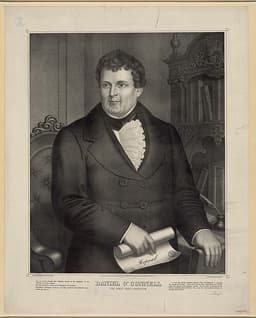
Daniel OConnell
Politician · Modern
57.0Total

Fakhruddin Ali Ahmed
Politician · Modern
39.3Total
Basic Information
Born
1775
1905
Died
1847
1977
Era
Modern
Modern
Nationality
Ireland
India
Occupation
Politician
Politician
Civilization
Western
Indian
Score Comparison
Military (10%)
50.0
36.4
Political (20%)
72.0
25.0
Influence (20%)
55.0
47.1
Legacy (20%)
52.0
35.8
Leadership (15%)
68.0
34.6
Strategy (15%)
42.7
60.0
TOTAL
57.0
39.3
Daniel OConnell — Complete Timeline
1823 AD
Catholic Association FoundedPolitical Action◆ Major
O'Connell founded the Catholic Association to campaign for Catholic emancipation. The organization used mass membership and the 'Catholic Rent' (a penny a month subscription) to mobilize Irish Catholics politically.
Catholic EmancipationPolitical OrganizationMass Mobilization
Impact: nationalprogressive
1828 AD
Election to ParliamentPolitical Action◆ Major
O'Connell won a by-election in County Clare, defeating a Protestant candidate. As a Catholic, he was legally barred from taking his seat, forcing the British government to pass the Catholic Relief Act 1829 to avoid civil unrest.
ElectionCatholic EmancipationPolitical Crisis
Impact: nationalprogressive
1829 AD
Catholic Relief Act 1829Reform
The British Parliament passed the Catholic Relief Act, allowing Catholics to sit in Parliament and hold most public offices. O'Connell's campaign was the primary cause, though the act also raised the property qualification for Irish voters.
Catholic EmancipationLegislationReform
Impact: nationalprogressive
1840 AD
Repeal Association FoundedPolitical Action◆ Major
O'Connell founded the Repeal Association to campaign for the repeal of the Acts of Union 1800 and the restoration of an Irish parliament. The movement used mass meetings, known as 'monster meetings', to demonstrate popular support.
RepealNationalismMass Politics
Impact: nationalprogressive
1843 AD
Monster Meeting at TaraPolitical Action
O'Connell held a massive 'monster meeting' at the Hill of Tara, attracting an estimated 750,000 people. These peaceful demonstrations demonstrated the strength of the Repeal movement but alarmed the British government.
Monster MeetingRepealMass Mobilization
Impact: nationalprogressive
1844 AD
Trial for ConspiracyPolitical Action◆ Major
O'Connell was tried and convicted for conspiracy to incite rebellion, based on his Repeal campaign speeches. He was sentenced to a year in prison but was released after three months by the House of Lords on appeal.
TrialImprisonmentRepeal
Impact: national
Fakhruddin Ali Ahmed — Complete Timeline
1971 AD
Appointed Minister of AgriculturePolitical Action◆ Major
Fakhruddin Ali Ahmed was appointed as India's Minister of Agriculture under Prime Minister Indira Gandhi. He oversaw agricultural policies during the Green Revolution, focusing on food security.
AgricultureGreen RevolutionCongress
Impact: nationalconstructive
1974 AD
Elected President of IndiaPolitical Action◆ Major
Fakhruddin Ali Ahmed was elected as the 5th President of India, serving from 1974 to 1977. He was the second Muslim to hold the office, and his presidency was marked by the Emergency period.
PresidencyMuslimElection
Impact: national
1975 AD
Proclaimed Emergency in 1975Political Action◆ Major
President Fakhruddin Ali Ahmed signed the proclamation of a national Emergency on June 25, 1975, on the advice of Prime Minister Indira Gandhi. This suspended fundamental rights and led to authoritarian rule until 1977.
EmergencyConstitutionalAuthoritarian
Impact: nationaldestructive
1977 AD
Died in officeOther◆ Major
Fakhruddin Ali Ahmed died in office on February 11, 1977, due to a heart attack. He was the second Indian president to die in office, leading to B.D. Jatti serving as acting president.
DeathPresidencyConstitutional
Impact: nationaltragic
This comparison has not been analyzed yet.
One-time AI generation (~1 minute). Scores and timeline are already available below.
Rankings
🥇
Daniel OConnellLeader
Mil: 50.0Pol: 72.0Inf: 55.0
57.0
🥈
Fakhruddin Ali Ahmed
Mil: 36.4Pol: 25.0Inf: 47.1
39.3
+17.7 behind
How This Comparison Works
Algorithm
Each figure is scored on 6 dimensions (0—100 scale) based on structured historical data: Military (10%), Political (20%), Influence (20%), Legacy (20%), Leadership (15%), Strategy (15%). The weighted total produces the final ranking.
Data Sources
Scores are computed from structured sub-indicators in the database. Scale factors adjust for era (Ancient ×0.85, Modern ×1.0) and civilization size (Eastern ×1.05, Other ×0.80) to account for differences in population and military scale.
Maximum 3 Figures
Comparisons are limited to 2—3 figures to ensure readability and statistical meaningfulness.
Error Margins
±5 points per dimension — Sub-scores are derived from historical records with inherent uncertainty. Two figures within 5 points on a dimension should be considered roughly equivalent in that area.
Total Score Accuracy
±3 points overall — The weighted combination of 6 dimensions produces a total score with approximately ±3 points of uncertainty. Differences of less than 3 points are not statistically significant— the figures are effectively tied.
Known Limitations
- Historical records are incomplete and uneven across civilizations
- Figures from oral-tradition societies may be underrepresented
- Occupation labels can misclassify multi-role figures
- Scores measure capability and impact, not moral character
- Quantitative scoring is a comparison tool, not absolute truth
Capability Radar
Military (10%) — Battles & Warfare
Battles
28
43
Win Rate
31
49
Expansion
35
49
Political (20%) — Governance & Reform
Reform
85
10
Diplomacy
80
20
Economy
30
10
Influence (20%) — Cultural & Global Reach
Cultural
65
5
Global
55
5
Legacy (20%) — Historical Impact
Historical
70
10
Longevity
60
5
Leadership (15%) — Power & Stability
Tenure
40
15
Stability
60
5
Strategy (15%) — Tactics & Innovation
Strategy
40
53
Tactics
38
54
Reform
44
61
Similar Comparisons
Comments & Discussion
No comments yet. Be the first to share your thoughts!