Loading...
Daniel Noboa vs Napoleon Bonaparte
Napoleon Bonaparte leads by 30.3 pts · 2 figures compared
…
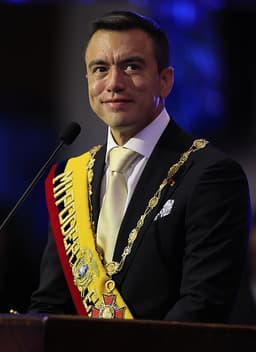
Daniel Noboa
Politician · Modern
40.6Total

Napoleon Bonaparte
General · Modern
70.9Total
Basic Information
Born
1987
1769
Died
—
1821
Era
Modern
Modern
Nationality
Ecuador
France
Occupation
Politician
General
Civilization
Western
Western
Score Comparison
Military (10%)
50.0
94.0
Political (20%)
32.2
72.0
Influence (20%)
47.1
40.0
Legacy (20%)
35.8
80.0
Leadership (15%)
38.1
78.0
Strategy (15%)
43.4
90.0
TOTAL
40.6
70.9
Daniel Noboa — Complete Timeline
2023 AD
Elected President of EcuadorPolitical Action◆ Major
Daniel Noboa won the 2023 snap presidential election runoff against Luisa Gonz
ElectionYouthSnap Election
Impact: national
2024 AD
Declared internal armed conflict against drug cartelsPolitical Action◆ Major
In January 2024, following a series of violent attacks including a prison riot and the escape of a major drug lord, Noboa declared an 'internal armed conflict' against organized crime groups. He deployed the military and designated 22 gangs as terrorist organizations, escalating the war on drugs.
War on DrugsMilitaryOrganized Crime
Impact: nationaldestructive
Napoleon Bonaparte — Complete Timeline
1799 AD
Coup of 18 BrumaireOther◆ Major
Napoleon Bonaparte, with support from his brother Lucien and key political figures, overthrew the Directory in a bloodless coup. He established the Consulate with himself as First Consul, effectively becoming the ruler of France. This event ended the French Revolution's most unstable period.
French RevolutionCoupRise to Power
Impact: regional
1804 AD
Promulgation of the Napoleonic CodeOther◆ Major
Napoleon enacted the Civil Code of the French, known as the Napoleonic Code, a comprehensive set of laws that replaced the fragmented feudal legal systems. The code established legal equality, protected property rights, and secularized law. It became the basis for legal systems in many European and world countries.
Legal ReformNapoleonic CodeCivil Law
Impact: globalconstructive
1805 AD
Battle of AusterlitzWar◆ Major
Napoleon's Grande Arm
Napoleonic WarsBattleDecisive Victory
Impact: global
1812 AD
Invasion of RussiaWar◆ Major
Napoleon led the Grande Arm
Napoleonic WarsInvasionDisaster
Impact: globaldestructive
1815 AD
Battle of WaterlooWar◆ Major
Napoleon's French army was defeated by the combined forces of the Duke of Wellington's Anglo-Allied army and Gebhard Leberecht von Bl
Napoleonic WarsBattleFinal Defeat
Impact: globaldestructive
Expert Analysis
daniel-noboa-vs-napoleon-bonaparte
# The Emperor and the Heir: Two Men, Two Centuries, One Question
On a misty morning in December 1805, Napoleon Bonaparte stood before his Grande Armée in the fields of Austerlitz, about to crush the combined forces of Russia and Austria in what would be hailed as his greatest victory. Two hundred and eighteen years later, in January 2024, Daniel Noboa sat in the presidential palace of Quito, declaring an internal armed conflict against drug cartels that had turned his small nation into a battleground. One man commanded the most powerful army in Europe; the other governed a country struggling to control its own streets. What separates these two figures—both young, both ambitious, both thrust into power at moments of crisis—is not merely time, but the very nature of power itself.
Origins
Napoleon Bonaparte was born in 1769 on the island of Corsica, a year after France purchased the island from Genoa. His family belonged to the minor nobility, but they were not wealthy. The young Napoleon spoke Italian-accented French and was mocked by his classmates at military school for his provincial origins. This outsider status forged in him a fierce determination to prove himself—and a deep understanding that merit, not birth, would be his path to greatness. The French Revolution, which erupted when he was twenty, shattered the old order and opened doors that would have remained closed under the monarchy.
Daniel Noboa, born in 1987, inherited a different world. His father, Álvaro Noboa, is one of Ecuador’s wealthiest men, a banana tycoon who ran for president five times without success. Daniel grew up in privilege, educated in the United States at Harvard and New York University, then at Northwestern’s Kellogg School of Management. He entered politics not as an outsider storming the gates, but as an heir stepping into a family business. The Ecuador he inherited was a nation battered by political instability—three presidents in three years before his election—and overrun by drug cartels that had turned the country into a transit hub for cocaine.
Rise to Power
Napoleon’s ascent was meteoric and earned. At twenty-four, he drove the British out of Toulon and was promoted to brigadier general. By twenty-six, he was commanding the Army of Italy, where his lightning campaigns forced Austria to sue for peace. His 1798 Egyptian campaign, though ultimately a strategic failure, burnished his legend. Returning to France amid political chaos, he seized power in the 1799 coup of 18 Brumaire, becoming First Consul at thirty. Five years later, he crowned himself Emperor.
Noboa’s rise was faster but less dramatic. In 2023, Ecuador’s president dissolved the National Assembly amid impeachment proceedings, triggering snap elections. Noboa, running for a newly created centrist party, finished second in the first round. In the runoff, he defeated Luisa González, a protégé of former president Rafael Correa, with 52 percent of the vote. At thirty-five, he became Ecuador’s youngest president—but his path required no battlefield, no coup, only a campaign and a ballot box.
Leadership & Governance
Napoleon governed as a military conqueror and a reformer. His Napoleonic Code standardized French law, abolished feudal privileges, and enshrined principles of meritocracy—though it also restricted women’s rights and restored slavery in the colonies. He built roads, established the Bank of France, and reformed education. But his genius was strategic: he fought over sixty battles and lost only seven, his campaigns studied in military academies to this day. His political wisdom, however, proved brittle. He failed to consolidate his conquests diplomatically, alienated potential allies, and overreached in Russia and Spain.
Noboa governs a nation of eighteen million, not a continent. His most decisive act came in January 2024, when he declared an “internal armed conflict” against drug cartels after a prison riot and the escape of a major drug lord. He deployed the military to the streets, suspended certain civil liberties, and targeted twenty-two criminal groups as terrorist organizations. The move was bold but risky—a president governing by decree, his popularity dependent on visible results. Unlike Napoleon, Noboa cannot march on Moscow; he must navigate a fragile democracy, a fractious legislature, and an economy dependent on oil and remittances.
Triumph & Tragedy
Napoleon’s greatest triumph was Austerlitz in 1805, where he lured the Allies into a trap and destroyed their armies. His greatest tragedy was the 1812 invasion of Russia, where he lost over 400,000 men to winter, disease, and guerrilla attacks. Exiled to Elba in 1814, he returned for the Hundred Days, only to meet final defeat at Waterloo in 1815. He died in exile on Saint Helena, a prisoner of the British.
Noboa’s triumphs are smaller in scale but no less significant. His declaration of war on cartels initially reduced violence in some areas, though critics warned of human rights abuses. His tragedy may yet unfold: Ecuador remains deeply divided, the economy fragile, and the cartels adaptive. He has not faced a Waterloo, but he has not won an Austerlitz either.
Character & Destiny
Napoleon was possessed by ambition: “Impossible is a word to be found only in the dictionary of fools,” he said. He believed he could shape history through sheer will and military genius. That belief made him great—and also doomed him. He could not stop, could not consolidate, could not accept limits.
Noboa is more pragmatic, less romantic. He entered politics as a businessman, not a revolutionary. His decisions are cautious, his rhetoric measured. He speaks not of glory but of security. In another era, he might have been a competent manager. In this one, he must be something more.
Legacy
Napoleon’s legacy is monumental. The Napoleonic Code influenced legal systems across Europe and the Americas. His military innovations shaped warfare for a century. He is remembered as a genius and a tyrant, a liberator and a conqueror—a figure who reshaped his world.
Noboa’s legacy is unwritten. He may be remembered as the young president who restored order—or as one who sacrificed democracy for security. His scores, at 48.7, are modest compared to Napoleon’s 82.4. But they measure potential, not destiny.
Conclusion
Napoleon and Noboa are separated by two centuries, but they share a common question: What does it mean to lead in a time of crisis? Napoleon answered with conquest, ambition, and ultimate ruin. Noboa answers with caution, pragmatism, and a fragile hope. One sought to remake the world; the other seeks only to save his country. In the end, perhaps the greatest difference is not in their abilities but in their circumstances: Napoleon had an empire to gain; Noboa has one to lose.
Rankings
🥇
Napoleon BonaparteLeader
Mil: 94.0Pol: 72.0Inf: 40.0
70.9
🥈
Daniel Noboa
Mil: 50.0Pol: 32.2Inf: 47.1
40.6
+30.3 behind
How This Comparison Works
Algorithm
Each figure is scored on 6 dimensions (0—100 scale) based on structured historical data: Military (10%), Political (20%), Influence (20%), Legacy (20%), Leadership (15%), Strategy (15%). The weighted total produces the final ranking.
Data Sources
Scores are computed from structured sub-indicators in the database. Scale factors adjust for era (Ancient ×0.85, Modern ×1.0) and civilization size (Eastern ×1.05, Other ×0.80) to account for differences in population and military scale.
Maximum 3 Figures
Comparisons are limited to 2—3 figures to ensure readability and statistical meaningfulness.
Error Margins
±5 points per dimension — Sub-scores are derived from historical records with inherent uncertainty. Two figures within 5 points on a dimension should be considered roughly equivalent in that area.
Total Score Accuracy
±3 points overall — The weighted combination of 6 dimensions produces a total score with approximately ±3 points of uncertainty. Differences of less than 3 points are not statistically significant— the figures are effectively tied.
Known Limitations
- Historical records are incomplete and uneven across civilizations
- Figures from oral-tradition societies may be underrepresented
- Occupation labels can misclassify multi-role figures
- Scores measure capability and impact, not moral character
- Quantitative scoring is a comparison tool, not absolute truth
Capability Radar
Military (10%) — Battles & Warfare
Battles
30
95
Win Rate
31
90
Expansion
32
95
Political (20%) — Governance & Reform
Reform
20
95
Diplomacy
25
80
Economy
20
85
Influence (20%) — Cultural & Global Reach
Cultural
10
85
Global
10
90
Legacy (20%) — Historical Impact
Historical
10
95
Longevity
5
90
Leadership (15%) — Power & Stability
Tenure
15
85
Stability
10
70
Strategy (15%) — Tactics & Innovation
Strategy
41
95
Tactics
40
98
Reform
45
92
Similar Comparisons
Comments & Discussion
No comments yet. Be the first to share your thoughts!