Loading...
Crassus vs Zhang Liao
Crassus leads by 3.6 pts · 2 figures compared
…
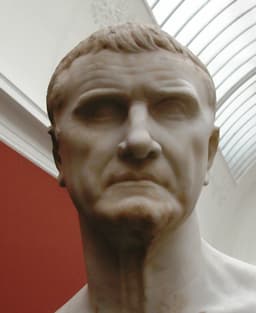
Crassus
General · Ancient
55.5Total

Zhang Liao
General · Ancient
51.9Total
Basic Information
Born
-115
169
Died
-53
222
Era
Ancient
Ancient
Nationality
Roman Republic
China
Occupation
General
General
Civilization
Western
Eastern
Score Comparison
Military (10%)
65.0
82.0
Political (20%)
46.6
27.9
Influence (20%)
57.2
57.2
Legacy (20%)
50.0
50.0
Leadership (15%)
61.1
40.4
Strategy (15%)
60.0
66.3
TOTAL
55.5
51.9
Crassus — Complete Timeline
71 BC
Suppression of Spartacus's RevoltWar◆ Major
Crassus raised and commanded six legions to crush the slave rebellion led by Spartacus. After cornering and defeating the rebels in Lucania, he crucified 6,000 survivors along the Appian Way, ending the Third Servile War.
Slave RevoltSpartacusCrucifixionThird Servile War
Impact: nationaldestructive
60 BC
Formation of the First TriumviratePolitical Action
Crassus allied with Julius Caesar and Pompey the Great to form an informal political coalition known as the First Triumvirate. This alliance dominated Roman politics, advancing each member's interests against the Senate.
Political AllianceCaesarPompeySenate
Impact: global
53 BC
Battle of CarrhaeWar◆ Major
Crassus invaded Parthia without proper support and was defeated at Carrhae. His army was annihilated by Parthian cavalry, and Crassus was killed during negotiations. This disaster marked a major Roman defeat and ended the Triumvirate.
Parthian WarDefeatDeath
Impact: regionaltragic
Zhang Liao — Complete Timeline
200 AD
Battle of GuanduWar◆ Major
Zhang Liao served under L
Three KingdomsBattleDefection
Impact: nationalconstructive
207 AD
Battle of White Wolf MountainWar◆ Major
Zhang Liao led a cavalry force in Cao Cao's campaign against the Wuhuan tribes. He personally killed the Wuhuan chieftain Tadun, securing Wei's northern frontier.
Three KingdomsBattleWuhuan
Impact: regionalconstructive
215 AD
Battle of HefeiWar
Zhang Liao defended Hefei against Sun Quan's invasion with only 800 cavalry. He launched a surprise attack that routed the Wu vanguard, forcing Sun Quan to retreat. This victory made him a legendary figure.
Three KingdomsBattleSun Quan
Impact: nationalconstructive
220 AD
Appointed General of the VanguardPolitical Action◆ Major
After Cao Pi became emperor, Zhang Liao was appointed General of the Vanguard, one of the highest military ranks in Wei. He continued to serve as a key commander.
Three KingdomsPromotionCao Pi
Impact: nationalconstructive
222 AD
Death from IllnessOther
Zhang Liao died from illness while on campaign against Sun Quan. He was posthumously honored as a marquis, and his legacy as a peerless warrior endured.
Three KingdomsDeathIllness
Impact: national
Expert Analysis
Origins
Marcus Licinius Crassus (c. 115–53 BCE) was born into a wealthy plebeian family in the Roman Republic. His father and brother were killed during the Marian purges, forcing young Crassus to flee to Spain. There he hid in a cave, living off the land, before emerging to join Sulla's faction. This early trauma instilled a relentless drive for wealth and power. He amassed a fortune through property speculation, mining, and slave trading, becoming the richest man in Rome.
Zhang Liao (c. 169–222 CE) was born in Yanmen Commandery (modern Shanxi) during the late Eastern Han dynasty. His family served as minor officials. Zhang Liao began his career as a cavalry officer under the warlord Ding Yuan, then served Lü Bu, and finally defected to Cao Cao after Lü Bu's defeat. His early military experience in the chaotic frontier shaped his aggressive cavalry tactics.
Rise to Power
Crassus rose to prominence by financing Sulla's march on Rome in 83 BCE. He used his wealth to secure political influence, serving as praetor in 73 BCE. His major breakthrough came in 71 BCE when he suppressed Spartacus's slave revolt. Crassus raised six legions at his own expense, cornered Spartacus in Lucania, and crucified 6,000 survivors along the Appian Way. This victory gave him military prestige, though Pompey claimed credit for mopping up stragglers. In 70 BCE, Crassus became consul alongside Pompey. He further cemented his power by forming the First Triumvirate with Julius Caesar and Pompey in 60 BCE.
Zhang Liao rose through merit on the battlefield. After joining Cao Cao around 199 CE, he quickly proved himself in the campaign against Yuan Shao. At the Battle of Guandu (200 CE), Zhang Liao led cavalry charges that disrupted Yuan Shao's supply lines. His decisive moment came in 207 CE at the Battle of White Wolf Mountain, where he personally killed the Wuhuan chieftain Tadun, securing Cao Cao's northern frontier. This victory earned him the rank of General of the Vanguard. His most famous feat was at Hefei in 215 CE, where with only 800 cavalry he launched a surprise attack against Sun Quan's 100,000-strong army, routing the vanguard and forcing a siege lift.
Leadership & Governance
Crassus led primarily through wealth and patronage. He bought loyalty, funding armies and political campaigns. His leadership style was cautious in military matters, relying on overwhelming force rather than tactical brilliance. Politically, he was a skilled negotiator, balancing between Caesar and Pompey. However, his governance was transactional: he viewed provinces as opportunities for profit. As governor of Syria, he plundered the Temple of Jerusalem and extorted taxes, alienating locals.
Zhang Liao led by personal example and tactical aggression. He inspired loyalty by sharing hardships with his men. At Hefei, he personally led the charge, killing several enemy soldiers. His leadership score of 40.4 reflects a more limited scope than Crassus's political maneuvering. Zhang Liao's governance was confined to military commands; he never held civil office. His strategy score of 66.3 is higher than Crassus's 60.0, reflecting his ability to win against superior numbers.
Triumph & Tragedy
Crassus's greatest triumph was crushing Spartacus, which restored order and enhanced his reputation. He also brokered the First Triumvirate, dominating Roman politics for years. However, his tragic failure came at Carrhae in 53 BCE. Ignoring advice, he invaded Parthia with 36,000–44,000 men. The Parthians used feigned retreats and mounted archers to decimate his legions. Crassus was killed during negotiations, and his head was used as a prop in a play. His military score of 65.0 reflects this defeat.
Zhang Liao's triumph was the defense of Hefei, where his 800 cavalry shattered Sun Quan's invasion. This victory secured Wei's southern border and made him a legendary figure. He also succeeded at White Wolf Mountain and Guandu. His tragedy was an early death from illness at age 53 while on campaign. Unlike Crassus, he died with his reputation intact. His military score of 82.0 is significantly higher, reflecting consistent victories.
Character & Destiny
Crassus was driven by greed and ambition. His character was calculating but arrogant, believing wealth could solve all problems. This hubris led him to underestimate the Parthians. His political score of 46.6 reflects his inability to secure lasting alliances; both Caesar and Pompey eventually turned against him. His total score of 55.5 is higher than Zhang Liao's 51.9 due to his broader influence.
Zhang Liao was loyal, courageous, and tactically astute. He knew when to switch sides (from Lü Bu to Cao Cao) but remained faithful thereafter. His character was that of a warrior, not a politician. His political score of 27.9 is low because he never sought power beyond military command. His legacy score of 50.0 matches Crassus's, but his military prowess is far superior.
Legacy
Crassus's legacy is mixed. He is remembered as the richest man in Rome and a key figure in the Republic's fall. His defeat at Carrhae exposed Roman vulnerability to Parthian tactics. His wealth set a precedent for using personal fortune to achieve political power. In modern times, his name is synonymous with excessive wealth ("Crassus-like"). However, his military failures overshadow his political achievements.
Zhang Liao is revered in Chinese history as a peerless general. The Battle of Hefei is studied as a classic example of using a small force to defeat a larger one. He is enshrined in the Temple of Famous Officials and appears in the novel "Romance of the Three Kingdoms" as a heroic figure. His legacy endures in Chinese culture, where he symbolizes courage and tactical brilliance. His influence score of 57.2 equals Crassus's, but his impact is more focused on military art.
Conclusion
Comparing Crassus and Zhang Liao reveals a contrast between political wealth and military skill. Crassus's total score of 55.5 edges Zhang Liao's 51.9, but this reflects Crassus's broader historical role rather than his effectiveness. In military terms, Zhang Liao is clearly superior: his 82.0 military score dwarfs Crassus's 65.0. Zhang Liao won against overwhelming odds, while Crassus's only major victory was against a slave revolt, and his final campaign was a disaster. Crassus had greater political influence, but that influence was built on money, not leadership. Zhang Liao's impact on military strategy and Chinese culture is more enduring. Therefore, Zhang Liao had a greater impact as a military figure, while Crassus's impact was tied to his wealth and the Republic's politics. In a direct comparison of generalship, Zhang Liao wins decisively.
Rankings
🥇
CrassusLeader
Mil: 65.0Pol: 46.6Inf: 57.2
55.5
🥈
Zhang Liao
Mil: 82.0Pol: 27.9Inf: 57.2
51.9
+3.6 behind
How This Comparison Works
Algorithm
Each figure is scored on 6 dimensions (0—100 scale) based on structured historical data: Military (10%), Political (20%), Influence (20%), Legacy (20%), Leadership (15%), Strategy (15%). The weighted total produces the final ranking.
Data Sources
Scores are computed from structured sub-indicators in the database. Scale factors adjust for era (Ancient ×0.85, Modern ×1.0) and civilization size (Eastern ×1.05, Other ×0.80) to account for differences in population and military scale.
Maximum 3 Figures
Comparisons are limited to 2—3 figures to ensure readability and statistical meaningfulness.
Error Margins
±5 points per dimension — Sub-scores are derived from historical records with inherent uncertainty. Two figures within 5 points on a dimension should be considered roughly equivalent in that area.
Total Score Accuracy
±3 points overall — The weighted combination of 6 dimensions produces a total score with approximately ±3 points of uncertainty. Differences of less than 3 points are not statistically significant— the figures are effectively tied.
Known Limitations
- Historical records are incomplete and uneven across civilizations
- Figures from oral-tradition societies may be underrepresented
- Occupation labels can misclassify multi-role figures
- Scores measure capability and impact, not moral character
- Quantitative scoring is a comparison tool, not absolute truth
Capability Radar
Military (10%) — Battles & Warfare
Battles
55
65
Win Rate
60
70
Expansion
30
40
Political (20%) — Governance & Reform
Reform
30
20
Diplomacy
60
45
Economy
85
25
Influence (20%) — Cultural & Global Reach
Cultural
40
55
Global
45
40
Legacy (20%) — Historical Impact
Historical
55
60
Longevity
50
55
Leadership (15%) — Power & Stability
Tenure
65
40
Stability
40
35
Strategy (15%) — Tactics & Innovation
Strategy
40
75
Tactics
45
80
Reform
10
30
Similar Comparisons
Comments & Discussion
No comments yet. Be the first to share your thoughts!