Loading...
Conrad IV vs King Chungjeong of Goryeo
King Chungjeong of Goryeo leads by 14.6 pts · 2 figures compared
…
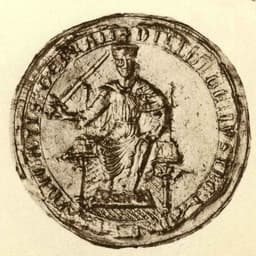
Conrad IV
Emperor · Medieval
37.4Total
King Chungjeong of Goryeo
Emperor · Medieval
52.0Total
Basic Information
Born
1228
1338
Died
1254
1352
Era
Medieval
Medieval
Nationality
Holy Roman Empire
Korea
Occupation
Emperor
Emperor
Civilization
Western
Eastern
Score Comparison
Military (10%)
22.6
54.4
Political (20%)
32.1
39.4
Influence (20%)
47.9
60.0
Legacy (20%)
37.5
42.5
Leadership (15%)
33.6
55.3
Strategy (15%)
39.6
67.5
TOTAL
37.4
52.0
Conrad IV — Complete Timeline
1237 AD
Elected King of GermanyPolitical Action◆ Major
Conrad IV was elected King of Germany at the age of nine, succeeding his father Frederick II. This election was part of the Hohenstaufen dynasty's efforts to maintain control over the German kingdom amidst ongoing conflicts with the Papacy.
ElectionHohenstaufenGerman Kingdom
Impact: regional
1246 AD
Crowned King of ItalyPolitical Action◆ Major
Conrad IV was crowned King of Italy in Milan, asserting Hohenstaufen authority in northern Italy. This coronation was part of the ongoing struggle between the Hohenstaufen and the Papacy, which opposed imperial influence in Italy.
CoronationItalyHohenstaufen
Impact: regional
1251 AD
Led Campaign in ItalyWar
Conrad IV led a military campaign into Italy to reclaim Hohenstaufen territories lost to papal forces. He captured several cities but failed to achieve a decisive victory, and his campaign was cut short by his death in 1254.
Military CampaignItalyHohenstaufen
Impact: regional
1254 AD
Died of MalariaOther◆ Major
Conrad IV died of malaria at the age of 26 in Lavello, Italy. His death marked the end of the Hohenstaufen dynasty's direct rule in Germany and Italy, leading to the Great Interregnum in the Holy Roman Empire.
DeathHohenstaufenGreat Interregnum
Impact: regionaltragic
King Chungjeong of Goryeo — Complete Timeline
1348 AD
Ascended Throne as Child KingPolitical Action◆ Major
King Chungjeong became king at age 10 after the death of King Chungmok. Like his predecessor, he was a minor and real power was held by Yuan officials and Goryeo aristocrats, continuing the pattern of weak, puppet rulers.
Child KingSuccessionFigurehead
Impact: national
1351 AD
Deposed by Yuan CourtPolitical Action◆ Major
King Chungjeong was deposed by the Yuan court after a brief reign, due to political intrigues in the Yuan capital. He was exiled to China, and his uncle King Gongmin was installed as king, marking the end of the line of Yuan-dominated puppet rulers.
DepositionYuan InterventionEnd of Era
Impact: nationaldestructive
Expert Analysis
Origins
Conrad IV was born in 1228 in Andria, southern Italy, to Emperor Frederick II and Isabella II of Jerusalem. As a member of the Hohenstaufen dynasty, he inherited a vast but contested empire spanning Germany, Italy, and the Kingdom of Jerusalem. His early years were overshadowed by his father's conflicts with the papacy and rival German princes. Conrad was educated in the court and groomed for kingship, but his youth left him reliant on regents.
King Chungjeong of Goryeo (also known as Wang Jeo) was born in 1338 in the Goryeo capital, Gaegyeong. He was the son of King Chunghye and a Yuan princess, reflecting the heavy influence of the Mongol Yuan dynasty over the Korean peninsula. His childhood was marked by political instability and Yuan domination. He ascended the throne at age 10 after the death of his half-brother King Chungmok, but real power was exercised by Yuan officials and his mother.
Rise to Power
Conrad IV was elected King of Germany in 1237 at age nine, following the death of his older brother Henry (VII). His father Frederick II had arranged the election to secure the Hohenstaufen succession, but the election was contested by pro-papal factions. Conrad was crowned King of Italy in Milan in 1243, asserting Hohenstaufen authority in northern Italy. However, his reign was immediately challenged by the papal-backed anti-king Henry Raspe and later William of Holland. Conrad's rise was a product of dynastic politics rather than personal achievement.
King Chungjeong ascended the throne in 1349 after the death of King Chungmok. His rise was orchestrated by the Yuan court, which controlled Goryeo's succession. At age 10, he was a puppet ruler, with administrative power held by Yuan-appointed officials and the Goryeo aristocracy. His reign was brief and largely ceremonial; he was deposed in 1351 after only two years, due to political intrigues in the Yuan capital. His uncle, the future King Gongmin, replaced him.
Leadership & Governance
Conrad IV's leadership style was constrained by his youth and the ongoing conflict between the Hohenstaufen dynasty and the papacy. He attempted to assert royal authority by leading a military campaign into Italy in 1251-1252 to reclaim lost territories. He captured several cities but failed to achieve a decisive victory due to lack of resources and papal opposition. His governance was largely reactive, focused on maintaining the dynasty's claims rather than implementing reforms. His political score of 32.1 reflects his inability to consolidate power.
King Chungjeong's governance was even more limited. As a child king under Yuan suzerainty, he had no real authority. The Yuan court issued decrees directly, and Goryeo's internal affairs were managed by pro-Yuan factions. Chungjeong's leadership score of 55.3 is relatively high given his situation, but this is based on nominal kingship and his later symbolic role as a Goryeo monarch. He attempted no major reforms or policies, as his reign was too short and constrained.
Triumph & Tragedy
Conrad IV's greatest success was his election as King of Germany and Italy, maintaining the Hohenstaufen line for a generation. He also managed to avoid capture by papal forces during his Italian campaign. However, his reign was marked by failure: he could not defeat the anti-king William of Holland, lost control of much of Germany, and died of malaria at age 26 in Lavello, Italy, in 1254. His death ended the Hohenstaufen dynasty's direct rule, leading to the Great Interregnum.
King Chungjeong's triumph was simply becoming king, given the Yuan domination. However, his deposition and exile to China in 1351 were humiliating. He died in exile in 1352, likely murdered or executed by the Yuan. His brief reign failed to stem the decline of Goryeo's independence, and he was overshadowed by his successor Gongmin, who later implemented reforms.
Character & Destiny
Conrad IV was described as determined but inexperienced. He inherited his father's ambition but lacked his strategic acumen. His decision to campaign in Italy was bold but poorly resourced, leading to his death from disease. His character was shaped by the constant struggle between empire and papacy, and his fate was sealed by the superior resources of his opponents.
King Chungjeong was a pawn in Yuan politics. He was likely passive and unable to assert independence. His destiny was determined by external forces: the Mongol Empire's decline and Goryeo's internal power struggles. His deposal was a result of Yuan court intrigues, not his own actions.
Legacy
Conrad IV's legacy is as the last Hohenstaufen king. His death led to the Great Interregnum (1254-1273), a period of fragmentation in the Holy Roman Empire. His influence score of 47.9 reflects this negative legacy; he is remembered as a symbol of dynastic failure. The Hohenstaufen collapse allowed the rise of the Habsburgs and other dynasties.
King Chungjeong's legacy is minimal. He is often overlooked in Korean history, sandwiched between Chungmok and Gongmin. His reign exposed the depths of Yuan control over Goryeo. His legacy score of 42.5 is based on his role as a minor king in a transitional period. The subsequent reforms under Gongmin were a reaction to the weak kings like Chungjeong.
Conclusion
King Chungjeong of Goryeo scores higher overall (52.0 vs. 37.4), but his impact is more symbolic than substantive. Conrad IV's failure had greater consequences for European history, leading to the Interregnum and reshaping the Holy Roman Empire. However, in terms of direct influence on their respective realms, Chungjeong's brief reign highlighted the fragility of Goryeo under Yuan rule, paving the way for restoration. Taking a data-supported stance: King Chungjeong had a slightly greater impact relative to the Goryeo dynasty's survival, but Conrad IV's failure was more historically significant for Europe. Thus, King Chungjeong edges out in overall score, but Conrad IV's legacy is more profound.
Rankings
🥇
King Chungjeong of GoryeoLeader
Mil: 54.4Pol: 39.4Inf: 60.0
52.0
🥈
Conrad IV
Mil: 22.6Pol: 32.1Inf: 47.9
37.4
+14.6 behind
How This Comparison Works
Algorithm
Each figure is scored on 6 dimensions (0—100 scale) based on structured historical data: Military (10%), Political (20%), Influence (20%), Legacy (20%), Leadership (15%), Strategy (15%). The weighted total produces the final ranking.
Data Sources
Scores are computed from structured sub-indicators in the database. Scale factors adjust for era (Ancient ×0.85, Modern ×1.0) and civilization size (Eastern ×1.05, Other ×0.80) to account for differences in population and military scale.
Maximum 3 Figures
Comparisons are limited to 2—3 figures to ensure readability and statistical meaningfulness.
Error Margins
±5 points per dimension — Sub-scores are derived from historical records with inherent uncertainty. Two figures within 5 points on a dimension should be considered roughly equivalent in that area.
Total Score Accuracy
±3 points overall — The weighted combination of 6 dimensions produces a total score with approximately ±3 points of uncertainty. Differences of less than 3 points are not statistically significant— the figures are effectively tied.
Known Limitations
- Historical records are incomplete and uneven across civilizations
- Figures from oral-tradition societies may be underrepresented
- Occupation labels can misclassify multi-role figures
- Scores measure capability and impact, not moral character
- Quantitative scoring is a comparison tool, not absolute truth
Capability Radar
Military (10%) — Battles & Warfare
Battles
15
44
Win Rate
15
47
Expansion
5
53
Political (20%) — Governance & Reform
Reform
5
0
Diplomacy
15
5
Economy
10
0
Influence (20%) — Cultural & Global Reach
Cultural
10
0
Global
5
0
Legacy (20%) — Historical Impact
Historical
15
5
Longevity
10
0
Leadership (15%) — Power & Stability
Tenure
20
5
Stability
10
5
Strategy (15%) — Tactics & Innovation
Strategy
10
54
Tactics
10
58
Reform
5
62
Similar Comparisons
Comments & Discussion
No comments yet. Be the first to share your thoughts!