Loading...
Conrad IV vs Julius Caesar
Julius Caesar leads by 45.4 pts · 2 figures compared
…
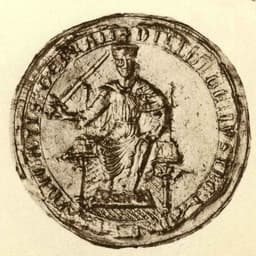
Conrad IV
Emperor · Medieval
37.4Total

Julius Caesar
General · Ancient
82.8Total
Basic Information
Born
1228
-100
Died
1254
-44
Era
Medieval
Ancient
Nationality
Holy Roman Empire
Roman Republic
Occupation
Emperor
General
Civilization
Western
Western
Score Comparison
Military (10%)
22.6
88.0
Political (20%)
32.1
78.0
Influence (20%)
47.9
85.0
Legacy (20%)
37.5
82.0
Leadership (15%)
33.6
80.0
Strategy (15%)
39.6
85.0
TOTAL
37.4
82.8
Conrad IV — Complete Timeline
1237 AD
Elected King of GermanyPolitical Action◆ Major
Conrad IV was elected King of Germany at the age of nine, succeeding his father Frederick II. This election was part of the Hohenstaufen dynasty's efforts to maintain control over the German kingdom amidst ongoing conflicts with the Papacy.
ElectionHohenstaufenGerman Kingdom
Impact: regional
1246 AD
Crowned King of ItalyPolitical Action◆ Major
Conrad IV was crowned King of Italy in Milan, asserting Hohenstaufen authority in northern Italy. This coronation was part of the ongoing struggle between the Hohenstaufen and the Papacy, which opposed imperial influence in Italy.
CoronationItalyHohenstaufen
Impact: regional
1251 AD
Led Campaign in ItalyWar
Conrad IV led a military campaign into Italy to reclaim Hohenstaufen territories lost to papal forces. He captured several cities but failed to achieve a decisive victory, and his campaign was cut short by his death in 1254.
Military CampaignItalyHohenstaufen
Impact: regional
1254 AD
Died of MalariaOther◆ Major
Conrad IV died of malaria at the age of 26 in Lavello, Italy. His death marked the end of the Hohenstaufen dynasty's direct rule in Germany and Italy, leading to the Great Interregnum in the Holy Roman Empire.
DeathHohenstaufenGreat Interregnum
Impact: regionaltragic
Julius Caesar — Complete Timeline
58 BC
Gallic WarsWar◆ Major
Caesar, as proconsul of Gaul, launched a series of campaigns that conquered all of Gaul (modern France, Belgium, and parts of Switzerland). He fought numerous battles, including against the Helvetii, the Belgae, and the Gallic chieftain Vercingetorix. The wars brought immense wealth and a loyal army to Caesar.
Gallic WarsConquestRoman Expansion
Impact: regional
49 BC
Crossing the RubiconPolitical Action◆ Major
Caesar led Legio XIII across the Rubicon River into Italy, defying the Roman Senate's order to disband his army. This act triggered a civil war against Pompey and the Optimates, ultimately leading to Caesar's dictatorship and the end of the Roman Republic.
Roman Civil WarEnd of RepublicPower Struggle
Impact: global
48 BC
Battle of PharsalusWar◆ Major
Caesar's outnumbered army defeated the larger forces of Pompey the Great at Pharsalus in Greece. Caesar's tactical use of a reserve line to counter Pompey's cavalry charge proved decisive. Pompey fled to Egypt, where he was assassinated, leaving Caesar as the undisputed master of the Roman world.
Roman Civil WarBattleDecisive Victory
Impact: regional
44 BC
Appointment as Dictator for LifePolitical Action◆ Major
The Roman Senate appointed Caesar dictator perpetuo (dictator for life), granting him unprecedented personal power. This move concentrated military, legislative, and judicial authority in one person, effectively ending the Roman Republic's traditional system of checks and balances and alarming many senators.
DictatorshipEnd of RepublicPower Consolidation
Impact: regionaldestructive
Assassination on the Ides of MarchPolitical Action◆ Major
A group of Roman senators, led by Marcus Junius Brutus and Gaius Cassius Longinus, stabbed Caesar to death at a meeting of the Senate in the Theatre of Pompey. The assassination was intended to restore the Republic, but instead triggered another civil war that led to the rise of the Roman Empire.
AssassinationRoman PoliticsEnd of Republic
Impact: globaldestructive
Expert Analysis
conrad-iv-vs-julius-caesar
# The Eagle and the Shadow
On a January morning in 49 BCE, Julius Caesar stood at the banks of the Rubicon River, a small stream separating his province of Gaul from Roman Italy proper. He knew that crossing meant civil war, a gamble that could cost him everything. He crossed anyway, uttering the famous words, "The die is cast." More than twelve centuries later, another young king, Conrad IV, stood at a similar precipice—but he never truly had the chance to throw the dice. Both men inherited vast ambitions from their fathers; both ruled over lands that seemed to stretch across the known world. Yet one became the name that defines power itself, while the other is barely a footnote, a flickering candle extinguished by malaria at twenty-six. What separates a titan from a tragedy? The answer lies not merely in talent, but in the currents of history that lifted one and drowned the other.
Origins
Julius Caesar was born into the patrician Julian clan, one of Rome's oldest families, but his was not a life of easy privilege. The Republic of his youth was tearing itself apart—civil wars, street violence, and the collapse of traditional norms shaped his worldview. His father died when Caesar was sixteen, leaving him to navigate a treacherous political landscape on his own. He learned early that survival meant audacity: as a young man, he defied the dictator Sulla's orders to divorce his wife, fleeing Rome in disguise rather than submit.
Conrad IV, by contrast, was born into the pinnacle of medieval power. His father, Frederick II, was perhaps the most extraordinary ruler of the thirteenth century—Holy Roman Emperor, King of Sicily and Jerusalem, a man who spoke six languages and kept a harem of exotic animals. Conrad was the heir to an empire that stretched from the Baltic to the Mediterranean. But he was also a child of the great struggle between the Hohenstaufen dynasty and the Papacy, a conflict that had already consumed his grandfather and would devour his father. His inheritance was less a kingdom than a battlefield.
Rise to Power
Caesar's ascent was a masterpiece of calculated risk. He climbed the Roman political ladder—quaestor, aedile, praetor, consul—but always with an eye on military glory. His appointment as governor of Gaul in 58 BCE gave him the army he needed, and over the next eight years he conquered a territory larger than Italy itself, winning battles against hundreds of thousands of warriors. He wrote his own story in the *Commentaries*, a work of propaganda so brilliant that it is still studied as literature. When his enemies in Rome tried to strip him of command, he gambled on the Rubicon and won.
Conrad's path was far more constrained. Elected King of Germany at age nine in 1237, he was a puppet for his father's regents. When Frederick II died in 1250, Conrad inherited a kingdom in chaos: the Pope had declared a crusade against the Hohenstaufens, and German princes were abandoning his cause. He was crowned King of Italy in 1246, but the title was hollow. His "rise" was not a climb but a desperate scramble to hold ground already lost.
Leadership & Governance
Caesar governed with a blend of ruthlessness and magnanimity that disarmed his enemies. As dictator, he reformed the calendar, extended citizenship to provincials, launched massive public works, and pardoned former opponents—then crushed those who refused his mercy. His military genius was inseparable from his political acumen: he knew that a legion's loyalty came from shared plunder and a leader who fought alongside his men. His strategy at Alesia, where he besieged a Gallic army while simultaneously defending against a relief force, remains a textbook example of tactical brilliance.
Conrad never had the chance to govern effectively. His brief reign was a series of defensive actions. In 1251, he led a campaign into Italy to reclaim territories lost to papal forces, capturing several towns. But he lacked the resources for a sustained war. The Hohenstaufen treasury was empty, the German princes indifferent, and the Papacy relentless. Conrad's political score of 36.6 reflects a ruler who was never truly in control—he was a figurehead in a game played by others.
Triumph & Tragedy
Caesar's greatest triumph was his conquest of Gaul, which made him the richest man in Rome and gave him the army that would carry him to dictatorship. His greatest tragedy was the Ides of March, 44 BCE, when sixty senators stabbed him to death in the Senate chamber. He died with twenty-three wounds, betrayed by men he had pardoned and promoted. Yet even in death, his triumph endured: his adopted heir Octavian would become Augustus, the first Roman emperor.
Conrad's tragedy was that he never had a triumph. His one notable campaign in Italy ended with no decisive victory. His death from malaria at twenty-six, alone in a camp in Lavello, was not a dramatic assassination but a quiet extinguishing. The Hohenstaufen dynasty ended with him, and Germany fell into the Great Interregnum, a period of chaos that lasted two decades. Conrad's legacy score of 49.4 reflects a ruler whose death mattered more than his life—because his death created a void.
Character & Destiny
Caesar was driven by an insatiable ambition that he never tried to hide. "I would rather be first in a little Iberian village than second in Rome," he reportedly said. His personality was magnetic, his energy boundless, his ruthlessness calculated. He understood that in a crumbling Republic, the man who seized power would be hated but remembered. He accepted that trade.
Conrad was shaped by forces beyond his control. He was born into a war that had already been lost by the time he took the throne. His father's conflicts with the Papacy had made the Hohenstaufens a symbol of tyranny in the eyes of half of Europe. Conrad's personality is opaque to history—we have no memoirs, no recorded speeches. He was a young man trying to hold an empire together with a broken sword. His strategy score of 32.0 suggests he was not a natural commander, but even a military genius would have struggled with what he faced.
Legacy
Caesar's legacy is so vast that it reshaped the Western world. The word "Kaiser" and "Tsar" derive from his name. The Julian calendar, with small modifications, was used for sixteen centuries. His writings shaped military education for two millennia. He is the archetype of the ambitious conqueror, a figure both admired and feared.
Conrad's legacy is the silence that followed him. The Hohenstaufen collapse opened the way for the rise of the Habsburgs, who would dominate Europe for centuries. In Italy, the end of Hohenstaufen rule allowed the rise of independent city-states. Conrad is remembered, if at all, as the last of his line, a young king who died before he could prove anything. His tomb in Messina is a quiet monument to what might have been.
Conclusion
Standing at the Rubicon, Caesar made a choice that defined history. Conrad IV, standing at the crossroads of a dying dynasty, never had a real choice at all. One man's ambition found a world ready to be remade; the other's inheritance was a world already in flames. The difference between a legend and a footnote is not always greatness—sometimes it is simply timing, luck, and the brutal arithmetic of power. Caesar crossed his river. Conrad never found his.
Rankings
🥇
Julius CaesarLeader
Mil: 88.0Pol: 78.0Inf: 85.0
82.8
🥈
Conrad IV
Mil: 22.6Pol: 32.1Inf: 47.9
37.4
+45.4 behind
How This Comparison Works
Algorithm
Each figure is scored on 6 dimensions (0—100 scale) based on structured historical data: Military (10%), Political (20%), Influence (20%), Legacy (20%), Leadership (15%), Strategy (15%). The weighted total produces the final ranking.
Data Sources
Scores are computed from structured sub-indicators in the database. Scale factors adjust for era (Ancient ×0.85, Modern ×1.0) and civilization size (Eastern ×1.05, Other ×0.80) to account for differences in population and military scale.
Maximum 3 Figures
Comparisons are limited to 2—3 figures to ensure readability and statistical meaningfulness.
Error Margins
±5 points per dimension — Sub-scores are derived from historical records with inherent uncertainty. Two figures within 5 points on a dimension should be considered roughly equivalent in that area.
Total Score Accuracy
±3 points overall — The weighted combination of 6 dimensions produces a total score with approximately ±3 points of uncertainty. Differences of less than 3 points are not statistically significant— the figures are effectively tied.
Known Limitations
- Historical records are incomplete and uneven across civilizations
- Figures from oral-tradition societies may be underrepresented
- Occupation labels can misclassify multi-role figures
- Scores measure capability and impact, not moral character
- Quantitative scoring is a comparison tool, not absolute truth
Capability Radar
Military (10%) — Battles & Warfare
Battles
15
95
Win Rate
15
92
Expansion
5
97
Political (20%) — Governance & Reform
Reform
5
90
Diplomacy
15
85
Economy
10
82
Influence (20%) — Cultural & Global Reach
Cultural
10
88
Global
5
94
Legacy (20%) — Historical Impact
Historical
15
95
Longevity
10
96
Leadership (15%) — Power & Stability
Tenure
20
75
Stability
10
60
Strategy (15%) — Tactics & Innovation
Strategy
10
94
Tactics
10
96
Reform
5
88
Similar Comparisons
Comments & Discussion
CarthagoDelendaEst6/17/2026
Comparing Caesar to Conrad IV is like comparing a lion to a housecat. Caesar didn't just inherit ambition—he forged his own legend at Alesia, decimating Vercingetorix's coalition, then crossed the Rubicon knowing exactly what he'd win. Conrad? He was a boy-king propped up by his father Frederick II's fading Hohenstaufen shadow, crushed by papal foes before he could even fight. One changed the world; the other barely dented it. History remembers winners, not sickly also-rans.
马里乌斯之矛6/17/2026
说真的,把康拉德四世和凯撒放在一起比较,简直是对凯撒的侮辱。康拉德就是个病秧子,二十六岁死于疟疾,连一场像样的战役都没打过!凯撒在高卢用八年时间征服了八百座城池、三百个部落,还亲自撰写了《高卢战记》来塑造自己的传奇。康拉德有什么?几封教皇的诅咒信?历史不是慈善机构,不会因为你有“伟大父亲”就给你留位置。
LegioXIII6/17/2026
I respect the attempt at contrast, but this is apples to rotten oranges. Caesar was a military genius whose Commentaries remain core texts in officer academies; Conrad IV was essentially a medieval puppet whose biggest achievement was not dying before his coronation. Specific fact: Caesar's siege of Avaricum in 52 BCE lasted 27 days and ended with the massacre of 40,000 Gauls. Conrad's "greatest campaign" was skirmishing in southern Italy while his father did all the actual warfare. One earns fa
阿尔勒的观察者6/17/2026
作为一名研究中世纪史的爱好者,我觉得你们太过轻视康拉德了。没错,他死于疟疾,但这恰恰说明了命运的不公!凯撒活到了五十五岁,有足够时间创造奇迹;而康拉德二十六岁就死了,连德意志王位都没坐稳。他父亲腓特烈二世是“世界奇迹”,教皇因诺森四世倾尽全力打压霍亨斯陶芬家族——这种政治环境下,谁都没法成功。凯撒拿了一手好牌还出千,康拉德连牌都没发完就倒下了。
QuaestorOfData6/17/2026
Pure survivorship bias poisoning this whole comparison. Caesar succeeded because he lived long enough to cross the Rubicon, win the civil war, and build a dictatorship. Conrad IV died of malaria at 26—before he could even marshal his forces. Let's not pretend talent alone determines legacy. Fact: Conrad's father Frederick II was excommunicated multiple times, leaving Conrad a poisoned inheritance. Caesar faced a crumbling Republic that was actually salvageable. Give Conrad a decade more, and thi