Loading...
This comparison has not been analyzed yet.
One-time AI generation (~1 minute). Scores and timeline are already available below.
Conrad III vs Jungjong of Joseon
Jungjong of Joseon leads by 2.1 pts · 2 figures compared
…
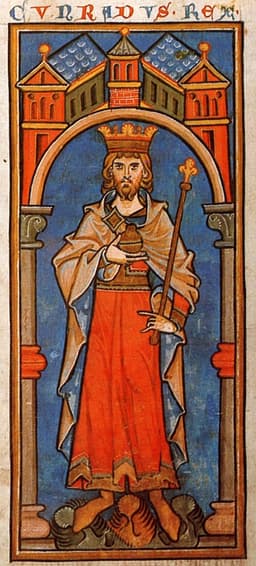
Conrad III
Emperor · Medieval
42.8Total

Jungjong of Joseon
Emperor · Medieval
44.9Total
Basic Information
Born
1093
1488
Died
1152
1544
Era
Medieval
Medieval
Nationality
Holy Roman Empire
Korea
Occupation
Emperor
Emperor
Civilization
Western
Eastern
Score Comparison
Military (10%)
45.0
10.2
Political (20%)
27.9
68.0
Influence (20%)
50.2
53.3
Legacy (20%)
41.7
47.5
Leadership (15%)
48.4
40.0
Strategy (15%)
38.3
25.0
TOTAL
42.8
44.9
Conrad III — Complete Timeline
1138 AD
Conflict with the WelfsWar
Conrad III engaged in a civil war with the Welf party, led by Henry the Proud and later Henry the Lion, from 1138 to 1142. The conflict ended with a compromise that allowed the Welfs to retain some territories.
Civil WarWelf Conflict
Impact: regionaldestructive
Election as King of GermanyPolitical Action◆ Major
Conrad III was elected King of Germany in 1138, becoming the first ruler of the Hohenstaufen dynasty. His election was opposed by the Welf party, leading to a prolonged conflict with Henry the Proud.
SuccessionHohenstaufen Dynasty
Impact: regional
1147 AD
Leadership of the Second CrusadeWar◆ Major
Conrad III led the German contingent of the Second Crusade to the Holy Land in 1147-1148. His army was defeated by the Seljuk Turks at the Battle of Dorylaeum in 1147, and the crusade ended in failure.
CrusadeMilitary Defeat
Impact: regionaltragic
1148 AD
Siege of DamascusWar
Conrad III participated in the Siege of Damascus in July 1148 during the Second Crusade. The siege failed after only four days due to internal disputes among crusader leaders, leading to the crusade's collapse.
CrusadeSiege
Impact: regionaltragic
Jungjong of Joseon — Complete Timeline
1506 AD
Accession to the thronePolitical Action◆ Major
Jungjong was installed as king after the overthrow of his half-brother Yeonsangun. His reign began with promises of reform but was soon dominated by factional struggles.
SuccessionCoupJoseon Dynasty
Impact: national
1519 AD
Third Literati Purge (Gimyo Sahwa)Political Action◆ Major
Jungjong's reign saw the Third Literati Purge, in which Sarim scholars who attempted to implement reforms were purged by the Hungu faction. This set back reform efforts and deepened factional divisions.
PurgeFactional ConflictJoseon Dynasty
Impact: nationaldestructive
1545 AD
Reign of Queen Munjeong as regentPolitical Action◆ Major
After Jungjong's death, his wife Queen Munjeong became regent for their young son Myeongjong. Her regency continued the factional conflicts that had marked Jungjong's reign.
RegencyJoseon DynastyFactional Conflict
Impact: national
This comparison has not been analyzed yet.
One-time AI generation (~1 minute). Scores and timeline are already available below.
Rankings
🥇
Jungjong of JoseonLeader
Mil: 10.2Pol: 68.0Inf: 53.3
44.9
🥈
Conrad III
Mil: 45.0Pol: 27.9Inf: 50.2
42.8
+2.1 behind
How This Comparison Works
Algorithm
Each figure is scored on 6 dimensions (0—100 scale) based on structured historical data: Military (10%), Political (20%), Influence (20%), Legacy (20%), Leadership (15%), Strategy (15%). The weighted total produces the final ranking.
Data Sources
Scores are computed from structured sub-indicators in the database. Scale factors adjust for era (Ancient ×0.85, Modern ×1.0) and civilization size (Eastern ×1.05, Other ×0.80) to account for differences in population and military scale.
Maximum 3 Figures
Comparisons are limited to 2—3 figures to ensure readability and statistical meaningfulness.
Error Margins
±5 points per dimension — Sub-scores are derived from historical records with inherent uncertainty. Two figures within 5 points on a dimension should be considered roughly equivalent in that area.
Total Score Accuracy
±3 points overall — The weighted combination of 6 dimensions produces a total score with approximately ±3 points of uncertainty. Differences of less than 3 points are not statistically significant— the figures are effectively tied.
Known Limitations
- Historical records are incomplete and uneven across civilizations
- Figures from oral-tradition societies may be underrepresented
- Occupation labels can misclassify multi-role figures
- Scores measure capability and impact, not moral character
- Quantitative scoring is a comparison tool, not absolute truth
Capability Radar
Military (10%) — Battles & Warfare
Battles
30
10
Win Rate
25
10
Expansion
20
5
Political (20%) — Governance & Reform
Reform
15
55
Diplomacy
30
50
Economy
20
50
Influence (20%) — Cultural & Global Reach
Cultural
25
40
Global
15
20
Legacy (20%) — Historical Impact
Historical
30
45
Longevity
20
40
Leadership (15%) — Power & Stability
Tenure
40
60
Stability
20
55
Strategy (15%) — Tactics & Innovation
Strategy
25
10
Tactics
30
10
Reform
10
15
Similar Comparisons
Comments & Discussion
No comments yet. Be the first to share your thoughts!