Loading...
Conrad III vs Napoleon Bonaparte
Napoleon Bonaparte leads by 28.1 pts · 2 figures compared
…
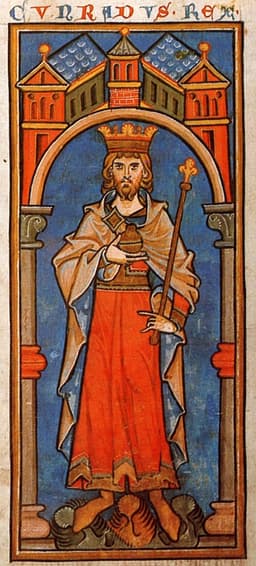
Conrad III
Emperor · Medieval
42.8Total

Napoleon Bonaparte
General · Modern
70.9Total
Basic Information
Born
1093
1769
Died
1152
1821
Era
Medieval
Modern
Nationality
Holy Roman Empire
France
Occupation
Emperor
General
Civilization
Western
Western
Score Comparison
Military (10%)
45.0
94.0
Political (20%)
27.9
72.0
Influence (20%)
50.2
40.0
Legacy (20%)
41.7
80.0
Leadership (15%)
48.4
78.0
Strategy (15%)
38.3
90.0
TOTAL
42.8
70.9
Conrad III — Complete Timeline
1138 AD
Conflict with the WelfsWar
Conrad III engaged in a civil war with the Welf party, led by Henry the Proud and later Henry the Lion, from 1138 to 1142. The conflict ended with a compromise that allowed the Welfs to retain some territories.
Civil WarWelf Conflict
Impact: regionaldestructive
Election as King of GermanyPolitical Action◆ Major
Conrad III was elected King of Germany in 1138, becoming the first ruler of the Hohenstaufen dynasty. His election was opposed by the Welf party, leading to a prolonged conflict with Henry the Proud.
SuccessionHohenstaufen Dynasty
Impact: regional
1147 AD
Leadership of the Second CrusadeWar◆ Major
Conrad III led the German contingent of the Second Crusade to the Holy Land in 1147-1148. His army was defeated by the Seljuk Turks at the Battle of Dorylaeum in 1147, and the crusade ended in failure.
CrusadeMilitary Defeat
Impact: regionaltragic
1148 AD
Siege of DamascusWar
Conrad III participated in the Siege of Damascus in July 1148 during the Second Crusade. The siege failed after only four days due to internal disputes among crusader leaders, leading to the crusade's collapse.
CrusadeSiege
Impact: regionaltragic
Napoleon Bonaparte — Complete Timeline
1799 AD
Coup of 18 BrumaireOther◆ Major
Napoleon Bonaparte, with support from his brother Lucien and key political figures, overthrew the Directory in a bloodless coup. He established the Consulate with himself as First Consul, effectively becoming the ruler of France. This event ended the French Revolution's most unstable period.
French RevolutionCoupRise to Power
Impact: regional
1804 AD
Promulgation of the Napoleonic CodeOther◆ Major
Napoleon enacted the Civil Code of the French, known as the Napoleonic Code, a comprehensive set of laws that replaced the fragmented feudal legal systems. The code established legal equality, protected property rights, and secularized law. It became the basis for legal systems in many European and world countries.
Legal ReformNapoleonic CodeCivil Law
Impact: globalconstructive
1805 AD
Battle of AusterlitzWar◆ Major
Napoleon's Grande Arm
Napoleonic WarsBattleDecisive Victory
Impact: global
1812 AD
Invasion of RussiaWar◆ Major
Napoleon led the Grande Arm
Napoleonic WarsInvasionDisaster
Impact: globaldestructive
1815 AD
Battle of WaterlooWar◆ Major
Napoleon's French army was defeated by the combined forces of the Duke of Wellington's Anglo-Allied army and Gebhard Leberecht von Bl
Napoleonic WarsBattleFinal Defeat
Impact: globaldestructive
Expert Analysis
conrad-iii-vs-napoleon-bonaparte
# The Emperor and the King: Two Paths to Power in the Shadow of History
In the summer of 1148, Conrad III stood before the walls of Damascus, his army exhausted and his crusade crumbling. Less than seven centuries later, on a June morning in 1815, Napoleon Bonaparte watched his Imperial Guard march into the mud of Waterloo, knowing that his own dream of empire was about to end. Both men reached for greatness; both fell short. But the chasm between them—in ambition, in achievement, in the very nature of their power—tells us something profound about how history shapes its heroes, and how they, in turn, shape history.
Origins
Napoleon was born in 1769 on the island of Corsica, a place of rugged independence that had only recently become French. His family was minor nobility, but his education was thoroughly modern: military academies, Enlightenment philosophy, the revolutionary ferment of the 1790s. He was a child of his age—an age of upheaval, when old monarchies were toppled and new men could rise on talent alone. “Impossible,” he once said, “is a word to be found only in the dictionary of fools.”
Conrad III, born in 1093, inherited a very different world. He was a Hohenstaufen, a rising dynasty in the fractured Holy Roman Empire, where power was measured not in armies but in alliances, oaths, and bloodlines. His Germany was a patchwork of duchies and bishoprics, where the emperor ruled only by the consent of powerful princes. Conrad’s world was medieval: God, honor, and feudal obligation were the currencies of rule. There was no room for a Corsican upstart here; a king was born, not made.
Rise to Power
Napoleon’s ascent was meteoric. A young artillery officer during the French Revolution, he seized his moment at the Siege of Toulon in 1793, then crushed royalist rebels in Paris in 1795. By 1796, at just 26, he commanded the Army of Italy. His campaigns were masterpieces of speed and deception. He crowned himself Emperor in 1804, not by birthright but by popular vote and bayonet. His path was one of will—he made himself emperor.
Conrad III’s rise was slower and more precarious. He was elected King of Germany in 1138, but only after a bitter contest. His rival, Henry the Proud of the Welf dynasty, had been the favorite; Conrad won by a narrow vote of the princes. The election was not a triumph but the beginning of a civil war. From 1138 to 1142, Conrad fought the Welfs, led first by Henry the Proud and then by his son, Henry the Lion. His kingship was never secure. He ruled not by conquest but by negotiation, and his power was always conditional.
Leadership & Governance
Napoleon governed as a modern autocrat. He centralized the French state, reformed the tax system, and established the Napoleonic Code—a legal framework that influenced civil law across Europe. He was a military genius, scoring victories at Austerlitz (1805) and Jena (1806) that shattered old empires. His leadership was charismatic, ruthless, and efficient. But he also made fatal errors: the invasion of Russia in 1812, the Peninsular War in Spain, and the hubris that led to Waterloo.
Conrad III governed as a medieval king, constrained by custom and the Church. He led the Second Crusade in 1147–1148, a pious but disastrous venture. His army was defeated by the Seljuk Turks before even reaching the Holy Land, and the Siege of Damascus in July 1148 ended in ignominious retreat. His political score of 57.0 reflects a reign consumed by internal strife—he never fully subdued the Welfs, and his legacy was overshadowed by the greater Hohenstaufen, Frederick Barbarossa. Conrad was a competent ruler in a world that demanded more than competence.
Triumph & Tragedy
Napoleon’s greatest triumph was the Battle of Austerlitz, where he destroyed the combined armies of Russia and Austria. His tragedy was the invasion of Russia, where 600,000 men marched east and only 100,000 returned. He died in exile on Saint Helena in 1821, a prisoner of the British, his empire reduced to a memory.
Conrad III’s triumph was simply becoming king—a feat of political survival in a hostile environment. His tragedy was the Second Crusade, a failure that tarnished his reputation and weakened his authority. He died in 1152, never having achieved the stability he sought. His legacy score of 55.0 is modest, but he founded a dynasty that would dominate Europe for generations.
Character & Destiny
Napoleon was driven by an insatiable ambition. He believed in destiny—his own. “I am not a man, but a thing,” he once said. “I am the revolution.” His personality was a force of nature, but it also blinded him. He could not stop, could not compromise, could not share power. That relentless drive made him great, and then destroyed him.
Conrad III was cautious, pious, and pragmatic. He knew his limits. He fought the Welfs not to annihilate them but to contain them. He led the crusade because honor and faith demanded it, not because he expected glory. His personality shaped a reign of endurance, not conquest. He was a survivor in an age of predators.
Legacy
Napoleon’s legacy is immense. The Napoleonic Code, the metric system, the modern concept of meritocracy—these survive him. He is remembered as a military genius and a tyrant, a liberator and a conqueror. His influence score of 82.0 and legacy of 78.0 reflect a figure who reshaped Europe.
Conrad III’s legacy is narrower. He is remembered as the first Hohenstaufen king, the founder of a dynasty that produced Frederick Barbarossa and Frederick II. But his own achievements were modest. He is a footnote in most histories, a bridge between eras. Yet without him, the Holy Roman Empire might have collapsed into chaos.
Conclusion
Two men, seven centuries apart, both reached for the crown. Napoleon seized it with fire and steel; Conrad III accepted it with a heavy heart. One changed the world; the other kept it from falling apart. In the end, history judges both: Napoleon as a titan who fell, Conrad as a steward who endured. Perhaps the difference is not in their ambition, but in their age. Napoleon lived in an age of revolution, where one man could remake the world. Conrad lived in an age of faith, where even a king was just a servant of God. Both were human; both were flawed. And both, in their own way, shaped the centuries that followed.
Rankings
🥇
Napoleon BonaparteLeader
Mil: 94.0Pol: 72.0Inf: 40.0
70.9
🥈
Conrad III
Mil: 45.0Pol: 27.9Inf: 50.2
42.8
+28.1 behind
How This Comparison Works
Algorithm
Each figure is scored on 6 dimensions (0—100 scale) based on structured historical data: Military (10%), Political (20%), Influence (20%), Legacy (20%), Leadership (15%), Strategy (15%). The weighted total produces the final ranking.
Data Sources
Scores are computed from structured sub-indicators in the database. Scale factors adjust for era (Ancient ×0.85, Modern ×1.0) and civilization size (Eastern ×1.05, Other ×0.80) to account for differences in population and military scale.
Maximum 3 Figures
Comparisons are limited to 2—3 figures to ensure readability and statistical meaningfulness.
Error Margins
±5 points per dimension — Sub-scores are derived from historical records with inherent uncertainty. Two figures within 5 points on a dimension should be considered roughly equivalent in that area.
Total Score Accuracy
±3 points overall — The weighted combination of 6 dimensions produces a total score with approximately ±3 points of uncertainty. Differences of less than 3 points are not statistically significant— the figures are effectively tied.
Known Limitations
- Historical records are incomplete and uneven across civilizations
- Figures from oral-tradition societies may be underrepresented
- Occupation labels can misclassify multi-role figures
- Scores measure capability and impact, not moral character
- Quantitative scoring is a comparison tool, not absolute truth
Capability Radar
Military (10%) — Battles & Warfare
Battles
30
95
Win Rate
25
90
Expansion
20
95
Political (20%) — Governance & Reform
Reform
15
95
Diplomacy
30
80
Economy
20
85
Influence (20%) — Cultural & Global Reach
Cultural
25
85
Global
15
90
Legacy (20%) — Historical Impact
Historical
30
95
Longevity
20
90
Leadership (15%) — Power & Stability
Tenure
40
85
Stability
20
70
Strategy (15%) — Tactics & Innovation
Strategy
25
95
Tactics
30
98
Reform
10
92
Similar Comparisons
Comments & Discussion
No comments yet. Be the first to share your thoughts!