Loading...
Confucius vs Julius Caesar
Julius Caesar leads by 21.4 pts · 2 figures compared
…
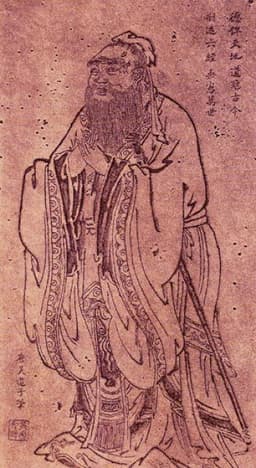
Confucius
Philosopher · Ancient
61.4Total

Julius Caesar
General · Ancient
82.8Total
Basic Information
Born
-551
-100
Died
-479
-44
Era
Ancient
Ancient
Nationality
China
Roman Republic
Occupation
Philosopher
General
Civilization
Eastern
Western
Score Comparison
Military (10%)
8.7
88.0
Political (20%)
35.1
78.0
Influence (20%)
95.0
85.0
Legacy (20%)
87.0
82.0
Leadership (15%)
35.4
80.0
Strategy (15%)
44.3
85.0
TOTAL
61.4
82.8
Confucius — Complete Timeline
501 BC
Appointment as Minister of Crime in LuPolitical Action
Confucius served as Minister of Crime in the state of Lu, where he implemented reforms to improve public order and justice. His tenure was short-lived due to political opposition, but it demonstrated his practical application of Confucian principles.
GovernmentReformLu
constructive
500 BC
Teaching Career in LuCultural
Confucius traveled through the state of Lu, teaching a group of disciples about ethics, ritual, and governance. He compiled and edited classical texts, including the Five Classics, and developed his philosophy centered on ren (benevolence) and li (ritual propriety).
TeachingPhilosophyConfucianism
Impact: globalconstructive
497 BC
Exile and Travels through Warring StatesPolitical Action◆ Major
After falling out of favor in Lu, Confucius went into voluntary exile, traveling to various states including Wei, Song, and Chen. He sought a ruler who would adopt his teachings, but was largely unsuccessful, spending 14 years wandering.
ExileTravelPhilosophy
Impact: regional
481 BC
Compilation of the Spring and Autumn AnnalsCultural◆ Major
Confucius is traditionally credited with compiling the Spring and Autumn Annals, a historical chronicle of the state of Lu. This work became a foundational text for Confucian historiography, emphasizing moral judgment in historical recording.
HistoriographyClassicsConfucianism
Impact: globalconstructive
479 BC
Death and Posthumous InfluenceCultural
Confucius died in Qufu, Lu, at age 72. His disciples compiled his teachings into the Analects, which later became the core text of Confucianism. Over centuries, his philosophy became the dominant ethical and political system in East Asia.
DeathLegacyConfucianism
Impact: globalconstructive
Julius Caesar — Complete Timeline
58 BC
Gallic WarsWar◆ Major
Caesar, as proconsul of Gaul, launched a series of campaigns that conquered all of Gaul (modern France, Belgium, and parts of Switzerland). He fought numerous battles, including against the Helvetii, the Belgae, and the Gallic chieftain Vercingetorix. The wars brought immense wealth and a loyal army to Caesar.
Gallic WarsConquestRoman Expansion
Impact: regional
49 BC
Crossing the RubiconPolitical Action◆ Major
Caesar led Legio XIII across the Rubicon River into Italy, defying the Roman Senate's order to disband his army. This act triggered a civil war against Pompey and the Optimates, ultimately leading to Caesar's dictatorship and the end of the Roman Republic.
Roman Civil WarEnd of RepublicPower Struggle
Impact: global
48 BC
Battle of PharsalusWar◆ Major
Caesar's outnumbered army defeated the larger forces of Pompey the Great at Pharsalus in Greece. Caesar's tactical use of a reserve line to counter Pompey's cavalry charge proved decisive. Pompey fled to Egypt, where he was assassinated, leaving Caesar as the undisputed master of the Roman world.
Roman Civil WarBattleDecisive Victory
Impact: regional
44 BC
Appointment as Dictator for LifePolitical Action◆ Major
The Roman Senate appointed Caesar dictator perpetuo (dictator for life), granting him unprecedented personal power. This move concentrated military, legislative, and judicial authority in one person, effectively ending the Roman Republic's traditional system of checks and balances and alarming many senators.
DictatorshipEnd of RepublicPower Consolidation
Impact: regionaldestructive
Assassination on the Ides of MarchPolitical Action◆ Major
A group of Roman senators, led by Marcus Junius Brutus and Gaius Cassius Longinus, stabbed Caesar to death at a meeting of the Senate in the Theatre of Pompey. The assassination was intended to restore the Republic, but instead triggered another civil war that led to the rise of the Roman Empire.
AssassinationRoman PoliticsEnd of Republic
Impact: globaldestructive
Expert Analysis
confucius-vs-julius-caesar
The Philosopher and the General
On a spring morning in 479 BCE, an old man lay dying in the city of Qufu, surrounded by weeping disciples. Half a world away and four centuries later, on the Ides of March in 44 BCE, a general in his prime fell bleeding at the feet of a marble statue, stabbed by men he had called friends. One ended his life in quiet obscurity, his teachings scattered among a handful of followers. The other ended his life at the pinnacle of power, his blood soaking the floor of the Roman Senate. Yet, of the two, it was the old man who would shape the destiny of billions, while the general's empire crumbled within generations. How did these two figures—Confucius, the philosopher of harmony, and Julius Caesar, the architect of conquest—travel such different paths, and what drove their radically different outcomes?
Origins
Confucius was born into a minor aristocratic family in the state of Lu, a small kingdom in what is now Shandong Province. His father died when he was three, leaving him to be raised in poverty by his mother. The world he inherited was the late Spring and Autumn period of Chinese history—a time of crumbling feudal order, constant warfare, and moral decay. From childhood, Confucius was obsessed with the rituals and texts of a golden age he believed had existed centuries earlier. He studied the *Book of Songs* and the *Book of Documents* with a hunger that bordered on desperation, seeking in ancient wisdom a cure for the chaos around him.
Julius Caesar, by contrast, was born into the heart of Roman power. His family, the Julii, claimed descent from the goddess Venus, and his uncle was the great general Gaius Marius. The Rome of Caesar's youth was a republic in its death throes—corrupt, violent, and ruled by a Senate that had forgotten how to govern. Where Confucius looked backward to an idealized past, Caesar looked forward to a future he intended to seize. He was educated in Greek philosophy and rhetoric, but his true classroom was the battlefield and the Forum, where ambition was the only virtue that mattered.
Rise to Power
Confucius's path to influence was slow and indirect. At age fifty, he was appointed Minister of Crime in Lu, a position he used to implement reforms that improved public order and justice. He was, by all accounts, an effective administrator—his political score of 70.8 reflects real competence. Yet his tenure lasted only a few years. When the ruler of Lu began indulging in pleasure rather than governance, Confucius resigned in disgust. He then embarked on a decade-long exile, wandering from state to state, offering his counsel to rulers who listened politely and then ignored him. "I have never met a man who loves virtue as much as he loves beauty," he once lamented.
Caesar's rise was swift and ruthless. He climbed the Roman political ladder with breathtaking speed—quaestor, aedile, praetor, consul—each step lubricated by borrowed money and strategic alliances. In 58 BCE, at age 42, he secured command of the Roman provinces in Gaul. Over the next eight years, he conquered a territory larger than Italy, slaughtering or enslaving perhaps a million people. His military score of 88.0 and strategy score of 88.0 are not mere numbers; they represent a campaign of such relentless brilliance that his *Commentaries on the Gallic War* remain required reading at military academies today. When the Senate ordered him to disband his army, he crossed the Rubicon River with a single legion, uttering the famous words, *"Alea iacta est"*—the die is cast.
Leadership & Governance
Confucius governed through persuasion and example. His leadership score of 78.2 reflects a style based on moral authority rather than force. He taught that a ruler should be like the North Star—fixed and unmoving, while all others revolve around him. His reforms in Lu focused on fairness in taxation, honesty in government, and respect for ritual. He believed that if a ruler were virtuous, the people would follow naturally. "Lead them by virtue and restrain them with ritual," he said, "they will have a sense of shame and will correct themselves."
Caesar governed through a combination of charisma, terror, and institutional reform. As dictator, he overhauled the Roman calendar, granted citizenship to provincials, launched massive public works, and reformed debt laws. His political score of 78.0 is nearly equal to Confucius's, but it was deployed differently. Where Confucius sought harmony through consensus, Caesar imposed order through authority. He pardoned former enemies, but he also centralized power in his own hands, mocking the Senate's traditions. "The Republic is nothing," he reportedly said, "a mere name without body or form."
Triumph & Tragedy
Confucius's greatest triumph was not recognized in his lifetime. His compilation of the *Spring and Autumn Annals* in 481 BCE was a quiet act of scholarship, but it preserved a moral vision of history that would later become the foundation of Chinese civilization. His tragedy was that he died believing he had failed. "The great mountain must crumble," he whispered on his deathbed, "the strong beam must break, the wise man must wither away like a plant."
Caesar's triumph was the conquest of Gaul and the defeat of his rival Pompey at the Battle of Pharsalus in 48 BCE. He stood at the apex of the world, master of Rome and its vast empire. His tragedy was that he could not stop. He refused to restore the Republic, instead accepting the title of dictator for life. On the Ides of March, 44 BCE, sixty senators surrounded him in the Theatre of Pompey and stabbed him twenty-three times. His last words, according to tradition, were to his friend Brutus: *"Et tu, Brute?"*—"And you, Brutus?"
Character & Destiny
Confucius was patient, humble, and stubbornly idealistic. He believed that human nature was fundamentally good and that education could perfect it. This optimism drove his entire life's work, even when reality repeatedly proved him wrong. His character shaped his destiny: because he refused to compromise his principles for power, he never achieved power—but his principles survived him.
Caesar was ambitious, pragmatic, and supremely confident. He believed that fate was something to be seized, not awaited. "It is easier to find men who will volunteer to die," he once said, "than to find those who are willing to endure pain with patience." His character drove him to conquer the world—and to ignore the growing hatred of the men he had conquered. His destiny was to die at the height of his power, a martyr to his own success.
Legacy
Confucius's influence score of 95.0 and legacy score of 81.5 are among the highest in human history. His teachings, compiled in the *Analects*, became the core curriculum for Chinese civil servants for over two thousand years. His ideas about filial piety, social harmony, and moral governance shaped not just China, but Korea, Japan, Vietnam, and much of East Asia. Today, more than 1.5 billion people live in cultures that bear his imprint.
Caesar's legacy score of 82.0 is also immense, but more ambiguous. His assassination triggered a civil war that ended the Roman Republic and began the Roman Empire. His name became a title—*Caesar*—used by emperors for centuries. His military campaigns set a standard for generals from Napoleon to Patton. But his empire fell, while Confucius's ideas endure. The philosopher who never ruled a kingdom has shaped more lives than the general who conquered half the world.
Conclusion
Standing on the deck of a ship in the English Channel, Napoleon Bonaparte once remarked, "Alexander, Caesar, Charlemagne, and I have founded empires. But on what did these creations of our genius depend? Upon force. Jesus Christ founded his empire upon love; and at this hour millions of men would die for him." He might have added Confucius to that list. The old man of Qufu built his empire not with legions or laws, but with words—words that whispered across centuries, teaching sons to honor fathers and rulers to govern with virtue. Caesar's empire was a monument of stone and blood; Confucius's empire was a monument of the mind. In the end, it is the mind that outlasts the stone.
Rankings
🥇
Julius CaesarLeader
Mil: 88.0Pol: 78.0Inf: 85.0
82.8
🥈
Confucius
Mil: 8.7Pol: 35.1Inf: 95.0
61.4
+21.4 behind
How This Comparison Works
Algorithm
Each figure is scored on 6 dimensions (0—100 scale) based on structured historical data: Military (10%), Political (20%), Influence (20%), Legacy (20%), Leadership (15%), Strategy (15%). The weighted total produces the final ranking.
Data Sources
Scores are computed from structured sub-indicators in the database. Scale factors adjust for era (Ancient ×0.85, Modern ×1.0) and civilization size (Eastern ×1.05, Other ×0.80) to account for differences in population and military scale.
Maximum 3 Figures
Comparisons are limited to 2—3 figures to ensure readability and statistical meaningfulness.
Error Margins
±5 points per dimension — Sub-scores are derived from historical records with inherent uncertainty. Two figures within 5 points on a dimension should be considered roughly equivalent in that area.
Total Score Accuracy
±3 points overall — The weighted combination of 6 dimensions produces a total score with approximately ±3 points of uncertainty. Differences of less than 3 points are not statistically significant— the figures are effectively tied.
Known Limitations
- Historical records are incomplete and uneven across civilizations
- Figures from oral-tradition societies may be underrepresented
- Occupation labels can misclassify multi-role figures
- Scores measure capability and impact, not moral character
- Quantitative scoring is a comparison tool, not absolute truth
Capability Radar
Military (10%) — Battles & Warfare
Battles
15
95
Win Rate
15
92
Expansion
19
97
Political (20%) — Governance & Reform
Reform
85
90
Diplomacy
70
85
Economy
40
82
Influence (20%) — Cultural & Global Reach
Cultural
95
88
Global
90
94
Legacy (20%) — Historical Impact
Historical
95
95
Longevity
95
96
Leadership (15%) — Power & Stability
Tenure
20
75
Stability
75
60
Strategy (15%) — Tactics & Innovation
Strategy
22
94
Tactics
28
96
Reform
31
88
Similar Comparisons
Comments & Discussion
No comments yet. Be the first to share your thoughts!