Loading...
Confucius vs Napoleon Bonaparte
Napoleon Bonaparte leads by 9.5 pts · 2 figures compared
…
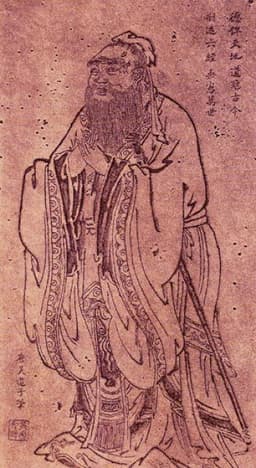
Confucius
Philosopher · Ancient
61.4Total

Napoleon Bonaparte
General · Modern
70.9Total
Basic Information
Born
-551
1769
Died
-479
1821
Era
Ancient
Modern
Nationality
China
France
Occupation
Philosopher
General
Civilization
Eastern
Western
Score Comparison
Military (10%)
8.7
94.0
Political (20%)
35.1
72.0
Influence (20%)
95.0
40.0
Legacy (20%)
87.0
80.0
Leadership (15%)
35.4
78.0
Strategy (15%)
44.3
90.0
TOTAL
61.4
70.9
Confucius — Complete Timeline
501 BC
Appointment as Minister of Crime in LuPolitical Action
Confucius served as Minister of Crime in the state of Lu, where he implemented reforms to improve public order and justice. His tenure was short-lived due to political opposition, but it demonstrated his practical application of Confucian principles.
GovernmentReformLu
constructive
500 BC
Teaching Career in LuCultural
Confucius traveled through the state of Lu, teaching a group of disciples about ethics, ritual, and governance. He compiled and edited classical texts, including the Five Classics, and developed his philosophy centered on ren (benevolence) and li (ritual propriety).
TeachingPhilosophyConfucianism
Impact: globalconstructive
497 BC
Exile and Travels through Warring StatesPolitical Action◆ Major
After falling out of favor in Lu, Confucius went into voluntary exile, traveling to various states including Wei, Song, and Chen. He sought a ruler who would adopt his teachings, but was largely unsuccessful, spending 14 years wandering.
ExileTravelPhilosophy
Impact: regional
481 BC
Compilation of the Spring and Autumn AnnalsCultural◆ Major
Confucius is traditionally credited with compiling the Spring and Autumn Annals, a historical chronicle of the state of Lu. This work became a foundational text for Confucian historiography, emphasizing moral judgment in historical recording.
HistoriographyClassicsConfucianism
Impact: globalconstructive
479 BC
Death and Posthumous InfluenceCultural
Confucius died in Qufu, Lu, at age 72. His disciples compiled his teachings into the Analects, which later became the core text of Confucianism. Over centuries, his philosophy became the dominant ethical and political system in East Asia.
DeathLegacyConfucianism
Impact: globalconstructive
Napoleon Bonaparte — Complete Timeline
1799 AD
Coup of 18 BrumaireOther◆ Major
Napoleon Bonaparte, with support from his brother Lucien and key political figures, overthrew the Directory in a bloodless coup. He established the Consulate with himself as First Consul, effectively becoming the ruler of France. This event ended the French Revolution's most unstable period.
French RevolutionCoupRise to Power
Impact: regional
1804 AD
Promulgation of the Napoleonic CodeOther◆ Major
Napoleon enacted the Civil Code of the French, known as the Napoleonic Code, a comprehensive set of laws that replaced the fragmented feudal legal systems. The code established legal equality, protected property rights, and secularized law. It became the basis for legal systems in many European and world countries.
Legal ReformNapoleonic CodeCivil Law
Impact: globalconstructive
1805 AD
Battle of AusterlitzWar◆ Major
Napoleon's Grande Arm
Napoleonic WarsBattleDecisive Victory
Impact: global
1812 AD
Invasion of RussiaWar◆ Major
Napoleon led the Grande Arm
Napoleonic WarsInvasionDisaster
Impact: globaldestructive
1815 AD
Battle of WaterlooWar◆ Major
Napoleon's French army was defeated by the combined forces of the Duke of Wellington's Anglo-Allied army and Gebhard Leberecht von Bl
Napoleonic WarsBattleFinal Defeat
Impact: globaldestructive
Expert Analysis
confucius-vs-napoleon-bonaparte
# The Philosopher and the Emperor: Two Paths to Immortality
On a spring morning in 497 BCE, an aging scholar in simple robes walked away from the walls of Lu, leaving behind a court that had grown deaf to his counsel. Twenty-three centuries later, on a frozen December day in 1812, a diminutive emperor in a gray overcoat watched his Grand Army dissolve into the Russian snow. Both men were leaving behind everything they had built—one by choice, the other by force. Yet both would shape the world long after their bodies had turned to dust. The question that haunts history is why: why did the gentle philosopher from Qufu achieve a quiet immortality while the brilliant general from Corsica, who once held Europe in his fist, died a prisoner on a remote Atlantic island?
Origins
Confucius was born in 551 BCE into a world of chaos. The Zhou dynasty was crumbling, and China had fractured into warring states where princes hired assassins and treaties were broken before the ink dried. His father, a minor military officer, died when Confucius was three, leaving his mother to raise him in poverty. He learned early that power without virtue was a poison, and that the only true nobility was that of character. "In a village of ten households," he once said, "there will always be someone as loyal as I am—but none who loves learning as much."
Napoleon Bonaparte entered the world in 1769 on the island of Corsica, a wild Mediterranean rock that France had just purchased from Genoa. His family was minor nobility—poor, proud, and resentful of French rule. Young Napoleon spoke Italian before French, and his schoolmates mocked his accent. But where Confucius turned inward toward self-cultivation, Napoleon turned outward toward conquest. He devoured military history and dreamed of liberating Corsica. The French Revolution, which would topple a king and unleash a continent-wide war, became his ladder.
Rise to Power
Confucius's path was slow and scholarly. He opened his school at twenty-two, teaching anyone who could bring a small gift of dried meat. His reputation grew not through battles but through words—carefully chosen, precisely weighed. By his fifties, he had attracted a circle of devoted disciples. In 501 BCE, at age fifty, he was appointed Minister of Crime in Lu. For a brief time, he tasted power: he reformed courts, punished corruption, and even ordered the execution of a rival minister to restore order. But his moral absolutism made enemies. When the duke of Lu began neglecting state affairs for pleasure, Confucius resigned. He could not serve where virtue was mocked.
Napoleon's rise was explosive. A twenty-four-year-old artillery officer during the siege of Toulon in 1793, he spotted the weak point in the British defenses and blasted his way to fame. By 1796, he commanded the Army of Italy and turned starving, mutinous soldiers into a conquering force. He did not wait for power—he seized it. In 1799, he staged a coup and made himself First Consul. By 1804, he crowned himself Emperor in Notre Dame, taking the crown from the Pope's hands and placing it on his own head. He would not bow to anyone.
Leadership & Governance
Confucius governed through example. As Minister of Crime, he reportedly so transformed Lu that people stopped locking their doors and lost objects remained on the road. His philosophy was bottom-up: cultivate the individual, then the family, then the state, then the world. "If you govern them by regulations and keep them in line by punishments," he taught, "the people will lose all sense of shame. But if you govern them by virtue and keep them in line by ritual, they will have a sense of shame and reform themselves."
Napoleon governed through force and law. His Napoleonic Code swept away feudal privileges, established equality before the law, and protected property rights. It was a masterpiece of rational administration—clear, systematic, modern. But it was also a tool of control. He centralized everything, crushed dissent, and restored slavery in French colonies. He built schools, roads, and banks, but he also built a surveillance state. "Power is my mistress," he admitted. "I have worked too hard at her conquest to allow anyone to take her from me."
Triumph & Tragedy
Confucius's greatest moment was also his most painful. After his exile began in 497 BCE, he wandered for thirteen years through states that admired his wisdom but feared his reforms. He was mocked by peasants, threatened by soldiers, and once mistaken for a bandit. Yet he never stopped teaching. His disciples recorded his conversations, and the Analects were born. The Spring and Autumn Annals, which he compiled around 481 BCE, became a model of moral history—recording events not just as they happened, but as they should have happened.
Napoleon's triumph was Austerlitz in 1805, where he destroyed a combined Russian and Austrian army with a feigned retreat that was pure genius. His tragedy was Russia in 1812, where he marched six hundred thousand men into a frozen graveyard. He abandoned his army to return to Paris, and the legend of invincibility shattered. Exiled to Elba in 1814, he escaped and raised another army—only to meet Wellington at Waterloo in 1815. That was the end. He died in 1821 on Saint Helena, a British prisoner, dictating memoirs that would become his final campaign for glory.
Character & Destiny
Confucius was patient, humble, and unshakeable. He accepted that his teachings might not bear fruit in his lifetime. "I transmit, I do not create," he said. His destiny was to be a seed, not a flower—to plant ideas that would bloom centuries later. He died in 479 BCE at age seventy-two, believing he had failed.
Napoleon was impatient, brilliant, and insatiable. He could not stop. "I live only for posterity," he once said, but he also said, "There is no immortality but the memory that is left in the minds of men." His destiny was to burn so brightly that he consumed himself. He died at fifty-one, his empire scattered, his son a hostage in Vienna.
Legacy
Confucius's legacy is invisible but everywhere. His ideas about filial piety, education, and moral governance became the bedrock of Chinese civilization for over two thousand years. The civil service exams that selected China's bureaucrats were based on his texts. Today, his influence score of 95.0 reflects a reach that extends from Seoul to San Francisco—not through conquest, but through conversation.
Napoleon's legacy is visible and contested. His military innovations are still studied at West Point and Sandhurst. The Napoleonic Code shapes the legal systems of forty countries. His political score of 75.0 and military score of 94.0 reflect a man who changed the map of Europe—but also filled it with graves. He is remembered as a liberator and a tyrant, a genius and a madman.
Conclusion
Perhaps the difference between them is this: Confucius wanted to change how people thought; Napoleon wanted to change how people obeyed. One worked from the inside out, the other from the outside in. Confucius died in obscurity and became immortal; Napoleon died in captivity and became a legend. The philosopher taught that the highest form of power is invisible—a good ruler is one the people barely notice. The emperor taught that power must be seen, felt, and feared. Two thousand years later, we still read the Analects. We still study Napoleon. But which one truly conquered the world?
Rankings
🥇
Napoleon BonaparteLeader
Mil: 94.0Pol: 72.0Inf: 40.0
70.9
🥈
Confucius
Mil: 8.7Pol: 35.1Inf: 95.0
61.4
+9.5 behind
How This Comparison Works
Algorithm
Each figure is scored on 6 dimensions (0—100 scale) based on structured historical data: Military (10%), Political (20%), Influence (20%), Legacy (20%), Leadership (15%), Strategy (15%). The weighted total produces the final ranking.
Data Sources
Scores are computed from structured sub-indicators in the database. Scale factors adjust for era (Ancient ×0.85, Modern ×1.0) and civilization size (Eastern ×1.05, Other ×0.80) to account for differences in population and military scale.
Maximum 3 Figures
Comparisons are limited to 2—3 figures to ensure readability and statistical meaningfulness.
Error Margins
±5 points per dimension — Sub-scores are derived from historical records with inherent uncertainty. Two figures within 5 points on a dimension should be considered roughly equivalent in that area.
Total Score Accuracy
±3 points overall — The weighted combination of 6 dimensions produces a total score with approximately ±3 points of uncertainty. Differences of less than 3 points are not statistically significant— the figures are effectively tied.
Known Limitations
- Historical records are incomplete and uneven across civilizations
- Figures from oral-tradition societies may be underrepresented
- Occupation labels can misclassify multi-role figures
- Scores measure capability and impact, not moral character
- Quantitative scoring is a comparison tool, not absolute truth
Capability Radar
Military (10%) — Battles & Warfare
Battles
15
95
Win Rate
15
90
Expansion
19
95
Political (20%) — Governance & Reform
Reform
85
95
Diplomacy
70
80
Economy
40
85
Influence (20%) — Cultural & Global Reach
Cultural
95
85
Global
90
90
Legacy (20%) — Historical Impact
Historical
95
95
Longevity
95
90
Leadership (15%) — Power & Stability
Tenure
20
85
Stability
75
70
Strategy (15%) — Tactics & Innovation
Strategy
22
95
Tactics
28
98
Reform
31
92
Similar Comparisons
Comments & Discussion
No comments yet. Be the first to share your thoughts!