Loading...
This comparison has not been analyzed yet.
One-time AI generation (~1 minute). Scores and timeline are already available below.
Claudius Gothicus vs Eurystheus of Mycenae
Claudius Gothicus leads by 3.7 pts · 2 figures compared
…
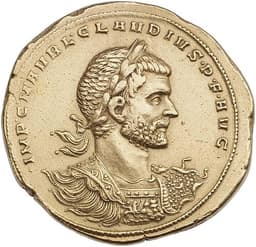
Claudius Gothicus
Emperor · Ancient
46.1Total

Eurystheus of Mycenae
Emperor · Ancient
42.4Total
Basic Information
Born
214
-1280
Died
270
-1250
Era
Ancient
Ancient
Nationality
Roman Empire
Mycenae
Occupation
Emperor
Emperor
Civilization
Western
Western
Score Comparison
Military (10%)
70.0
25.9
Political (20%)
27.9
27.9
Influence (20%)
47.1
53.3
Legacy (20%)
41.7
48.3
Leadership (15%)
45.0
41.5
Strategy (15%)
60.0
39.6
TOTAL
46.1
42.4
Claudius Gothicus — Complete Timeline
269 AD
Battle of NaissusWar
Claudius commanded the Roman army against a massive Gothic invasion at Naissus (modern Ni
Gothic WarBattleMilitary Victory
Impact: regional
270 AD
Expulsion of the Goths from the BalkansWar◆ Major
Following the Battle of Naissus, Claudius pursued the remaining Gothic forces across the Balkans. He cleared them from Thrace and Moesia, and forced them to retreat across the Danube. This campaign ended the Gothic threat to the empire for a generation.
Gothic WarBalkansDanube Frontier
Impact: regionalconstructive
Death from PlagueOther◆ Major
Claudius died of the Antonine Plague (likely smallpox) at Sirmium after a short reign of less than two years. His death was a significant loss for the empire, as he had shown promise as a capable military leader and reformer.
DeathPlagueShort Reign
Impact: nationaltragic
Eurystheus of Mycenae — Complete Timeline
1270 BC
Imposed the Twelve Labors on HeraclesPolitical Action
Eurystheus, as king of Mycenae, commanded Heracles to perform twelve seemingly impossible tasks as penance for killing his family. These labors included slaying the Nemean Lion and capturing the Erymanthian Boar.
HeraclesMythologyPunishment
Impact: globaldestructive
1260 BC
Refused to Acknowledge Heracles' LaborsPolitical Action
After each labor, Eurystheus refused to count certain tasks as valid, forcing Heracles to perform additional labors. This prolonged Heracles' servitude and increased the king's reputation for cowardice.
HeraclesDeception
Impact: regionaldestructive
1250 BC
Killed in Battle by Heracles' SonsWar◆ Major
Eurystheus was killed in battle near the Scironian Cliffs while pursuing the Heracleidae, the sons of Heracles, who had returned to reclaim the Peloponnese. His death ended the Perseid dynasty's rule over Mycenae.
BattleDeathHeracleidae
Impact: regionaltragic
This comparison has not been analyzed yet.
One-time AI generation (~1 minute). Scores and timeline are already available below.
Rankings
🥇
Claudius GothicusLeader
Mil: 70.0Pol: 27.9Inf: 47.1
46.1
🥈
Eurystheus of Mycenae
Mil: 25.9Pol: 27.9Inf: 53.3
42.4
+3.7 behind
How This Comparison Works
Algorithm
Each figure is scored on 6 dimensions (0—100 scale) based on structured historical data: Military (10%), Political (20%), Influence (20%), Legacy (20%), Leadership (15%), Strategy (15%). The weighted total produces the final ranking.
Data Sources
Scores are computed from structured sub-indicators in the database. Scale factors adjust for era (Ancient ×0.85, Modern ×1.0) and civilization size (Eastern ×1.05, Other ×0.80) to account for differences in population and military scale.
Maximum 3 Figures
Comparisons are limited to 2—3 figures to ensure readability and statistical meaningfulness.
Error Margins
±5 points per dimension — Sub-scores are derived from historical records with inherent uncertainty. Two figures within 5 points on a dimension should be considered roughly equivalent in that area.
Total Score Accuracy
±3 points overall — The weighted combination of 6 dimensions produces a total score with approximately ±3 points of uncertainty. Differences of less than 3 points are not statistically significant— the figures are effectively tied.
Known Limitations
- Historical records are incomplete and uneven across civilizations
- Figures from oral-tradition societies may be underrepresented
- Occupation labels can misclassify multi-role figures
- Scores measure capability and impact, not moral character
- Quantitative scoring is a comparison tool, not absolute truth
Capability Radar
Military (10%) — Battles & Warfare
Battles
65
10
Win Rate
70
10
Expansion
30
10
Political (20%) — Governance & Reform
Reform
20
10
Diplomacy
25
20
Economy
20
15
Influence (20%) — Cultural & Global Reach
Cultural
20
40
Global
20
40
Legacy (20%) — Historical Impact
Historical
40
50
Longevity
30
60
Leadership (15%) — Power & Stability
Tenure
30
30
Stability
25
20
Strategy (15%) — Tactics & Innovation
Strategy
55
10
Tactics
60
10
Reform
20
5
Similar Comparisons
Comments & Discussion
No comments yet. Be the first to share your thoughts!